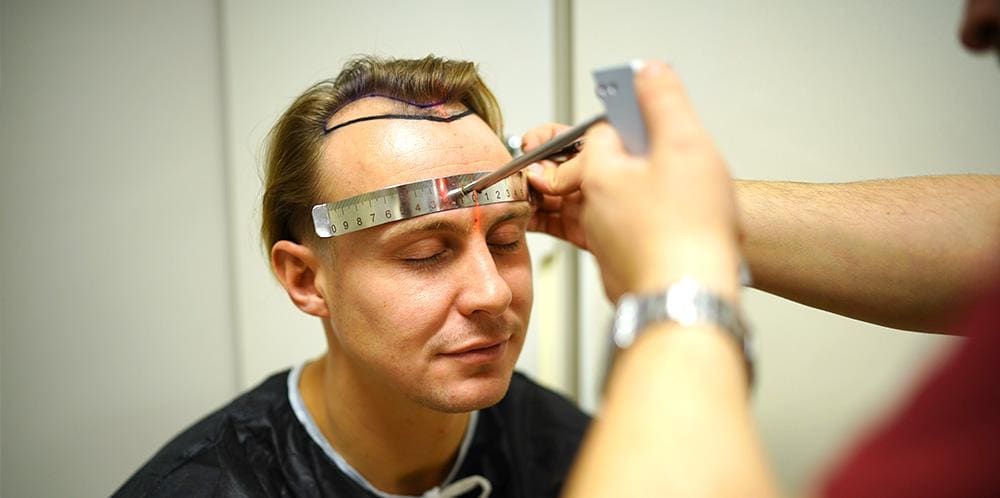
Will your hair recede behind a transplanted hairline?
Often, if it is not treated. The grafts at the front stay put, but without treatment the hereditary hair loss around them carries on.
As long as the hair loss itself goes untreated, the hereditary pattern carries on around a transplanted front. The grafts stay where they were placed, so a low front can end up as a lone strip in front of a thin area.
Why does a transplanted hairline age differently from the hair around it?
Because the grafts at the front largely resist DHT and stay put, while the hair you have around them keeps disappearing with androgenetic alopecia. The front holds, and everything behind and to the sides gradually goes. If the hairline was placed conservatively, it looks normal. If it was placed low, it eventually becomes a strip.
The grafts in a new front are follicles that largely resist DHT. They stay. Around the front is your own hair, and with androgenetic alopecia it keeps receding.
That mix is what explains how transplanted hairlines change over time. The front does not move. It holds its ground while the hair behind and to the sides gives way.
How it looks depends on where the front was placed and how much changes around it. A conservatively placed hairline in front of a maturing pattern looks completely ordinary. A low hairline in front of a bare area that keeps growing looks like a strip.
Where on the head do the changes happen after a new front?
Four zones. The area just behind the hairline, which without treatment is often the first to show a gap. The temples, where recession makes the frontal band steadily narrower. The middle of the scalp, which keeps thinning when only the front third has been transplanted. And the crown, which spreads until it meets the thinning middle, at which point the front looks as if it does not belong to the rest.
- The zone just behind the hairline. The first gap often appears here, if your own hair there was miniaturising when you had surgery and was not treated.
- The temples and temple points. The temples recede at their own pace. Combine a rebuilt front with temples that keep receding and you get an ever thinner band standing on its own.
- The middle of the scalp. If only the front third was transplanted, the middle keeps thinning behind it.
- The crown. It spreads until it meets the thinning middle. At that point a front-only reconstruction starts to look detached.
Why is hairline height the most important decision?
Because no other decision made on the day of surgery lasts as long or is as hard to change. A mature hairline, placed where it naturally sits on older men, still fits as the pattern progresses. A low, youthful hairline looks wrong when you are fifty and needs many more grafts. A hairline can be softened later. It can never be moved up.
Of all the choices made on the day of surgery, hairline placement has the longest-lasting effect and is the hardest to undo.
A mature hairline, placed where it typically sits on men of forty and with slightly receded temples, still fits as the pattern progresses. The face grows into it.
A youthful hairline, low and straight with rebuilt temple points, impresses at thirty and looks more and more wrong at fifty, because no fifty-year-old has a hairline like that naturally. It also uses many more grafts, both now and in the further sessions it ties you to.
Almost every patient wants the lower version. Surgeons who give in build a mistake that lasts for ever. Softening the line and making it irregular is possible. Moving it up is not.
How does untreated recession develop over the years?
Clinical experience shows a fairly consistent course when the hair you have is left untreated. From years 1 to 3 the result looks as planned. From years 3 to 7 thinning shows behind the hairline. From years 7 to 15 the gap widens and the frontal band narrows, and many people then seek another session. After 15 years the front either looks like a sharp band or simply like ordinary thinning.
Here too, the description is based on clinical experience rather than published follow-up. Without treatment of your own hair, the course is much the same from patient to patient.
- Years 1 to 3. The result looks as it was drawn. Your own hair behind the grafts is still doing its job.
- Years 3 to 7. Thinning behind the hairline starts to show. The transplanted area looks denser than what surrounds it.
- Years 7 to 15. The gap widens, and as the temples recede the frontal band gets narrower. This is typically when patients ask for another session.
- After 15 years. Depending on how your pattern develops, the front may look like a sharp edge in front of a mostly bare scalp. If the plan was conservative and your own hair was treated, however, it simply looks like ordinary thinning.
What can change how a transplanted hairline ages?
Most important is medication that protects the hair you have, and finasteride has five-year data from several countries. Next comes a conservative hairline, which uses fewer grafts and ages well, and treating the middle of the scalp as well as the front, because a hairline with nothing behind it ages worst. And saved donor reserve, so the surgeon can follow the pattern instead of chasing it.
- Medication that protects the hair you have. Nothing matters more, and it is also what you have most control over yourself. Finasteride has been followed for five years in several countries, and few data in the field go further back. What suits you is for a doctor who knows your health to decide.
- A conservative hairline. Uses fewer grafts and ages well.
- Treating the middle as well as the front. A hairline with no hair behind it is what ages worst of all.
- Saved donor reserve, so the surgeon can follow the pattern rather than having to chase it.
Sources
- Maas D, et al. Rethinking the occipital scalp as a control in advanced androgenetic alopecia. Journal of the American Academy of Dermatology, 2026 (ahead of print). pubmed.ncbi.nlm.nih.gov/42398778
- Long-term (5-year) multinational experience with Finasteride 1 mg in the treatment of men with androgenetic alopecia. European Journal of Dermatology, 2002. pubmed.ncbi.nlm.nih.gov/11809594
- Gupta AK, Venkataraman M, Talukder M, Bamimore MA. Finasteride for hair loss: a review. Journal of Dermatological Treatment, 2022;33(4):1938-1946. pubmed.ncbi.nlm.nih.gov/34291720
- Jimenez F, Ruifernández JM. Distribution of human hair in follicular units. A mathematical model for estimating the donor size in follicular unit transplantation. Dermatologic Surgery, 1999;25(4):294-298. pubmed.ncbi.nlm.nih.gov/10417585
- Xu Y, et al. Case Report: Paired vertex-occipital assessment reveals donor-area involvement in diffuse unpatterned alopecia. Frontiers in Medicine, 2026;13:1797275. pubmed.ncbi.nlm.nih.gov/41982548
This text is based on published studies and on how specialists in the field usually work. It is meant as general information, not as medical advice for you, and it never overrides what your surgical team has told you. If they say something different from what is written here, their advice is what counts.
Wondering what's possible for your hair?
Send three sharp photos of your hair, from the front, the top and the back. You'll get an honest answer on what can be done, roughly how many grafts it would take and what it costs.
- Free and with no obligation
- Photos are assessed by the clinic's medical team
- Replies usually within an hour in the daytime


A study tells you something about groups. Only a doctor who has seen your photos can say what applies to your hair. The medical team at the clinic at the top of our ranking offers a free assessment.
Goes to the clinic at the top of our ranking.