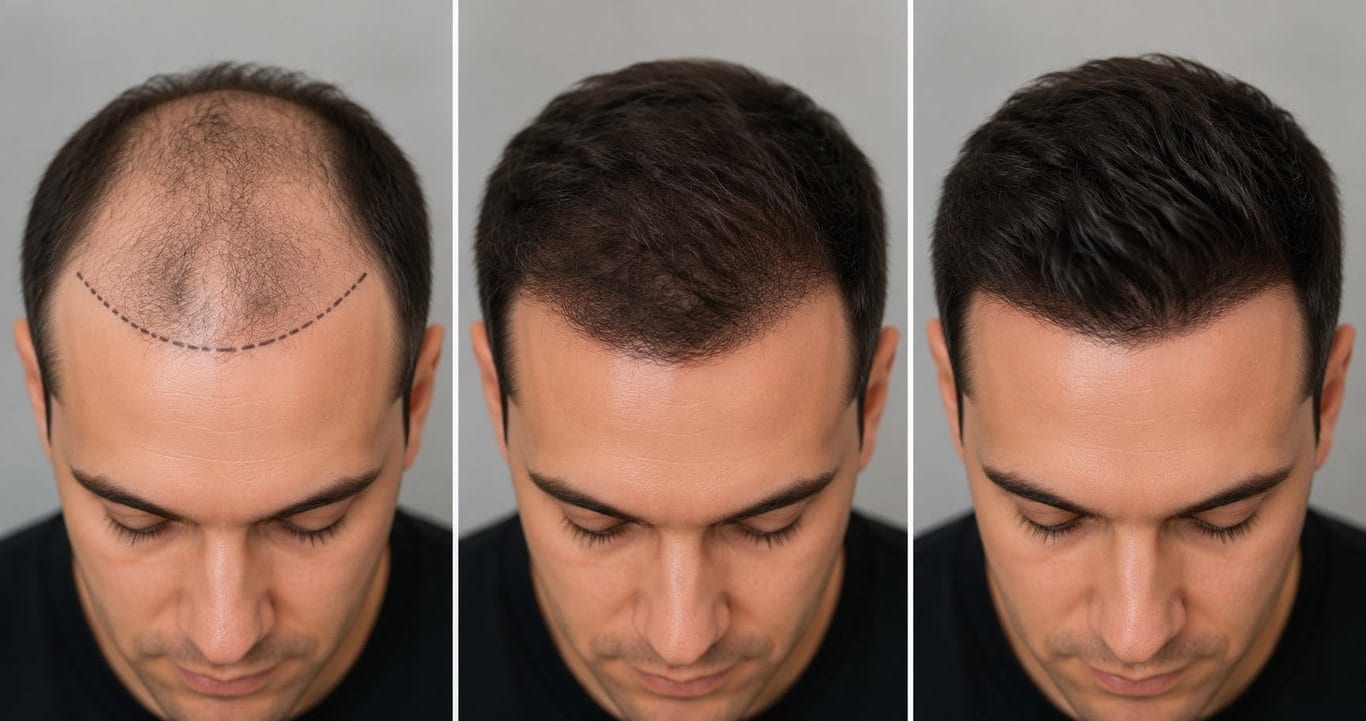
Five years after a hair transplant: what lasts?
After five years the grafts are usually still growing, because they were taken from an area that largely resists DHT.
Five years after the procedure the grafts are usually still growing, because they were taken from an area that largely resists DHT. The changes happen in the hair around them. Few hair transplant studies follow patients for that long, so most of what we know about this period is based on clinical experience rather than data.
How much research is there on five-year results?
Very little. Almost all studies measure the result at twelve months, and even the newer quality-of-life studies from the groups of Maletic and Nilforoushzadeh end their follow-up before the five-year mark. What you read here combines well-established biology with consistent clinical experience. It is not published evidence.
Being honest about five-year results means starting with the same admission every time: there are almost no published data. Research in this field measures the result at twelve months. Whether the subject is add-on treatment, technique or equipment, satisfaction and density are measured after one year, and that is where it stops.
The newer quality-of-life studies are no different. Maletic's group found higher SF-36 scores after hair transplantation. Nilforoushzadeh and co-authors measured a statistically significant improvement in quality of life and self-esteem from before to after the procedure. Both studies are valuable. Neither followed patients for five years.
So what follows is known biology combined with clinical experience that points the same way but is not evidence. Where a claim rests on experience rather than published follow-up, we say so.
What is usually still in place after five years?
The grafts, because follicles from the donor area largely resist DHT and usually keep growing. The hairline, which stays where it was drawn. The scars at the back, which had fully matured before the first year was out. And the angle and direction of each graft, which are exactly as they were when the graft was placed.
- The grafts. Follicles taken from the safe zone at the back of the head largely resist DHT, and they keep that property wherever they are moved. Most people still have hair growing from their grafts five years later.
- Where the hairline sits. The line drawn on the day of surgery does not move. That is why placement matters so much: it stays for the rest of your life.
- The scars at the back. Both dot scars and strip scars have fully matured within a year and change little afterwards, except that the density around them can change.
- Angle and direction. Each graft points the same way as when it was placed. If the angles are poor after one year, they will be poor after five as well.
What changes over five years?
The big variable is your own hair between and behind the grafts. It keeps miniaturising as long as androgenetic alopecia goes untreated. Without treatment the crown often opens up further, the overall look can seem thin even though every graft is still there, donor density falls slowly with age, and colour and texture change as part of normal ageing.
- Your own hair between and behind the grafts. No factor matters more. Androgenetic alopecia progresses without treatment, and the hair in the recipient area that was not moved keeps getting thinner.
- The crown. If the crown was starting to thin at the time of the procedure and was not treated, it has usually opened up further five years later.
- How dense it looks. After five years everything can look thin even though every graft is still there, simply because your own hair between the grafts has gone.
- Density at the back. The donor area also thins with age, but slowly.
- Colour and texture, which change as you get older.
Why are some people disappointed after five years?
Usually because the grafted area looks fine while the hair you had behind it has thinned, and the plan did not allow for continued hair loss. In other words, the grafts have not failed. That is why the twelve-month photo says little about how things look at five years, and a consultation that only covers the first year skips what decides how you feel about the result later.
When people are unhappy five years on, it is rarely because the grafts have failed. The usual reason is that the transplanted area looks fine while the rest behind it does not.
Picture a man who gets a dense front at thirty-two, takes no medication, and turns up at his surgeon's again at thirty-seven. The grafts he paid for are there. Behind them is a visible gap where his own hair used to be. Surgically, nothing went wrong. The plan simply did not account for the pattern continuing.
So the twelve-month photo is a poor predictor of how things look at five years. If the surgeon only talks about the first-year result, you have not heard about what decides how you feel about your hair later on.
What improves the chance that the result holds for five years?
A conservative, age-appropriate hairline that ages well. Medication that protects the hair you have, and finasteride has five-year data from several countries. Donor reserve saved for hair loss that comes later. Being older at the time of the procedure, when the pattern has settled. And a first session of moderate rather than maximum density, spread over a sensible area.
- A conservative, age-appropriate hairline. Hairlines placed high enough age well. Low hairlines rarely do.
- Medication that protects the hair you have, agreed with a doctor who knows your health. Finasteride has long-term data from several countries over five years, and for once there is evidence that reaches that far.
- Saved donor reserve, so further hair loss can be dealt with.
- Age at the time of the procedure. Older patients with a settled pattern get more predictable five-year results than younger ones.
- A first session of moderate density, not maximum, spread over an area that makes sense.
How do you use the five-year view when choosing a clinic?
Around five years after the procedure, the difference between a well-planned and a poorly planned transplant becomes visible to other people. Before then, almost all properly performed surgery looks good. So ask for full-head photos at five years as well as the twelve-month photos. Very few clinics have photos like that to show.
Sources
- Maletic A, et al. Impact of Hair Transplantation on Quality of Life. Aesthetic Plastic Surgery, 2024;48(9):1825-1830. pubmed.ncbi.nlm.nih.gov/38123846
- Nilforoushzadeh MA, et al. Assessment of quality of life and self-esteem in male patients with androgenetic alopecia before and after hair transplantation. Journal of Cosmetic Dermatology, 2023;22(8):2283-2287. pubmed.ncbi.nlm.nih.gov/36912697
- Long-term (5-year) multinational experience with Finasteride 1 mg in the treatment of men with androgenetic alopecia. European Journal of Dermatology, 2002. pubmed.ncbi.nlm.nih.gov/11809594
- Maas D, et al. Rethinking the occipital scalp as a control in advanced androgenetic alopecia. Journal of the American Academy of Dermatology, 2026 (ahead of print). pubmed.ncbi.nlm.nih.gov/42398778
- Jimenez F, Ruifernández JM. Distribution of human hair in follicular units. A mathematical model for estimating the donor size in follicular unit transplantation. Dermatologic Surgery, 1999;25(4):294-298. pubmed.ncbi.nlm.nih.gov/10417585
This text is based on published studies and on how specialists in the field usually work. It is meant as general information, not as medical advice for you, and it never overrides what your surgical team has told you. If they say something different from what is written here, their advice is what counts.
Wondering what's possible for your hair?
Send three sharp photos of your hair, from the front, the top and the back. You'll get an honest answer on what can be done, roughly how many grafts it would take and what it costs.
- Free and with no obligation
- Photos are assessed by the clinic's medical team
- Replies usually within an hour in the daytime


A study tells you something about groups. Only a doctor who has seen your photos can say what applies to your hair. The medical team at the clinic at the top of our ranking offers a free assessment.
Goes to the clinic at the top of our ranking.