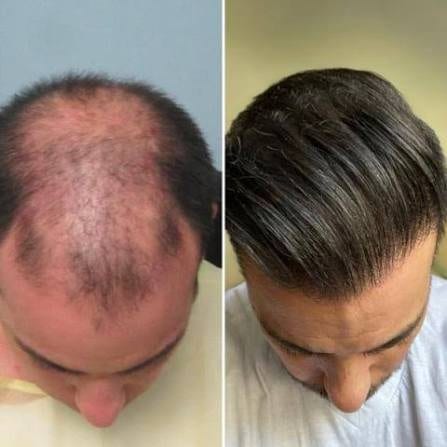
Ten years after a hair transplant: what has changed?
The grafts are usually still growing a decade later. The scalp around them, however, has changed a great deal.
A decade after the procedure the grafts are usually still growing, while everything around them has changed a great deal. Published ten-year data on hair transplant results barely exist, so what you read here is based on clinical experience rather than evidence.
Has anyone studied results ten years on?
Hardly at all. There is no registry, no standardised cohort and no long-term comparative study. If a clinic quotes a percentage of grafts surviving after ten years, the figure does not come from published follow-up. The gap exists because long follow-up is expensive, patients scatter, no authority requires it, and no sponsor wants to pay for it.
Meaningful published research on results ten years after a hair transplant does not exist. No registry has been set up, no cohort has been followed with standardised hair counts, and nobody has run a comparative study over that length of time.
The gap cannot be filled with reasoning. What you read next is what the biology suggests and what surgeons repeatedly report, and we label it as exactly that. If you hear a clinic mention what percentage of grafts are alive after ten years, there is no published follow-up behind the figure.
Why the gap exists is telling, too. Long follow-up costs a lot, patients move and drop out of contact with the clinic, no authority requires such data, and unlike with medicines there is no sponsor who profits from paying. The missing data reflect the economics of the field. The question has not been settled.
What is expected to remain after ten years?
The grafts, because follicles from the back of the head are largely unaffected by DHT and are consistently reported to keep growing even after that long. The position and shape of the hairline, which was fixed for good on the day of surgery. And the scars, which had fully matured before the first year was out. "Largely" is still an important caveat, though, because in 2026 Maas and colleagues questioned whether hair at the back of the head is as unaffected as has been assumed.
- The grafts. Follicles from the back of the head resist DHT well, and surgeons consistently report that they keep growing ten years on and beyond.
- The position and shape of the hairline. Set on the day of surgery, permanently.
- The scars. Fully matured before the first year was out.
For the first point, the caveat rests on the word "largely". Newer research has questioned whether hair at the back of the head can always be treated as unaffected. In 2026 Maas and colleagues challenged the habit of using the occipital scalp as a control area in advanced androgenetic alopecia. Over ten or twenty years that caveat carries more weight than it does after one year.
What has usually changed after ten years?
Without treatment, most of your own hair has gone while the grafts keep growing. A thinning crown has often become bald. Many people have had further sessions. The hair has greyed and become finer. The face has aged, so the hairline can sit differently. And the scalp skin is older, which changes how both grafts and scars look.
- Your own hair. Ten years of untreated androgenetic alopecia takes most of the hair that was miniaturising when you had surgery. The grafts stay, their surroundings do not.
- The crown, for most people whose crown was part of the pattern. In ten years a thinning crown has time to become bare.
- Further sessions. By then many people have had a second or third round, and the back of the head shows the effect of the total extraction.
- The hair itself ages. Grey hair, finer strands and fewer hairs per cm² over the years affect both the grafts and your own hair.
- The face gets older. A hairline that suited a face at thirty can look different on a face at forty, and a low hairline stands up to the years less well than a higher one.
- The skin. The scalp changes with age, and that shows in both the grafts and the scars.
What two outcomes do surgeons see after ten years?
The good path: a restrained hairline, medium density, medication that keeps your own hair, and reserve still intact. A decade later it looks like perfectly ordinary hair on a man of that age. The bad path: a low, aggressive hairline, as many grafts as possible, no medication and an exhausted donor area. That cannot be corrected. The difference lies in the plan, not in the surgeon's hands.
Surgeons describe two completely different end points, and which one you reach is largely decided before you lie down on the table for the first time.
The good course: a restrained, age-appropriate hairline, medium density, medication that keeps your own hair, reserve saved and two sessions at most. A decade later his hair looks like that of any other man his age. Nobody notices a thing.
The bad course: a low, aggressive hairline set at a young age, as dense as possible the first time, no medication, and native hair that has disappeared. Ten years later this man has a dense area at the front, a bare or thin area behind it, and a donor area that has been harvested in three sessions and has nothing more to give. It cannot be corrected.
What separates them is not the surgeon's skill. It is the plan.
What should you ask a clinic about the ten-year view?
Ask whether they have full-head photos of their own patients ten years on, what the plan is if your crown opens up, how many grafts you will have in reserve after the session, and how the hair you already have will be protected. Only a handful of clinics have photos like that.
- Can you show full-head photos of your own patients ten years after the procedure?
- What is the plan if my crown goes bare over the next ten years?
- How many grafts will I have in reserve once this session is done?
- How will the hair I have today be preserved?
Few can answer the first question, and that says more about the industry than about any single clinic. But clinics that do have ten-year photos to show are telling you something important: they have followed their patients that long, and they are willing to show how it turned out.
Sources
- Maas D, et al. Rethinking the occipital scalp as a control in advanced androgenetic alopecia. Journal of the American Academy of Dermatology, 2026 (ahead of print). pubmed.ncbi.nlm.nih.gov/42398778
- Long-term (5-year) multinational experience with Finasteride 1 mg in the treatment of men with androgenetic alopecia. European Journal of Dermatology, 2002. pubmed.ncbi.nlm.nih.gov/11809594
- Maletic A, et al. Impact of Hair Transplantation on Quality of Life. Aesthetic Plastic Surgery, 2024;48(9):1825-1830. pubmed.ncbi.nlm.nih.gov/38123846
- Jimenez F, Ruifernández JM. Distribution of human hair in follicular units. A mathematical model for estimating the donor size in follicular unit transplantation. Dermatologic Surgery, 1999;25(4):294-298. pubmed.ncbi.nlm.nih.gov/10417585
- Romera de Blas C, Vega Díez D, Ricart Vayá JM, Gómez Zubiaur A. Complications in follicular unit excision hair transplantation: current evidence and practical approaches. Frontiers in Medicine, 2026;13:1750989. pubmed.ncbi.nlm.nih.gov/41709896
This text is based on published studies and on how specialists in the field usually work. It is meant as general information, not as medical advice for you, and it never overrides what your surgical team has told you. If they say something different from what is written here, their advice is what counts.
Wondering what's possible for your hair?
Send three sharp photos of your hair, from the front, the top and the back. You'll get an honest answer on what can be done, roughly how many grafts it would take and what it costs.
- Free and with no obligation
- Photos are assessed by the clinic's medical team
- Replies usually within an hour in the daytime


A study tells you something about groups. Only a doctor who has seen your photos can say what applies to your hair. The medical team at the clinic at the top of our ranking offers a free assessment.
Goes to the clinic at the top of our ranking.