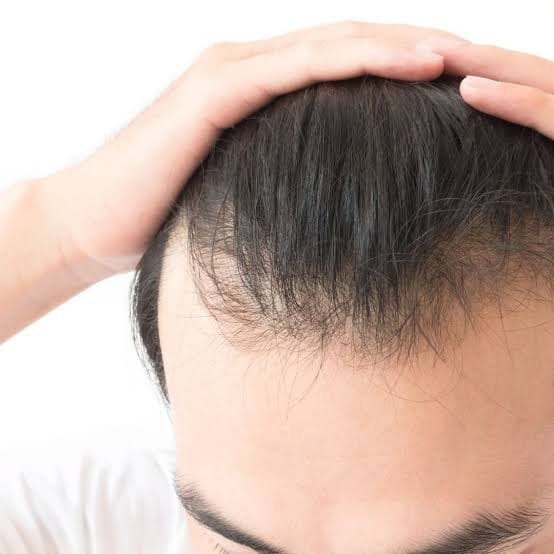
Does hair loss continue in areas that were not transplanted?
Yes. Areas that got no grafts lose hair at their own pace, whatever happened at the front.
Areas that got no grafts lose hair at their own pace. The crown is the most common and most costly example. If you treat only the front while the pattern is still spreading, you are in practice committing yourself to more operations.
Does a transplant at the front slow hair loss elsewhere on the head?
No. Grafts in the front third do not affect the crown, the mid-scalp or the temples. These areas follow the underlying pattern all the same. It matters because an untreated area creates contrast with a treated one, and a dense front next to a growing bald crown draws more attention than evenly thin hair.
The surgeon moves hair but does not change the hormones that drive hair loss. The crown, the mid-scalp and the temples therefore carry on in the same direction as before. When the front is dense and the crown is going bald at the same time, the difference between them is the first thing people notice.
Why does the crown use up so many grafts?
Because a bald patch on the crown grows outwards in every direction. The area increases with the square of the radius. So every year of hair loss needs more grafts than the year before. The whorl uses grafts on direction and angle without giving much coverage, and the crown needs high density because it is seen from above.
The crown follows different rules from the front and so deserves its own assessment.
- It spreads in a circle. As the radius of a round bald patch increases, the area grows with the square of the radius. Every new year of hair loss therefore needs more grafts than the year before.
- The crown has a whorl. The hair there lies in a spiral. For it to look natural, the grafts have to be placed at the right angle and direction, and that costs grafts without a matching gain in coverage.
- It needs high density. People see the crown from above, at an angle where the scalp easily shows through.
- Grafts placed at the edge end up as an island when the hair loss continues past them.
This is why many cautious surgeons leave the crown alone in young patients. If you are promised full crown coverage in the first session while your hair loss is still developing, take a closer look at the plan.
What happens to rebuilt temple points if the temples keep receding?
The temples keep receding regardless of the operation, and they narrow the front from both sides. If you have had your temple points rebuilt, you can end up worse off than if you had left them alone, because the hair loss continues around them. A mature hairline with slightly receding temples holds up better over time.
Rebuilt temple points look good in the first year. Ten years later they may be left as two small islands in an area where everything around them has moved back. That is why many surgeons prefer a hairline that already has some of the mature shape, and let the temples keep some of their recession.
What does a plan for many years ahead need to take into account?
A good plan is built on the worst Norwood stage you are likely to reach, not where you are today. It prioritises the front third, then the mid-scalp, and the crown last or never. A rebuilt front with a thinner crown looks like ordinary hair. The reverse does not.
- The worst Norwood stage you are likely to reach, not the stage you are at now.
- A clear order of priority. The front third first, then the mid-scalp, and the crown last, if it is to be treated at all. The front frames the face. A rebuilt front with a thin crown looks like completely ordinary male hair, while a dense crown behind a bald front does not.
- A donor reserve with a specific number, set aside for the hair loss still to come.
- Medical treatment, because it is the only thing that slows hair loss in the areas that get no grafts.
What can you do when the crown opens up after the front has been transplanted?
You have three realistic options. Medication does not give a bald crown its hair back, but it can slow the spread. Micropigmentation of the crown softens the contrast without using donor hair. A targeted new session aimed at the transition in the mid-scalp can make sense if the reserve allows. Avoid spending most of the reserve on covering a crown that is still growing.
If you come back with a good front and a crown that has recently gone bald, you have three sensible options and one you should steer clear of.
- Medical treatment, if you are not already using it. It does not restore hair on a crown that has gone bald, but it can slow the spread, and that changes what any further operation needs to cover.
- Scalp micropigmentation on the crown. It softens the contrast, takes nothing from the donor reserve and often looks better than a few hundred grafts would have managed.
- A new, targeted session aimed at the transition in the mid-scalp, not full crown coverage, and only if the reserve really allows it.
- The option to avoid: spending most of the remaining reserve on covering a crown that is still spreading. You end up with an island and nothing left for later.
What should you ask the surgeon about the crown before the first session?
Ask what the plan does if the crown opens up over the next decade, and which grafts will be used then. If the surgeon has planned thoroughly, you get a specific number of grafts that have been set aside. A surgeon who hasn't will only tell you what can be achieved right now.
The answer separates a plan for life from a plan for next summer. If all you hear is how good the front will look, half the conversation is missing.
Sources
- Maas D, et al. Rethinking the occipital scalp as a control in advanced androgenetic alopecia. Journal of the American Academy of Dermatology, 2026 (ahead of print). pubmed.ncbi.nlm.nih.gov/42398778
- Jimenez F, Ruifernández JM. Distribution of human hair in follicular units. A mathematical model for estimating the donor size in follicular unit transplantation. Dermatologic Surgery, 1999;25(4):294-298. pubmed.ncbi.nlm.nih.gov/10417585
- Gupta AK, Venkataraman M, Talukder M, Bamimore MA. Finasteride for hair loss: a review. Journal of Dermatological Treatment, 2022;33(4):1938-1946. pubmed.ncbi.nlm.nih.gov/34291720
- Romera de Blas C, Vega Díez D, Ricart Vayá JM, Gómez Zubiaur A. Complications in follicular unit excision hair transplantation: current evidence and practical approaches. Frontiers in Medicine, 2026;13:1750989. pubmed.ncbi.nlm.nih.gov/41709896
- Long-term (5-year) multinational experience with Finasteride 1 mg in the treatment of men with androgenetic alopecia. European Journal of Dermatology, 2002. pubmed.ncbi.nlm.nih.gov/11809594
This page gathers the published research and common clinical practice. It is general information, not medical advice, and it cannot replace the advice of the team operating on you. If they tell you something different from what you read here, their advice is what counts.
Wondering what's possible for your hair?
Send three sharp photos of your hair, from the front, the top and the back. You'll get an honest answer on what can be done, roughly how many grafts it would take and what it costs.
- Free and with no obligation
- Photos are assessed by the clinic's medical team
- Replies usually within an hour in the daytime


A study tells you something about groups. Only a doctor who has seen your photos can say what applies to your hair. The medical team at the clinic at the top of our ranking offers a free assessment.
Goes to the clinic at the top of our ranking.