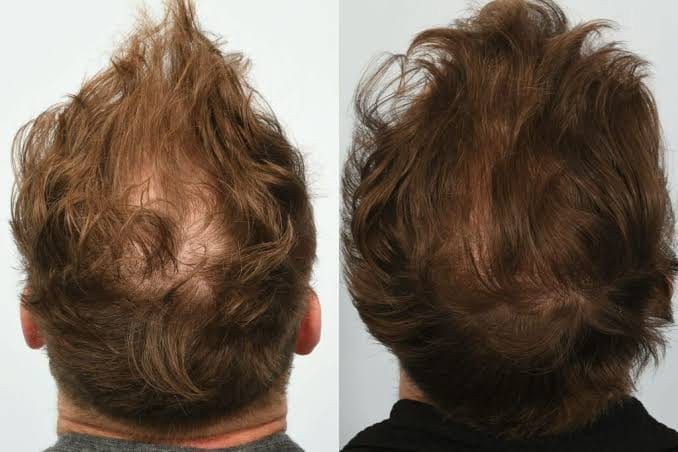
Crown hair transplant: does the coverage last long term?
The grafts in the crown stay put. The problem is that the bald area around them keeps growing.
The grafts in the crown stay put, but the bald area around them keeps growing. Crown loss spreads outwards in every direction, so if the donor reserve can't keep pace with a pattern that's still developing, the transplanted coverage ends up as an island. And usually it doesn't.
Do crown grafts fall out as the crown gets balder?
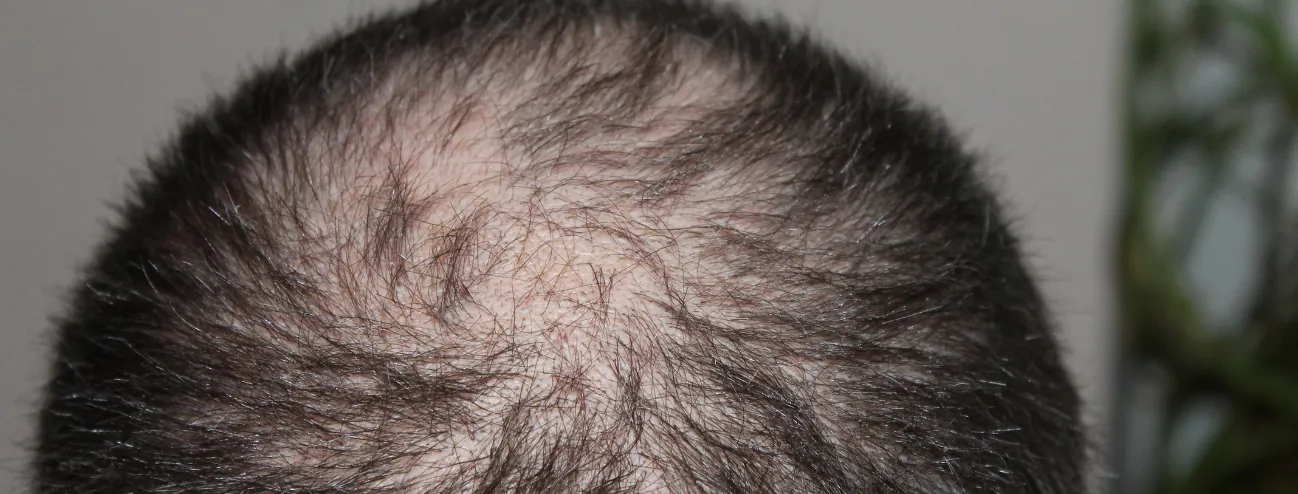
No. Crown grafts tolerate DHT about as well as frontal grafts and usually stay put. What fails is the edge: as the bald spot grows outwards, grafts placed at the old border end up, after a few years, in the middle of newly bare scalp. The crown therefore disappoints more often than the hairline, and it usually only shows after a few years.
Crown grafts are taken from the same stable area at the back of the head as hairline grafts, and they behave the same way. They tolerate DHT well and usually don't disappear.
The edge is another matter. Crown loss spreads outwards, and grafts placed along the border of a bald area end up, after a few years, surrounded by scalp that has just lost its hair. The patch of transplanted hair is still there. It just no longer marks a boundary.
This explains why patients are more often unhappy with the crown than with the front, and why the disappointment tends to show up after a few years rather than in year one.
Why does the crown need so many grafts?
When the radius of the bald spot doubles, the area quadruples, and so does the number of grafts needed. The whorl needs grafts for direction and angle without adding coverage, and the crown needs higher density than the front to look covered. At the same time, it competes with the front third for a limited reserve.
- It grows in every direction. A round bald area with an increasing radius has an area that grows with the square of the radius. If the radius doubles, four times as many grafts are needed.
- The whorl. The hair at the top of the back of the head grows in a spiral. For a natural look, angle and direction have to be recreated, and that costs grafts without adding coverage.
- Density has to be high. The crown is seen from above, from an angle where the scalp easily shows through. So more grafts per square centimetre are needed than at the front before it looks filled.
- It takes from the front. Every graft that goes to the crown is a graft the front third doesn't get. And it's the front that frames the face.
So the crown is the area that needs the most grafts, in the pattern that most often keeps spreading, and all to cover a part of the head others rarely see.
Why is the front prioritised over the crown?
Because a dense front with a thin crown looks like perfectly normal hair on an ageing man. The opposite, a filled crown with a receding hairline, doesn't occur naturally and therefore looks odd. When the reserve is limited, each graft in the front third has the greatest effect, so the crown has to wait.
When can it be right to transplant the crown?
When the pattern has stabilised, often in older men whose crown is no longer getting bigger. There also need to be grafts to spare once the front has had its share, and you should be on medical treatment, since nothing else slows the progression. Modest partial coverage often gives a better-looking result than chasing full density.
- The pattern has stopped. Best suited are older patients whose crown has stayed unchanged for a while. Then the border stays where it is.
- There are grafts to spare once the front is done. Crown work should be paid for with what's left over, not with grafts the front needs.
- Expectations of density are modest. A little hair that softens the contrast with the scalp often does more for the overall look than a dense crown that has cost the whole reserve.
- Medical treatment is under way. No other treatment slows the expansion.
- Micropigmentation has been considered. In the crown, SMP is particularly effective at reducing contrast, uses no donor hair and often gives more for the resources than grafts.
What should you ask before agreeing to a crown transplant?
Get the surgeon to estimate how much your crown will grow over fifteen years and what will then happen to the grafts. Ask how many grafts the procedure uses and how many will be left for the front. And ask whether micropigmentation could achieve the same thing more cheaply.
- How big do you think my crown will be in fifteen years?
- What happens to the grafts if the bald spot spreads past them?
- How many grafts will this use, and how many will be left for the front?
- Could SMP give me more for my money in this particular area?
- Am I on medical treatment? If not, why are we operating on an area that's still expanding?
If a surgeon declines to operate on the crown of a young patient whose hair loss is still progressing, it isn't reluctance to help. The surgeon doesn't want your reserve spent on the area where the result has the worst odds of lasting.
Sources
- Kaufman KD, Olsen EA, Whiting D, Savin R, DeVillez R, Bergfeld W, et al.. Finasteride in the treatment of men with androgenetic alopecia. Finasteride Male Pattern Hair Loss Study Group. Journal of the American Academy of Dermatology, 1998;39(4 Pt 1):578-589. pubmed.ncbi.nlm.nih.gov/9777765
- Finasteride Male Pattern Hair Loss Study Group. Long-term (5-year) multinational experience with Finasteride 1 mg in the treatment of men with androgenetic alopecia. European Journal of Dermatology, 2002;12(1):38-49. pubmed.ncbi.nlm.nih.gov/11809594
- Gupta AK, Venkataraman M, Talukder M, Bamimore MA. Finasteride for hair loss: a review. Journal of Dermatological Treatment, 2022;33(4):1938-1946. pubmed.ncbi.nlm.nih.gov/34291720
- Jimenez F, Ruifernández JM. Distribution of human hair in follicular units. A mathematical model for estimating the donor size in follicular unit transplantation. Dermatologic Surgery, 1999;25(4):294-298. pubmed.ncbi.nlm.nih.gov/10417585
- Rassman WR, Pak JP, Kim J, Estrin NF. Scalp micropigmentation: a concealer for hair and scalp deformities. The Journal of Clinical and Aesthetic Dermatology, 2015;8(3):35-42. pubmed.ncbi.nlm.nih.gov/25852813
- Maas D, Spindler A, Zappi I, Shapiro J, Lo Sicco KI. Rethinking the occipital scalp as a control in advanced androgenetic alopecia. Journal of the American Academy of Dermatology, 2026 (ahead of print). pubmed.ncbi.nlm.nih.gov/42398778
Here we summarise published research and standard clinical practice as general information. The text is not medical advice and cannot replace what your surgical team tells you. If they say something different from what is written here, their advice is what counts.
Wondering what's possible for your hair?
Send three sharp photos of your hair, from the front, the top and the back. You'll get an honest answer on what can be done, roughly how many grafts it would take and what it costs.
- Free and with no obligation
- Photos are assessed by the clinic's medical team
- Replies usually within an hour in the daytime


A study tells you something about groups. Only a doctor who has seen your photos can say what applies to your hair. The medical team at the clinic at the top of our ranking offers a free assessment.
Goes to the clinic at the top of our ranking.