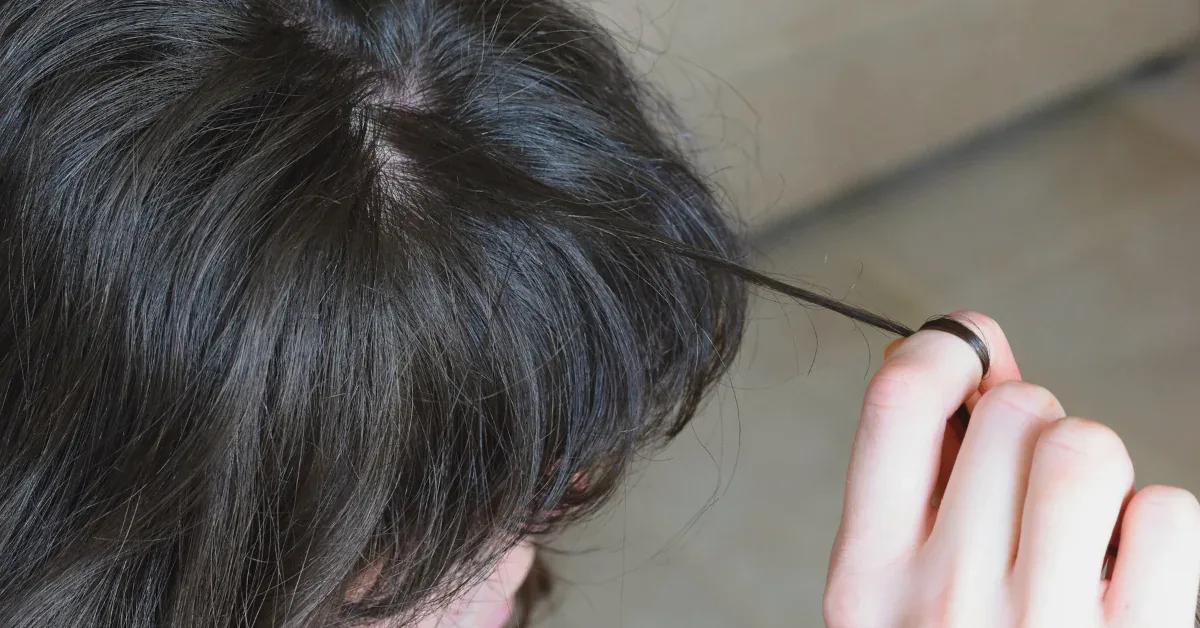
Trichotillomania: when hair loss comes from pulling out your hair
Some people lose hair because they pull it out themselves, often without noticing. Here's how trichotillomania differs from hereditary hair loss, what helps, and why surgery nearly always has to wait.
What is trichotillomania?
It's a condition where you repeatedly pull out your own hair, often without being fully aware you're doing it. It's classed as an obsessive-compulsive related disorder, or as a problem with impulse control, and the right professionals to see are psychologists and psychiatrists, not hair surgeons.
It's usually the hair on the scalp that's affected. Eyebrows and eyelashes can also be pulled.
How can you tell it apart from hereditary hair loss?
The patches are uneven and irregular. Hereditary hair loss tends to follow a familiar pattern, with receding temples and thinning at the crown. With trichotillomania, the bare areas are irregular and rarely symmetrical.
Within the same area you'll often see hairs of different lengths, because some have been pulled out and are growing back. What you rarely see is the gradual shrinking of the hairs, known as miniaturisation, that's typical of androgenetic alopecia. A specialist can usually tell the difference by examining the scalp.
Why does getting the right diagnosis matter so much?
Because the cause is behaviour, not hormones. That means neither finasteride, minoxidil nor surgery tackles the actual problem. If you only treat the consequences and not the pulling, the hair keeps disappearing.
That's also why a reputable clinic will always find out what lies behind the hair loss before suggesting anything at all. Have a look at the overview of causes of hair loss for the other types.
Which treatment works?
Psychological treatment first and foremost. The best documented is cognitive behavioural therapy, especially a method called habit reversal training. It involves becoming aware of when and how the pulling happens, and learning a different action to replace it with.
If you also have anxiety or obsessive-compulsive disorder, medication for that can help. The goal is to stop the pulling, because only then can the hair grow back. Many people get their hair fully back once they have the behaviour under control, as long as the hair follicles haven't been permanently damaged.
Can you have a hair transplant if you have trichotillomania?
Only in special cases. After many years of pulling, some hair follicles may be destroyed for good. In those cases, surgery could in theory rebuild the area.
The precondition is that the pulling has stopped and stayed under control for a long time. If surgery is done while it's still going on, the new hairs get pulled out just like the old ones, and both money and donor hair are wasted. A responsible surgeon will therefore always refer you to psychological treatment first.
What should you do if you recognise yourself here?
Talk to your GP. There's nothing to be ashamed of. The condition can be treated. Ask for a referral to a psychologist with experience in cognitive behavioural therapy. It can also help to note down when the pulling happens, in which situations and how you're feeling at the time. Bring your notes to the first appointment.
This article is general information. It can't replace treatment from a professional.
If your hair loss has only just started, a procedure may not be the right step yet. The medical team at the clinic at the top of our ranking can look at your photos and tell you honestly whether to wait, start with treatment or consider more.
Goes to the clinic at the top of our ranking.