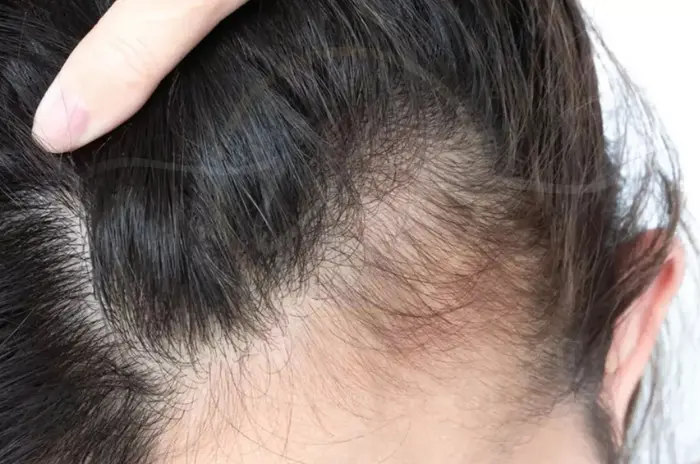
Traction alopecia: can tight hairstyles cause permanent hair loss?
If you've lost hair from tight hairstyles or hair extensions, it can come back, but only if you catch it in time. Here's how to recognise the signs, and what helps when it's too late.
Is hair loss from tight hairstyles permanent?
Yes, if the pulling goes on long enough. The hair loss is called traction alopecia, and it is caused by hair being pulled tight over a long period. Genes and hormones have nothing to do with it. The cause is purely mechanical, which makes this kind of loss unusually preventable.
Common culprits are tight ponytails and buns, braids and cornrows, extensions and turbans worn tightly. Hair disappears where the pull is strongest, most often along the hairline at the forehead and above the ears.
What signs should you look out for?
Small things, but they're worth taking seriously. Your scalp is sore, or you get a headache after putting your hair up. The skin along the hairline turns red and irritated, or small spots appear. You see short, broken hairs along the edge. And your temples gradually recede.
If this sounds familiar, now is the time to loosen the grip. At this early stage, the hair can usually come back.
What happens to the follicle when hair is pulled tight?
It is under constant strain, which causes inflammation around it. Repeated pulling, day after day, gradually weakens the follicle. First the hairs fall out, while the follicle is still alive. If the pulling continues for years, the follicle can die and be replaced by scar tissue. Then the loss is permanent.
That is why timing is everything with this type of hair loss. The same pull that causes temporary shedding over six months can cause lasting damage after many years. Read more about what happens when scar tissue takes over in scarring alopecia.
Does the hair grow back if you stop wearing the hairstyle?
Often, if you catch it early. If the follicles are still alive, the hair usually comes back without help once the strain stops. It can take several months, so you need to be patient.
If the follicles have been replaced by scar tissue, however, the hair won't come back, whatever treatment you try. So how long you wait decides whether the loss is temporary or permanent.
How is traction alopecia treated?
First by stopping the pulling. Loosen the hairstyle, avoid extensions and tight updos, and give your hairline a rest. If the scalp is inflamed, your doctor can offer topical treatments. Minoxidil is sometimes used to support regrowth while the damage can still be reversed.
If you're really unsure what kind of hair loss you have, it's wise to get it assessed. Other causes can look similar, see causes of hair loss.
Can a hair transplant help when the hair loss is permanent?
Often quite well, especially in women. If the follicles are dead, a transplant can recreate the hairline. Conditions are often favourable: the loss is usually limited to the hairline, the back of the head is usually unaffected, and the loss stays stable once the pulling has stopped.
There is one important condition. You have to stay away from tight hairstyles for good, because pulling damages the new hairs in the same way as the old ones. Read more about hair loss and treatment in women on the page about women and hair transplants.
What should you do today if this sounds like you?
Take your hair down tonight, and choose a looser style for the next few months, such as a lower ponytail, a soft hair tie or your hair fully down. Photograph your hairline and temples now and once a month, in the same light. If you see no improvement after a few months, or your hairline has already clearly receded, book an appointment with your GP or a dermatologist.
This article is general information and doesn't replace a medical assessment of you.
If your hair loss has only just started, a procedure may not be the right step yet. The medical team at the clinic at the top of our ranking can look at your photos and tell you honestly whether to wait, start with treatment or consider more.
Goes to the clinic at the top of our ranking.