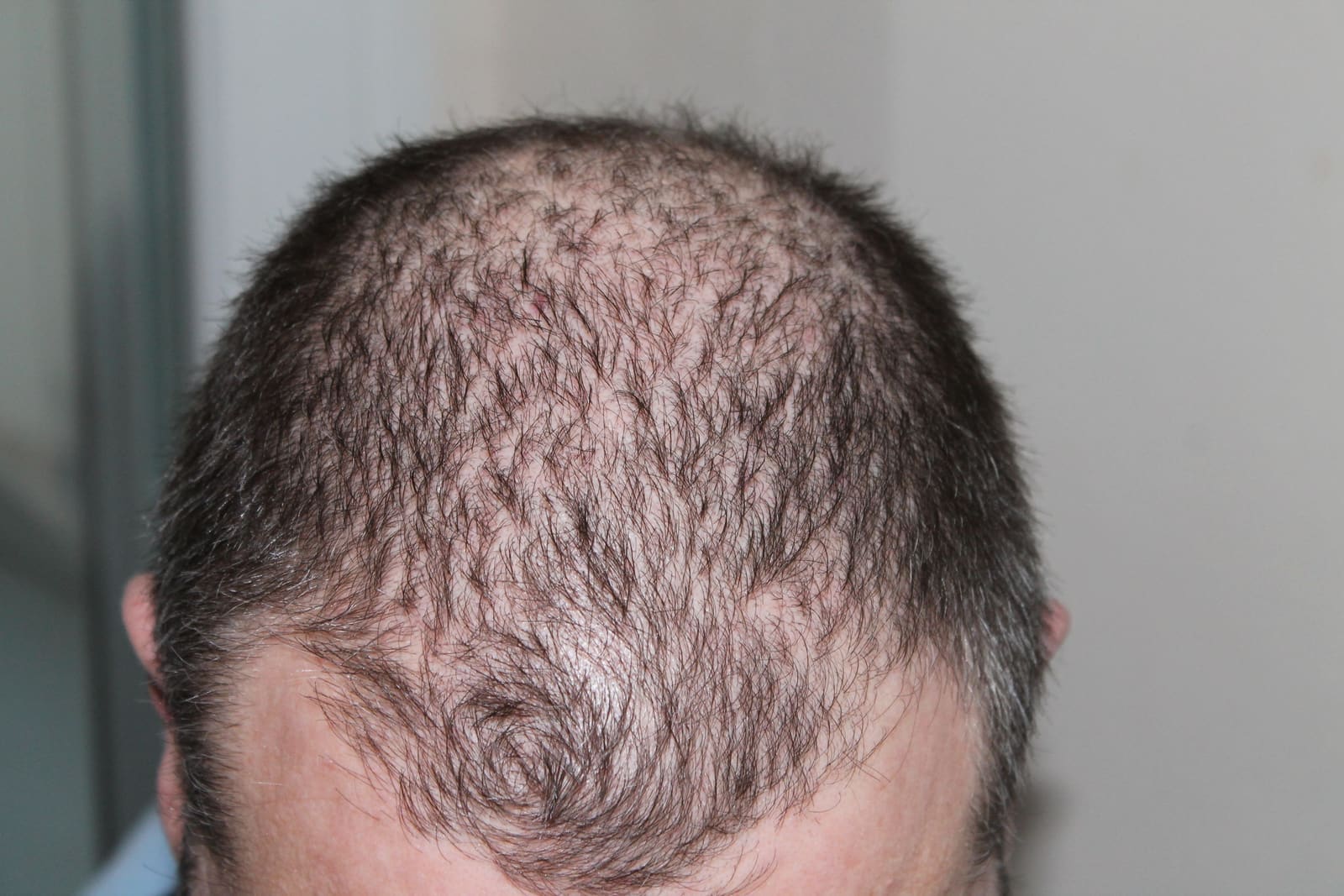
DHT and genes: why does men's hair thin on top?
It isn't the amount of testosterone that makes you bald. It's how vulnerable your hair follicles are to one particular hormone. Here's how it fits together.
Why does the beard get thicker while the hair on top disappears?
Because the same hormone has opposite effects on different hair follicles. DHT gives you a heavier beard and more body hair, but in men with a hereditary tendency it thins the hair on top of the head. What decides it isn't how much hormone you have. It's how vulnerable your hair follicles are to it.
Many people believe bald men have extra testosterone. That isn't true. Two men with exactly the same hormone levels can end up with very different hair growth, simply because they've inherited different sensitivity.
What is DHT?
DHT is short for dihydrotestosterone, a male sex hormone (androgen). It forms when the enzyme 5-alpha reductase converts some of your testosterone.
DHT has many useful jobs in the body. The problem only arises in the scalp of people who have inherited the tendency. There, the hormone damages the hair follicles over time.
What happens to a hair exposed to DHT?
It shrinks, cycle by cycle. In genetically sensitive hair follicles, DHT binds to androgen receptors and makes the growth phase (anagen) shorter with each round. The technical term is miniaturisation.
Each time a new hair grows from the same follicle, it's a little finer, a little shorter and a little lighter than the one before. Eventually only a thin, almost invisible vellus hair appears, and then nothing at all. That's why the loss comes so gradually that many people don't notice it until it has been going on for several years.
Why does hair loss always follow the same pattern?
Because the sensitivity is located in specific areas. The hair follicles at the temples, along the hairline and at the crown have a genetic programme that makes them vulnerable to DHT. The follicles at the back of the head and on the sides are largely unaffected. This is inherited cell behaviour that is set early in foetal life.
The result is the familiar pattern doctors describe with the Norwood scale, where loss starts at the temples or the crown and works its way inwards. You can read how the stages are graded in the article on the Norwood scale.
The pattern also explains why a hair transplant is possible. The stable hair at the back and sides can be moved to the vulnerable areas, and it doesn't lose its resistance along the way.
Do you inherit hair loss from your mother's father?
Not just from him. It's a stubborn myth that hair loss is passed down through your mother's father. The tendency is highly heritable, but it's controlled by many genes (it's polygenic), and they come from both sides of the family.
That means a father with little hair doesn't doom you to the same fate, and a father with thick hair doesn't let you off the hook. Your family history says something about the likelihood, but how it ends depends on the whole genetic mix. If you want to estimate how far your own loss might go, see the article on how to estimate future hair loss.
Can you slow down DHT hair loss?
Partly, yes. It's precisely because we understand the DHT mechanism that medication can help. Finasteride blocks the enzyme that converts testosterone, 5-alpha reductase. The amount of DHT in the scalp therefore drops considerably. Miniaturisation then slows down, and for many men the hair stays stable or improves.
Minoxidil works from a different angle. It stimulates growth and keeps hairs in the anagen phase for longer. You'll find doses, evidence and how the two are used together in the guide on reducing hair loss without surgery and in the background article on causes of hair loss.
Does transplanted hair also fall out over time?
No, for the most part it doesn't. The hair follicles from the back and sides of the head cope well with DHT, because their genes make them largely unresponsive to it, and that property goes with them when they're planted on top of the head. They don't suddenly become vulnerable just because they've changed address. That's why the result of a transplant can last a lifetime.
The original hair around the new grafts, however, is as vulnerable as before. It should still be protected with medication. Otherwise you can end up with small islands of new hair surrounded by scalp that becomes more and more see-through.
What should you do now?
Think through the hair loss in your family, on both your mother's and your father's side, and write down when it started for them. Take the note and a couple of photos of your hairline and crown to your GP or a dermatologist. If your loss is hereditary and already under way, the conversation about medication should come first.
This article is general information and does not replace a medical assessment.
If your hair loss has only just started, a procedure may not be the right step yet. The medical team at the clinic at the top of our ranking can look at your photos and tell you honestly whether to wait, start with treatment or consider more.
Goes to the clinic at the top of our ranking.