
Is a hair transplant permanent? Graft longevity and DHT resistance
The grafts stay because they come from an area that largely resists DHT. Largely is not the same as completely.
The grafts stay because they come from an area that largely resists DHT. That resistance is relative rather than absolute, and newer research has begun to ask whether it is safe to assume the hair at the back of the head is unaffected.
What is donor dominance, and why does the method depend on it?
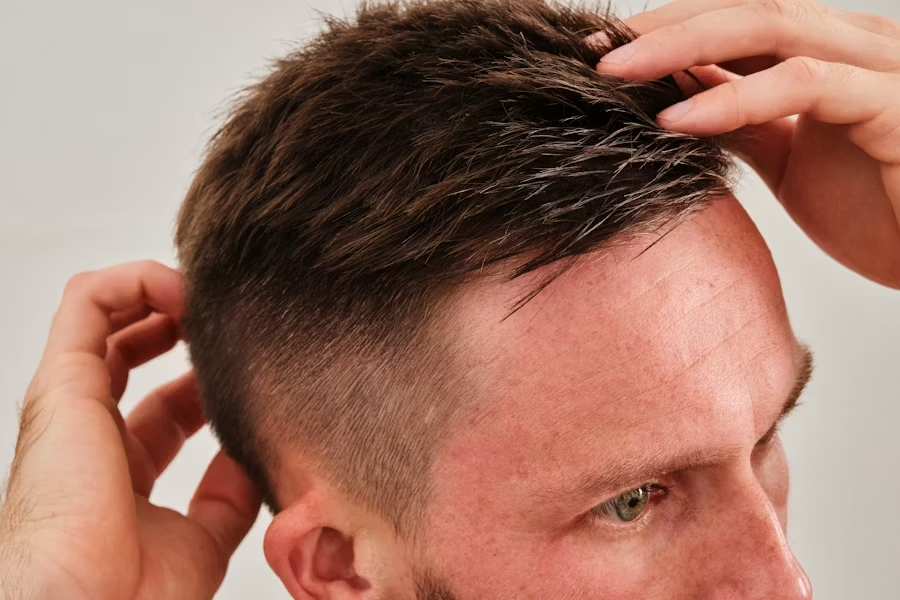
Donor dominance means a follicle keeps its characteristics when it is moved. Hair moved from the back of the head still behaves like hair from the back of the head, and it reacts far more weakly to DHT than the follicles at the front and crown. The precise wording is that donor hair largely resists DHT. The effect is strong, but the hair does not become immune, and over twenty years that difference matters.
The whole method rests on donor dominance. A follicle carries its characteristics with it, so hair from the back of the head behaves like back-of-head hair even in its new place at the front.
The characteristic that matters is how strongly the follicle reacts to dihydrotestosterone. In androgenetic alopecia the follicles at the front and crown shrink under the influence of DHT, while the follicles at the back of the head barely react. Move back-of-head follicles forward and they keep growing.
The right way to describe this is that donor hair largely resists DHT. The effect is strong enough to make the procedure reliable. But it does not make the hair immune, and over twenty years the difference between "resistant" and "immune" is far more than a play on words.
Why is "permanent" too strong a word?
Because the grafts resist DHT relatively well, not completely. The boundaries of the safe zone are estimated and never tested, so grafts from its edge may be less resistant. And age brings thinner and fewer hairs regardless. Most correctly harvested grafts last for decades, but the honest word is long-lasting, not guaranteed.
The simple promise comes with a few caveats.
- The resistance is relative. Donor follicles react much more weakly to DHT. But their reaction is not zero.
- The boundaries are an estimate. Nobody can draw a line on the head and test it. Grafts from the edge of a zone assumed to be safe may be less resistant than grafts from the middle. If the pattern was still developing on the day of surgery, the boundary may have been drawn too optimistically.
- Age comes regardless. Density and hair thickness decline over the years, even without androgenetic alopecia. The grafts get older, just as you do.
None of these points means transplants fail. Most correctly harvested grafts grow for several decades. It just means the honest promise is that the grafts are meant to last and are expected to last, not that they are permanent and guaranteed.
Does "permanent" apply to the whole result or only the grafts?
Strictly speaking only the transplanted grafts, not the result as a whole. Your own hair in front of, behind and beside the grafts keeps changing, and that causes the familiar disappointment after ten years: the grafts are there, but the hair around them has gone.
What the word really covers is the grafts: a specific number of follicles in specific places. The rest of the head is still on the move, including your own hair between the grafts, the crown further back and the temples on either side. When you hear that a transplant is permanent, it is easy to believe your appearance is settled for life. That is not what is settled.
This misunderstanding has bigger consequences than any other in the field. It leads to the typical disappointment after ten years, where the grafts are exactly where they were placed but the hair around them has gone and the patient thought the matter was closed. Medication such as finasteride protects the hair you already have, not the grafts. The grafts look after themselves. The hair next to them does not.
What new research questions whether hair at the back of the head is unaffected?
Two publications from 2026. Maas and colleagues challenged the habit of using hair at the back of the head as an unaffected reference in advanced androgenetic alopecia. Xu and colleagues compared crown and occiput in the same patient and pointed out that nobody has proved the back of the head is spared, especially in diffuse hair loss without a pattern. Together they make a case for examining the donor area under magnification.
In 2026 two publications appeared that challenge the core assumption itself, not a detail on its fringes.
In the Journal of the American Academy of Dermatology, Maas and colleagues argued that the occipital scalp should be reconsidered as a control area in advanced androgenetic alopecia. That hair at the back of the head is unaffected is a convention underlying both study design and donor assessment at the clinic. Challenging it shakes the foundations.
Xu and colleagues examined the crown and the back of the head in one and the same patient. Their conclusion was that nobody has proved the back of the head is spared, and that disease there is easily overlooked, especially when hair loss is diffuse and without a pattern.
A commentary and a case report do not turn practice upside down. They are still a reason to phrase things more cautiously, and to insist that the donor area is actually examined under magnification before anyone declares it healthy.
Why don't all grafts last in the long term?
When grafts fail, there is usually a concrete reason. Harvesting outside the safe zone. Diffuse hair loss without a pattern that also affects the back of the head. Miniaturisation in the donor area that nobody spotted. Scarring alopecia that destroys the grafts at the front. Or rough handling and a lot of transection, which causes early failure. The first three are errors in the donor assessment, and they can be caught with magnification.
When grafts do not last, there is almost always an explanation, and none of the explanations is that the method does not work.
- Harvested outside the safe zone, for example low on the nape, up near the crown or by the temples. Such grafts carry the same vulnerability as the hair where they came from.
- Diffuse hair loss without a pattern, which affects the whole head, including the back. When the back of the head thins, the grafts taken from there do the same where they now sit.
- Undetected miniaturisation in the donor area. The same problem, only milder.
- Scarring alopecia at the front, where active inflammation destroys the grafts planted into it.
- Rough handling or a lot of transection, which causes failure in the first year rather than gradual loss.
The first three all come down to an inadequate donor assessment. That is why the examination under magnification before the procedure is the step that matters most for whether the result lasts.
What is DUPA, and what does it mean for assessing donor hair?
Diffuse thinning without a fixed pattern, where the hair gets thinner over the whole scalp, including the donor area. Grafts from such an area keep thinning after they are moved, so the patient is usually a poor candidate, and only trichoscopy can reliably reveal the condition.
For most people hair loss follows a pattern, and the donor area resists DHT as it should. A small number have what is called DUPA, diffuse thinning without a fixed pattern, where the hair gets thinner all over the head, including at the back and sides. With DUPA you are usually a poor candidate. Follicles taken from an area that is already thinning keep thinning in their new location, so the result gradually fades and the donor hair has been used up for nothing.
Catching DUPA requires examining the donor area with trichoscopy. The surgeon looks for miniaturisation and for strands of different thickness side by side. A glance at the back of your head from across the desk is not enough, and if you are evenly thin all over rather than in a clear pattern, that is a reason for a more thorough examination, not for a bigger session.
How long can you expect your grafts to last?
Expect them to last a long time, but not for ever, and do not take "permanent" as a medical promise. Ask instead whether anyone looked at the back of your head under magnification, whether miniaturisation was found, and where the limits for harvesting were set. The answers say more about graft longevity than anything that happens after the operation.
Which words are more honest than "permanent", and what does the wording say about a clinic?
Say that the hair comes from an area where DHT has little effect and is expected to grow for a long time, and that the operation moves hair you already have. If there is talk of a lifetime guarantee, find out what it covers. And rather than promises of 100 % lasting results, you should be told what the plan delivers if your hair loss gets as bad as it can.
- Instead of "permanent": the hair is taken from an area that largely resists DHT, and it is expected to keep growing for many years.
- Instead of "a permanent solution": the procedure moves hair you already have and does not prevent hair loss elsewhere on the head.
- If you come across a "lifetime guarantee": find out what is actually guaranteed, for how long, and what you get if something goes wrong.
- Instead of "100 % natural and permanent results": find out what the plan delivers if your hair loss progresses as far as it realistically could.
The words a clinic uses are among the few things you can judge before you have paid. If it says "largely resistant", explains that your own hair will keep thinning, brings up medication and can show what the plan delivers fifteen years ahead, it has thought long term. If it opens with "permanent" and only shows straight-on photos twelve months after the procedure, it is showing you the moment the result looks its best. The surgery need not be poor for that reason, but unrealistic expectations are the best-documented reason patients end up dissatisfied. Wording also features among the warning signs at clinics.
Sources
- Maas D, et al. Rethinking the occipital scalp as a control in advanced androgenetic alopecia. Journal of the American Academy of Dermatology, 2026 (ahead of print). pubmed.ncbi.nlm.nih.gov/42398778
- Xu Y, et al. Case Report: Paired vertex-occipital assessment reveals donor-area involvement in diffuse unpatterned alopecia. Frontiers in Medicine, 2026;13:1797275. pubmed.ncbi.nlm.nih.gov/41982548
- Jimenez F, Ruifernández JM. Distribution of human hair in follicular units. A mathematical model for estimating the donor size in follicular unit transplantation. Dermatologic Surgery, 1999;25(4):294-298. pubmed.ncbi.nlm.nih.gov/10417585
- Rassman WR, Bernstein RM, McClellan R, Jones R, Worton E, Uyttendaele H. Follicular unit extraction: minimally invasive surgery for hair transplantation. Dermatologic Surgery, 2002;28(8):720-728. pubmed.ncbi.nlm.nih.gov/12174065
- Gupta AK, Venkataraman M, Talukder M, Bamimore MA. Finasteride for hair loss: a review. Journal of Dermatological Treatment, 2022;33(4):1938-1946. pubmed.ncbi.nlm.nih.gov/34291720
- Tan IJ, Jafferany M. Psychological Dimensions of Hair Transplantation: A Narrative Review of Current Evidence. Journal of Cosmetic Dermatology, 2025;24(10):e70475. pubmed.ncbi.nlm.nih.gov/40990054
- Maletic A, et al. Impact of Hair Transplantation on Quality of Life. Aesthetic Plastic Surgery, 2024;48(9):1825-1830. pubmed.ncbi.nlm.nih.gov/38123846
This text is based on published studies and on how specialists in the field usually work. It is meant as general information, not as medical advice for you, and it never overrides what your surgical team has told you. If they say something different from what is written here, their advice is what counts.
Wondering what's possible for your hair?
Send three sharp photos of your hair, from the front, the top and the back. You'll get an honest answer on what can be done, roughly how many grafts it would take and what it costs.
- Free and with no obligation
- Photos are assessed by the clinic's medical team
- Replies usually within an hour in the daytime


A study tells you something about groups. Only a doctor who has seen your photos can say what applies to your hair. The medical team at the clinic at the top of our ranking offers a free assessment.
Goes to the clinic at the top of our ranking.