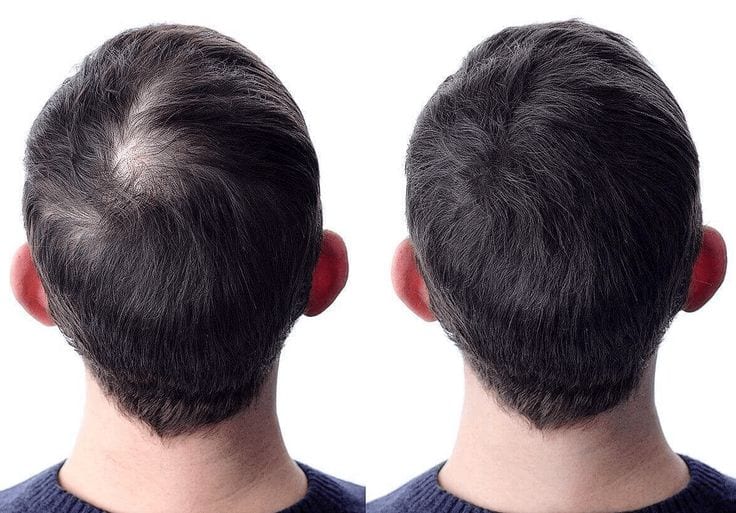
How dense will your hair be after a hair transplant?
Around half of natural density is what's usually implanted, and it still looks full. Here are the numbers, why denser isn't always better, and what decides how dense your result will be.
Will you get back the hair you had as a teenager?
Rarely. A hair transplant usually gives around half of natural density, but that's enough for the hair to look full and natural.
Many people arrive at the consultation with a photo of themselves at seventeen. That's understandable. But that density is almost never possible to recreate, and you don't need it to be happy with what you see in the mirror.
What do the density numbers mean?
Density is measured in follicular units per square centimetre, meaning small groups of one to four hairs that grow together. On a head that has never lost hair, there are roughly 80 to 100 of these units on every square centimetre. The surgeon usually implants 35 to 50, about half.
That sounds too little. In practice it looks much denser, because even moderate coverage catches the light and hides the skin underneath. We see a head of hair as full long before the numbers come close to natural. If you want to work out how many grafts your area needs, try the graft calculator.
Why doesn't the surgeon place the grafts even closer together?
Because it comes at a price. If the grafts are packed too tightly, they have to share the same limited oxygen supply, and more of them can die. Read more about what decides graft survival.
The donor area is also a limited resource. If you spend a lot of grafts pushing density to the maximum in one zone, you have fewer left for other areas and for later, if the loss continues. Moderate, safe placement therefore often gives a better overall impression than record density on a small patch.
What decides how dense your result will be?
- Donor capacity. How many grafts you have to work with sets the outer limit.
- Hair shaft thickness. Coarse hairs give more coverage per graft than fine ones.
- Contrast between hair and skin. When your hair colour is close to your skin colour, the hair looks denser.
- The size of the area. The larger the area the grafts are spread over, the lower the density in each spot.
Why is the front implanted most densely?
Because that's where people look. An experienced surgeon doesn't spread the grafts evenly. The densest implantation goes at the hairline itself and just behind it, where the eye lands first, and that's what creates the impression of fullness. Further back and on the crown, density can be somewhat lower without anyone noticing, and that saves the donor area.
The ability to put a limited number of grafts where they do the most good is a big part of the difference between a planned result and a random one. This is where the surgeon's experience shows most clearly in the final result.
Why are some people disappointed with a good result?
Because the expectations were wrong from the start. When patients are unhappy with an operation that went well technically, the reason is most often that the patient expected teenage density across the whole head. Then even a very good result can feel like too little.
Those who go in aiming for a natural, full look that suits their age are usually satisfied. An honest surgeon takes time to align expectations before the surgery. A clinic that promises extreme density over large areas is selling, not advising.
What should you ask at the consultation?
Ask the clinic what density they plan, in units per square centimetre, at the front and further back. Ask them to explain why, based on your donor area and hair type. Also ask to see results from patients with similar hair and a similar stage to yours, twelve months or more after surgery. A specific answer with numbers and reasoning is a good sign.
This article is general information. What is realistic for you must be assessed by a surgeon who has seen your scalp.
It depends on your donor area, your hair type and where the loss is. Send three photos and the medical team at the clinic at the top of our ranking will suggest a method and number of grafts.
Goes to the clinic at the top of our ranking.