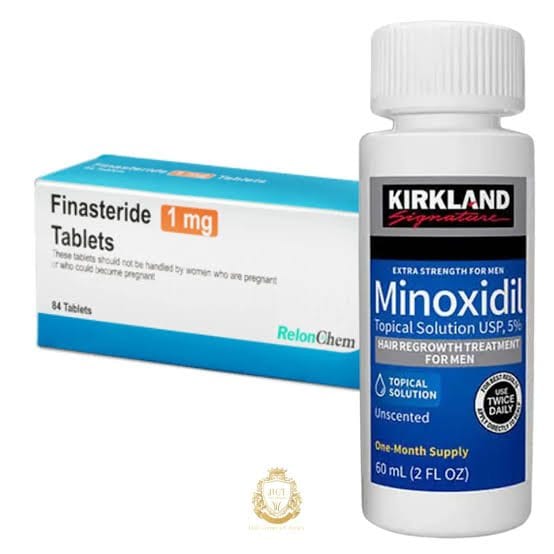
Do you need finasteride and minoxidil after FUE?
Often, yes. Surgery moves hair, but medication protects the hair you have left.
Surgery moves hair, while medication protects the hair you still have. A transplant doesn't stop hereditary hair loss in the areas that weren't treated, so it's common to combine the two to keep the result looking coherent over time.
Why is FUE often combined with medication?

A transplant moves DHT-resistant hair to where hair has been lost. Your own vulnerable hair around and between the grafts gets no protection from it. If your own hair keeps thinning, the transplanted hairs stay put while the rest recedes, and the result can be an island of hair even though every single graft grows as it should.
What do finasteride and minoxidil do alongside FUE?
Finasteride lowers DHT levels and can slow or partly reverse miniaturisation of the hair follicles. It isn't approved for women and is ruled out during pregnancy or possible pregnancy, although some doctors prescribe it off-label after the menopause. Minoxidil, as a solution on the skin or as a low-dose tablet, affects the hair growth cycle, but the tablet form is used off-label. Neither makes surgery unnecessary, and neither makes hair grow where the scalp is bare.
- Finasteride lowers DHT, with the aim of slowing miniaturisation or partly reversing it. It isn't an approved treatment for women, and anyone who is pregnant or could become pregnant must not use it. Some doctors still prescribe it off-label, mostly after the menopause.
- Minoxidil acts on the growth cycle, either as a solution or as a low-dose tablet. The tablets are used off-label.
- Neither medication can match surgery where the hair is gone, and a completely bald area stays bald.
The evidence is reviewed in the articles on oral minoxidil and non-surgical treatment.
When should you start medication before surgery?
If you start in good time, any initial shedding phase has time to pass before the procedure. If you start just beforehand, shedding from the medication can coincide with shock loss after the operation, and then it's hard to tell what's causing what. Some surgeons have you pause minoxidil solution around the procedure to spare the skin while it heals, and the surgeon needs to know about everything you take, because minoxidil dilates blood vessels.
- Starting well before the procedure gives any initial shedding time to pass
- Starting just before the procedure can make shedding from the medication overlap with shock loss, and then both are hard to interpret
- Some surgeons ask you to pause topical minoxidil around the operation so the skin heals without irritation
- List all medications and supplements on the form before the consultation. Minoxidil dilates blood vessels, and the surgeon needs to know
What happens if you stop medication after surgery?
The effect of hair loss medication usually lasts only as long as you take it. If you stop, hair loss returns to the pace you had before, which is exactly what the combination was meant to prevent. Decide on this before the operation, not after, since the answer determines how conservatively the hairline should be placed.
Sources
- Parsley WM, Perez-Meza D. Review of factors affecting the growth and survival of follicular graft. Journal of Cutaneous and Aesthetic Surgery, 2010;3(2). jcasonline.com
- Leavitt M, Perez-Meza D, Rao NA, Barusco M, Kaufman KD, Ziering C. Effects of finasteride (1 mg) on hair transplant. Dermatologic Surgery, 2005;31(10):1268-1276. pubmed.ncbi.nlm.nih.gov/16188178
- Avram M, Rogers N. Contemporary hair transplantation. Dermatologic Surgery, 2009;35(11):1705-1719. pubmed.ncbi.nlm.nih.gov/19674037
- Gupta AK, Venkataraman M, Talukder M, Bamimore MA. Finasteride for hair loss: a review. Journal of Dermatological Treatment, 2022;33(4):1938-1946. pubmed.ncbi.nlm.nih.gov/34291720
- Vano-Galvan S, et al. Safety of low-dose oral minoxidil for hair loss: A multicenter study of 1404 patients. Journal of the American Academy of Dermatology, 2021;84(6):1644-1651. pubmed.ncbi.nlm.nih.gov/33639244
This article is based on published research and established clinical practice in the field. It gives you general knowledge and is not medical advice. The instructions from the team operating on you take precedence, including where they differ from what is written here.
Wondering what's possible for your hair?
Send three sharp photos of your hair, from the front, the top and the back. You'll get an honest answer on what can be done, roughly how many grafts it would take and what it costs.
- Free and with no obligation
- Photos are assessed by the clinic's medical team
- Replies usually within an hour in the daytime


A study tells you something about groups. Only a doctor who has seen your photos can say what applies to your hair. The medical team at the clinic at the top of our ranking offers a free assessment.
Goes to the clinic at the top of our ranking.