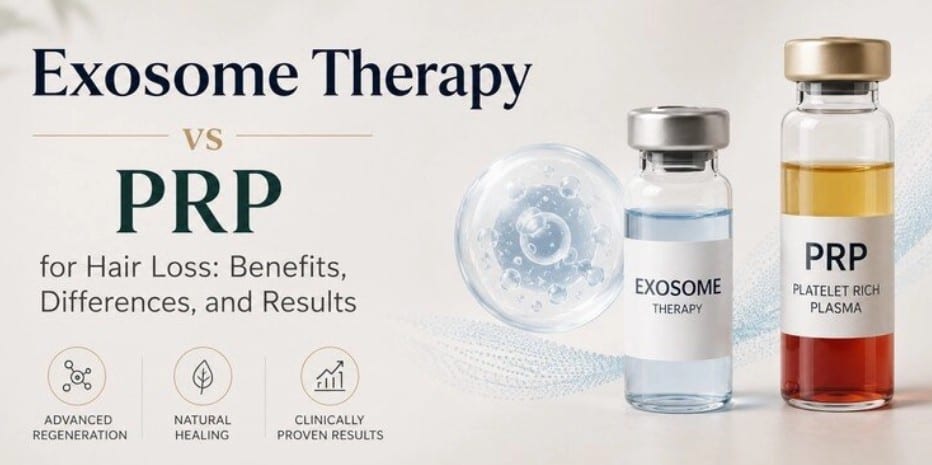
HBOT bundled with PRP, laser and exosomes: does it add anything?
Many clinics sell HBOT in the same package as PRP, exosomes, laser and supplements.
It is common to be offered HBOT in a package together with PRP, exosomes, laser and supplements. None of these combinations has been studied after a hair transplant. Putting several undocumented treatments together does not give you a documented treatment.
Why is a package of many add-ons so hard to assess?
Clinics often put PRP, the pressure chamber, exosomes, a home-use laser and supplements into one package with one price. The research, on the other hand, looks at the treatments one at a time. There are no studies of HBOT tried together with PRP, exosomes or laser after a transplant. In other words, the combination you are offered has never been tested.
Add-ons after a hair transplant are rarely bought one at a time. A typical premium package contains PRP during the operation, a round of pressure chamber treatment, exosomes or growth factors, a laser device for home use and a course of supplements. Everything comes at a single combined price.
For the clinic, that is profitable. For you, it becomes hard to see what you are actually paying for. Where research on these treatments exists, they have been studied one by one. HBOT plus PRP after a transplant has not been studied. The same goes for HBOT plus exosomes and HBOT plus laser. The package you buy has never been evaluated as a package.
Do several undocumented add-ons become something that works when combined?
No. If an add-on has not been shown to give more surviving grafts after twelve months, adding more of them will not show it. Many of the treatments affect the same signalling pathways for inflammation and new blood vessel formation, so two of them do not give a double effect. And if the result is good, neither you nor the clinic can say what made the difference.
It feels logical that several treatments that might each help a little must together help more. That is not true, and here is why.
- Uncertainty cannot be added up to certainty. If each add-on lacks evidence for more surviving grafts after twelve months, five such add-ons still give zero evidence.
- The treatments may do the same thing. Several of them act on the same processes of inflammation and new blood vessel formation. If two measures do the same job, the job does not get done twice.
- You never find out what worked. If things go well, no one can say which part contributed, not even the clinic. That is exactly why experience without a control group time and again leads to confident claims that studies later cannot confirm.
How well documented are HBOT, PRP, LLLT and exosomes on their own?
HBOT has been tested on 34 patients in one study. Fewer shed hair early and fewer got folliculitis, while graft survival after nine months did not differ reliably from the control group. PRP is widely studied in alopecia, but hardly at all for graft survival. The LLLT studies concern hair you already have, not new grafts. Exosomes and growth factors are sold hard but little studied, and their contents vary from supplier to supplier.
HBOT
There is one randomised trial here, with 34 patients. Early shedding affected 27.6 % in the HBOT group and 69.1 % in the control group. For itching and folliculitis, the figures were 11.8 % and 35.3 %. After nine months, 96.9 % of grafts survived in the HBOT arm and 93.8 % among the controls, a gap without statistical significance. Beyond that we have only a case report on five patients and a preliminary test in healthy volunteers.
PRP
In androgenetic alopecia, PRP is well researched, including in systematic reviews and meta-analyses. Known weaknesses are that the plasma is prepared in different ways and that studies measure different outcomes. Whether PRP improves graft survival after a transplant is far less well studied.
Low-level laser therapy
For androgenetic alopecia there is a real body of randomised trials. A 2025 meta-analysis pooled seven studies and found that density increased more when LLLT was added to topical minoxidil than with minoxidil alone. Here too, the findings concern hair that is already growing, not protection of new grafts.
Exosomes and growth factors
Here the marketing is strong and the research weak. What the products contain varies enormously between suppliers. There is no evidence base comparable to the others, and you should be correspondingly more sceptical.
Can HBOT combined with other add-ons cause problems?
For most combinations there is no known interaction. Even so, you should raise two things with the surgical team. The first is the schedule: the pressure chamber series fills the week after surgery, and PRP is often given while you are on the operating table. The second: hyperbaric oxygen affects the body's chemistry, and no one knows whether it influences a growth factor injection given the same week.
No interaction is known for most of the combinations. Still, there are two practical points you should clarify with your team rather than take for granted.
The first is about the calendar. Daily pressure chamber sessions take up the whole week after the operation. PRP is often given during the procedure, or in several rounds later. If you have travelled to have surgery, you need to know in advance how this will fit together. Find out before you pay, not afterwards.
Second, hyperbaric oxygen has biological effects of its own. According to Thom's review, it acts through reactive forms of oxygen and nitrogen that trigger signalling cascades in the cells. How this interacts with a growth factor injected the same week is unknown, simply because no one has studied it. That argues for caution about stacking treatments. It offers no reassurance.
How do you choose add-ons after a transplant sensibly?
Choose one add-on at most, learn what the research actually says about it, and have it listed with its own price so you can see what it costs. Ask what the package costs without each individual part. If the price stays the same, that part is in practice included in the surgery price. A clinic that is happy to break down the price and explain the evidence honestly reflects well on itself.
If you want add-ons, the most sensible approach is to stick to one. Find out exactly what the research supports, and pay for it as a separate item, so you know what it costs you.
- Ask for a breakdown of the package in which each add-on has its own price.
- Ask what the total becomes when you remove one part at a time. If the sum stays the same, the part is not a real choice, and you may as well regard it as built into the surgery price.
- For each add-on, ask which study shows that it helps after a transplant. Note whether the study was done on transplant patients or on androgenetic alopecia.
- Remember that what best secures a good result after five years is treating your own remaining hair. That is a conversation to have with a doctor.
If the clinic is willing to break down the price and give an accurate picture of the research behind each part, that tells you something useful about how the place is run. If you only get one price for the whole premium package, that tells you something too.
Sources
- Fan Z, Gan Y, Qu Q, Wang J, Lunan Y, Liu B, Chen R, Hu Z, Miao Y. The effect of hyperbaric oxygen therapy combined with hair transplantation surgery for the treatment of alopecia. Journal of Cosmetic Dermatology, 2021;20(3):917-921. pubmed.ncbi.nlm.nih.gov/32770782
- Giardiello F, De Medeiros Quirino L, Brigante R, Chumak M. Hyperbaric Oxygen Therapy for Enhanced Postoperative Recovery in Hair Transplantation. Cureus, 2025;17(12):e99635. doi.org/10.7759/cureus.99635
- Kieling L, et al. Is autologous platelet-rich plasma capable of increasing hair density in patients with androgenic alopecia? A systematic review and meta-analysis. Anais Brasileiros de Dermatologia, 2024;99(6):847-862. pubmed.ncbi.nlm.nih.gov/39013743
- Mawu FO, et al. Comparative efficacy and safety of low-level laser therapy and topical minoxidil combination vs. topical minoxidil monotherapy for androgenetic alopecia: a systematic review and meta-analysis. Lasers in Medical Science, 2025;40(1):338. pubmed.ncbi.nlm.nih.gov/40826200
- Thom SR. Hyperbaric oxygen: its mechanisms and efficacy. Plastic and Reconstructive Surgery, 2011;127 Suppl 1:131S-141S. pubmed.ncbi.nlm.nih.gov/21200283
This article summarises published research and common clinical practice. It is meant as general information and is not medical advice. Nor does it replace the advice you get from your own surgical team. If your team tells you something different from what is written here, follow your team.
Wondering what's possible for your hair?
Send three sharp photos of your hair, from the front, the top and the back. You'll get an honest answer on what can be done, roughly how many grafts it would take and what it costs.
- Free and with no obligation
- Photos are assessed by the clinic's medical team
- Replies usually within an hour in the daytime


A study tells you something about groups. Only a doctor who has seen your photos can say what applies to your hair. The medical team at the clinic at the top of our ranking offers a free assessment.
Goes to the clinic at the top of our ranking.