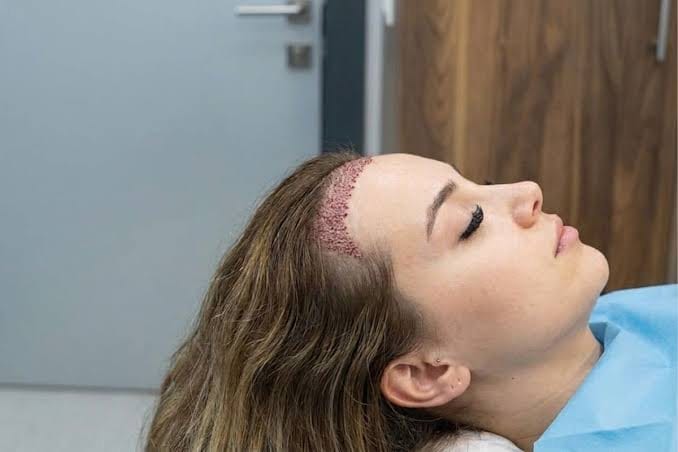
Can you have FUE with a tight scalp? Why laxity matters little
Yes. With FUE, how mobile your scalp is matters far less than with strip surgery, because there are no wound edges to pull together.
With FUE, how mobile your scalp is matters far less than with strip surgery, because there are no wound edges to pull together. For FUT, a tight scalp is a major limitation. For FUE, it's a minor technical detail, and that is exactly why FUE is often the better choice for these patients.
Why does scalp laxity matter so much in strip surgery and so little in FUE?
In strip surgery, a band of scalp is cut away and the edges are stitched together under tension. If the skin has little movement, the strip has to be narrower, and each operation yields fewer grafts. Studies have not shown that tight skin in itself causes more pain or wider scars. That's why the surgeon measures laxity before deciding how wide the strip should be. FUE removes tissue in small, separate cylinders that are not stitched closed. With no suture under tension, laxity is not what sets the limit.
What does a tight scalp mean for the FUE procedure itself?
It affects the technique more than the result. A little more force may be needed during extraction, the incisions in the recipient area can be slightly harder to make at exactly the right depth, the swelling afterwards may feel tighter, and the anaesthetic may spread a little differently. The surgeon adjusts for this, and none of these points is a reason not to go ahead.
- A little more force may be needed to free the grafts, and the surgeon may need to adjust the technique
- It can be slightly harder to make recipient incisions at exactly the planned depth
- Swelling afterwards can make the scalp feel noticeably tighter
- The anaesthetic may spread in a slightly different way
All of these are adjustments to technique. None of them is a reason to skip the procedure.
What should you do if your scalp has little movement?
If your scalp is very tight, FUE is usually a better choice than strip surgery, and if the surgeon still recommends FUT, you should get a clear explanation of why. Before FUT, specific exercises can make the skin more mobile. They follow a set routine and should only be done when a healthcare professional has asked you to.
Which questions settle the choice between FUE and FUT?
Ask whether the laxity of your scalp has been assessed and what the assessment showed, whether the finding tips the recommendation towards FUE or FUT, and whether it limits how many grafts can safely be taken from your donor area.
- Have you measured how mobile my scalp is, and what did it show?
- Does it affect whether you recommend FUE or FUT?
- Does it limit how many grafts can safely be extracted?
Laxity matters most in strip surgery, where the donor wound is stitched together under tension.
Sources
- Huang YL, Chang SL, Lee MC, Chang CH, Hu S, Gold MH. Measuring occipital scalp laxity before donor strip harvesting in hair transplantation. Journal of Drugs in Dermatology, 2014;13(10):1248-1252. pubmed.ncbi.nlm.nih.gov/25607560
- Park JH. Association Between Scalp Laxity, Elasticity, and Glidability and Donor Strip Scar Width in Hair Transplantation and a New Elasticity Measuring Method. Dermatologic Surgery, 2017;43(4):574-581. pubmed.ncbi.nlm.nih.gov/28005630
- Gupta AK, Love RP, Harris JA. Old Friend or New Ally: A Comparison of Follicular Unit Transplantation and Follicular Unit Excision Methods in Hair Transplantation. Dermatologic Surgery, 2020;46(8):1078-1083. pubmed.ncbi.nlm.nih.gov/32141930
- Kim YS, Na YC, Park JH. Comparison of postoperative pain according to the harvesting method used in hair restorative surgery. Archives of Plastic Surgery, 2019;46(3):241-247. pubmed.ncbi.nlm.nih.gov/31113186
Here we summarise published studies and standard clinical practice. The text is intended as general information and is not medical advice. Nor does it replace the instructions from the team operating on you. If they tell you something different from what is written here, their advice applies.
Wondering what's possible for your hair?
Send three sharp photos of your hair, from the front, the top and the back. You'll get an honest answer on what can be done, roughly how many grafts it would take and what it costs.
- Free and with no obligation
- Photos are assessed by the clinic's medical team
- Replies usually within an hour in the daytime


A study tells you something about groups. Only a doctor who has seen your photos can say what applies to your hair. The medical team at the clinic at the top of our ranking offers a free assessment.
Goes to the clinic at the top of our ranking.