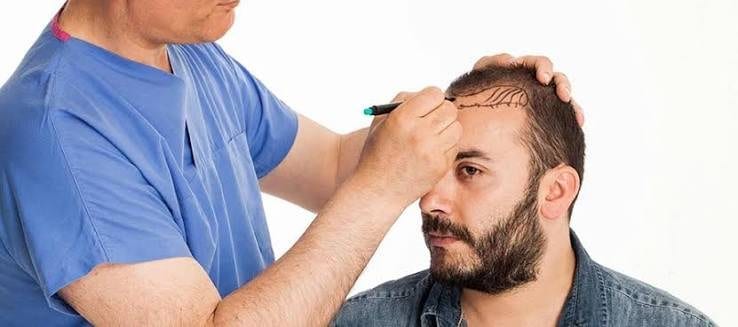
Megasession of over 3,000 grafts: what do you gain and risk?
A large session covers a lot of ground in a single trip to the clinic. The price is a longer procedure, in which the grafts harvested in the first hour wait longest before they are placed.
A single large session covers a big area in one trip to the clinic. Yet every extra graft lengthens the procedure, and the grafts harvested first spend the longest time outside the body. The size of the session therefore affects how many grafts survive. It is more than a question of logistics.
Why do many people choose a megasession?
The appeal is one trip, one recovery and one round of travel costs. You get closer to your end goal faster, a large area blends more evenly than if it is built up bit by bit, and at most clinics the price per graft falls when the number is high.
- Just one trip, one recovery and one bill for travel and accommodation
- A shorter route to the result you are aiming for
- A smoother transition across a large area than when it is filled in stages
- A lower price per graft at most clinics
What limits how large a session can be?
From the moment a graft is removed until it is implanted, it has no blood supply, and the proportion that survives falls as the hours pass, roughly estimated at around one per cent for every hour. In a long session with several thousand grafts, the first ones wait longest, which is why the number of hands in the team and how well the work is organised matter as much as the surgeon's skill.
The estimate of one per cent per hour is a rule of thumb. It is not a precise measure, but the direction is clear: waiting time costs grafts.
How does the donor area limit a megasession?
The donor area has a lifetime ceiling, set by the density and size of the safe zone. Hereditary hair loss rarely stops, so something has to be kept in reserve for later. If a clinic promises an unusually high number of grafts in one day, ask how they arrived at that figure and how much you will have left afterwards.
What questions should you have answered before agreeing to a megasession?
Ask how long the first grafts will be outside the body, how many people in the team work on implantation, and whether two sessions would give better survival, and if so, what splitting it would cost. Also ask how much of your total donor capacity this one session uses up.
- How long will the first grafts be outside the body?
- How many people implant grafts at the same time?
- Would two sessions give better survival, and if so, what would that cost?
- How much of my donor capacity will be used up?
We cover what the research says about waiting time and survival in the article on time outside the body.
Sources
- Parsley WM, Perez-Meza D. Review of factors affecting the growth and survival of follicular graft. Journal of Cutaneous and Aesthetic Surgery, 2010;3(2). jcasonline.com
- Li KT, Qu Q, Fan ZX, Wang J, Liu F, Hu ZQ, Miao Y. Clinical experience on follicular unit extraction megasession for severe androgenetic alopecia. Journal of Cosmetic Dermatology, 2020;19(6):1481-1486. pubmed.ncbi.nlm.nih.gov/31529675
- Chouhan K, Roga G, Kumar A, Gupta J. Approach to Hair Transplantation in Advanced Grade Baldness by Follicular Unit Extraction: A Retrospective Analysis of 820 Cases. Journal of Cutaneous and Aesthetic Surgery, 2019;12(4):215-222. pubmed.ncbi.nlm.nih.gov/32001965
- Goldin J, Zito PM, Raggio BS. Hair Transplantation. StatPearls (NCBI Bookshelf), 2025 (updated 2 August 2025). pubmed.ncbi.nlm.nih.gov/31613520
This article is based on published research and standard clinical practice in the field. It offers general information and is not medical advice. The instructions from the team that operates on you always come first, including where they differ from what is written here.
Wondering what's possible for your hair?
Send three sharp photos of your hair, from the front, the top and the back. You'll get an honest answer on what can be done, roughly how many grafts it would take and what it costs.
- Free and with no obligation
- Photos are assessed by the clinic's medical team
- Replies usually within an hour in the daytime


A study tells you something about groups. Only a doctor who has seen your photos can say what applies to your hair. The medical team at the clinic at the top of our ranking offers a free assessment.
Goes to the clinic at the top of our ranking.