HBOT and the first weeks after a hair transplant: comfort and downtime
The best HBOT can point to after a transplant concerns how the patient feels, not the final result. Fewer people shed hair early, itching and folliculitis drop to around a third, and a small case series reported faster scab shedding.
What HBOT has the best support for is how you feel along the way, not how your hair looks in the end. Fewer people experience early shedding, itching and folliculitis occur about a third as often, and five patients in a case series lost their scabs quickly.
What are the strongest HBOT findings actually about?

About how the first two weeks feel, not about how the result turns out. In Fan's study, 11.8 % with HBOT had itching and folliculitis, compared with 35.3 % without. Early shedding affected 27.6 % with HBOT and 69.1 % without. Both differences are large enough to be detected with good confidence. Neither says anything about the result at twelve months. Both concern the period most patients find the hardest.
There's something ironic about how HBOT is sold. The main selling point is usually more surviving grafts, and research hasn't been able to show that. What the studies actually show best is how the first fortnight feels. For most people, that is exactly the hardest part of the whole process.
In the Fan study, 11.8 % of those who had HBOT developed itching and folliculitis. In the control group the figure was 35.3 %. Early shedding affected 27.6 % with HBOT and 69.1 % without. Those are big gaps, and big gaps are exactly what a small study can pick up reliably.
Neither finding says anything about how you look after a year. Both concern the weeks when patients are most worried and most ready to believe the operation has failed.
What makes the time right after surgery so hard?
The scabs stay in the recipient area for up to ten days. It itches, and folliculitis looks worrying. After two to three weeks the transplanted hairs fall out. That is normal, because the follicle lives on and grows again from the third or fourth month, and you see the final result after twelve months. But it's not a pleasant phase to watch in the mirror.
If you've been through a transplant, you'll recognise this stage. In the recipient area the scabs stay for about a week, sometimes up to ten days. The skin itches as it heals, and the urge to scratch is strong precisely because it's forbidden. Folliculitis shows up as small, inflamed spots where the new hairs are meant to come through. It hurts and looks alarming.
Somewhere between weeks two and three, the transplanted hairs fall out. That's part of the process: the follicle survives, starts a new growth phase around the third or fourth month, and the final result shows after about twelve months. Even when you know this, it's hard to find expensive hairs on your pillow.
A treatment that gives less visible shedding and only a third as many inflammatory problems is therefore doing something about a real problem. It just doesn't change where you end up.
What did the case report on five patients show, and where is the weakness?
Giardiello followed five patients. The scabs came off on day three to five, patients gave the top or second-highest score for satisfaction, they had recovered after 2.8 days on average, and nobody had complications. Nobody went without HBOT, so the results can't be attributed to the treatment. An uncomplicated FUE often heals just as quickly without any add-on. The findings do, however, point the same way as the randomised trial.
Giardiello and colleagues followed five patients. The scabs were gone after 3 to 5 days, after four on average. On a scale from one to five, everyone answered four or five. Recovery took 2.8 days on average, pain eased by the third day, and nobody had complications.
The caveat needs to be stated plainly. Every patient received HBOT, and no group went without. Even after an ordinary, uncomplicated FUE, the scabs come off, the pain fades and the patient recovers, with no add-on at all. The figures describe the course in five people. They can't identify the cause.
They are nonetheless consistent with the inflammation finding in the randomised trial. When two separate studies point in the same direction, that means something, even though neither settles the matter.
How much time and discomfort does a course of HBOT involve?
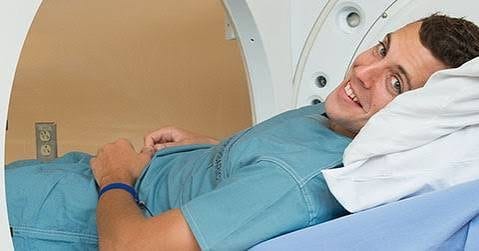
Expect 60 to 90 minutes in the chamber every day for six or seven days, plus travel. You have to equalise your ears at every session, and that is where most side effects arise. A sealed tube can trigger claustrophobia, and many stop for that reason. And you have to stay in the city where the clinic is.
The comfort has a flip side too. For an honest account, you need to include what the sessions demand of you.
- Time. You spend 60 to 90 minutes in the chamber at a time for six or seven days. Add the time it takes to raise and lower the pressure and to get there. In practice, half a day disappears, seven days in a row.
- Your ears. As the pressure rises, you have to equalise your ears at every session. Pressure injury to the middle ear, barotrauma, is the most common side effect of hyperbaric treatment. Swelling and blocked sinuses after a long operation increase the risk.
- Being shut in. In a single-person chamber you lie still in a sealed tube for up to 90 minutes. Many who stop the course do so because of claustrophobia.
- Exhaustion. The most intensive published protocol starts just four to six hours after your surgery ends. The procedure itself may have taken six to eight hours.
- Tied to the city. If you had surgery abroad, you have to stay near the centre for the whole first week instead of going home.
How should you decide whether HBOT is worth the money?
The question is not whether the result will be better, because nobody can promise that. Ask instead whether two first weeks with less discomfort and less worry are worth the price, the schedule and the hours in the chamber. If you have had severe folliculitis before, the answer may be yes. If you're flying home after a few days, it's probably no. A promise of more surviving grafts shouldn't be what decides it.
Whether your result will be better is something the existing research can't answer. The useful question is whether two calmer, less uncomfortable first weeks are worth the money, the daily schedule and the hours you spend in the chamber.
For some people the answer is clearly yes. That applies if you have struggled with severe folliculitis before, if you find the shedding phase really hard, and if you'll be staying near the clinic for the first week anyway.
For others the answer is just as clearly no. If you fly home on day three, if you find tight spaces difficult, or if the money could instead go on treating the hair that will decide how you look in five years, the case is weak.
Promises that more grafts will survive shouldn't drive the decision. That is the only thing research has examined directly, and there it found no reliable effect.
You'll find how HBOT compares with other add-ons in the overview of supportive treatments.
Sources
- Fan Z, Gan Y, Qu Q, Wang J, Lunan Y, Liu B, Chen R, Hu Z, Miao Y. The effect of hyperbaric oxygen therapy combined with hair transplantation surgery for the treatment of alopecia. Journal of Cosmetic Dermatology, 2021;20(3):917-921. pubmed.ncbi.nlm.nih.gov/32770782
- Giardiello F, De Medeiros Quirino L, Brigante R, Chumak M. Hyperbaric Oxygen Therapy for Enhanced Postoperative Recovery in Hair Transplantation. Cureus, 2025;17(12):e99635. doi.org/10.7759/cureus.99635
- Heyboer M, Sharma D, Santiago W, McCulloch N. Hyperbaric Oxygen Therapy: Side Effects Defined and Quantified. Advances in Wound Care, 2017;6(6):210-224. pubmed.ncbi.nlm.nih.gov/28616361
- Thom SR. Hyperbaric oxygen: its mechanisms and efficacy. Plastic and Reconstructive Surgery, 2011;127 Suppl 1:131S-141S. pubmed.ncbi.nlm.nih.gov/21200283
- Lee HY, Lee JY, Kim SC, Lee Y. Preliminary Effects of Hyperbaric Oxygen Therapy on Hair Follicle Characteristics in Healthy Subjects. Bioengineering, 2026;13(2):240. doi.org/10.3390/bioengineering13020240
This article summarises published research and standard clinical practice. It is meant as general information and is not medical advice. Nor does it replace the advice you get from your own surgical team. If your team tells you something different from what is written here, follow your team.
Wondering what's possible for your hair?
Send three sharp photos of your hair, from the front, the top and the back. You'll get an honest answer on what can be done, roughly how many grafts it would take and what it costs.
- Free and with no obligation
- Photos are assessed by the clinic's medical team
- Replies usually within an hour in the daytime


A study tells you something about groups. Only a doctor who has seen your photos can say what applies to your hair. The medical team at the clinic at the top of our ranking offers a free assessment.
Goes to the clinic at the top of our ranking.