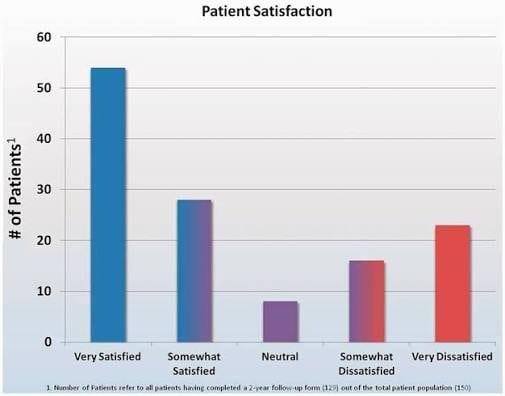
How satisfied are patients after many years? Nobody knows
How satisfied patients are after twelve months is well studied. What happens later has barely been looked at.
Satisfaction one year after a hair transplant has been studied thoroughly. Later years have barely been examined. Studies consistently find better quality of life and self-esteem, but none of them follow patients over several years.
What do studies say about how satisfied patients are?
Studies consistently find that patients become more satisfied. In 2024 Maletic and colleagues measured clearly higher SF-36 scores after the procedure. In Nilforoushzadeh and colleagues' study, both quality of life and self-esteem were statistically significantly better after than before. When individual techniques are studied, satisfaction at the one-year check-up is almost always high. All of them measured about a year afterwards.
Research on satisfaction and quality of life after hair transplantation points fairly clearly in a positive direction.
In 2024 Maletic and colleagues wrote in Aesthetic Plastic Surgery about how hair transplantation affects quality of life. SF-36 scores rose clearly after the procedure.
In Nilforoushzadeh and colleagues' study, men with androgenetic alopecia were asked about quality of life and self-esteem both before and after the procedure, and the change was statistically significant.
When individual techniques are studied, satisfaction at the one-year check-up is almost always high.
Taken together, this supports one simple conclusion: around a year after the procedure, patients are clearly more satisfied than they were before.
Why is there no data on satisfaction over many years?
No larger published study has followed satisfaction beyond the one-year mark, and none has measured it at year five, ten or twenty. That's a problem, because what changes a result most over time, the continued loss of your own hair, happens in exactly the period nobody measures. Someone who's delighted after one year and regrets it after eight never shows up in the statistics.
Every one of the studies stops at roughly the one-year mark. No one has done larger published follow-ups five, ten or twenty years on.
That gap matters more here than in most areas of surgery. What changes a result over time, the continued loss of your own hair, happens in exactly the period nobody studies.
Clinics know well the patient who is delighted after one year and disappointed eight years later. The published literature doesn't see him, because he's measured once and then disappears from the data.
Why is it easy to be satisfied after twelve months?
Because almost every competent procedure gives visible improvement within a year, while the memory of how you looked before is still fresh. The grafts have grown and look dense, your own hair around them hasn't thinned yet, the back of your head has healed, and your expectations are measured against the before photo.
This isn't meant cynically. Satisfaction after twelve months is genuinely high, because most properly performed procedures give visible improvement within a year, and because the starting point, how you looked before the procedure, is still fresh in your memory.
- The grafts have grown and give an impression of density.
- Your own hair around them hasn't had time to thin yet.
- The back of your head has healed and usually looks normal at the hair length you normally wear.
- You're comparing yourself with the photo from before the procedure.
After eight years none of these conditions holds any longer. A satisfaction figure measured after twelve months therefore says little about how things go in the long run.
Which long-term outcomes aren't measured?
Satisfaction beyond about one year. Regret, for which no published figures exist. How often results are corrected within ten years. Satisfaction with the back of the head as a separate measure. And the patients who never came back. That last one pushes a clinic's figures upwards, because dissatisfied patients more often go elsewhere.
- Satisfaction beyond about one year.
- Regret. No figures have been published for how many people regret a hair transplant.
- How often something is corrected within ten years. Nobody records it systematically.
- How patients feel about the back of their head, separately from how they feel about the front.
- Patients who don't attend follow-up. Follow-up studies measure those who came back, and that's a selected group.
The last point is a known problem with outcome data from cosmetic procedures in general. Dissatisfied patients more often seek help elsewhere, so a single clinic's satisfaction figures end up systematically too positive.
How should you use satisfaction figures when choosing a clinic?
One year after the procedure, patients reliably have better quality of life. Beyond that there are no published figures. So put more weight on what predicts a lasting result than on a clinic's satisfaction figures: a conservative front, medication for your own hair, reserve kept intact and a plan that holds up in the worst case.
In short: one year after the procedure, quality of life is reliably better, and that's where the knowledge ends.
In practice this means you should look less at satisfaction statistics and more at what predicts a result that lasts: a conservative hairline that suits your age, medical treatment for the hair you have, donor reserve that has been saved, and a plan made for the worst pattern, not for how you look today.
If you're quoted a percentage of satisfied patients, ask back: measured when, by whom, among how many, and how many didn't respond?
What decides whether you stay satisfied over time is covered under durability.
Sources
- Maletic A, et al. Impact of Hair Transplantation on Quality of Life. Aesthetic Plastic Surgery, 2024;48(9):1825-1830. pubmed.ncbi.nlm.nih.gov/38123846
- Nilforoushzadeh MA, et al. Assessment of quality of life and self-esteem in male patients with androgenetic alopecia before and after hair transplantation. Journal of Cosmetic Dermatology, 2023;22(8):2283-2287. pubmed.ncbi.nlm.nih.gov/36912697
- Tan IJ, Jafferany M. Psychological Dimensions of Hair Transplantation: A Narrative Review of Current Evidence. Journal of Cosmetic Dermatology, 2025;24(10):e70475. pubmed.ncbi.nlm.nih.gov/40990054
- Romera de Blas C, Vega Díez D, Ricart Vayá JM, Gómez Zubiaur A. Complications in follicular unit excision hair transplantation: current evidence and practical approaches. Frontiers in Medicine, 2026;13:1750989. pubmed.ncbi.nlm.nih.gov/41709896
- Maas D, et al. Rethinking the occipital scalp as a control in advanced androgenetic alopecia. Journal of the American Academy of Dermatology, 2026 (ahead of print). pubmed.ncbi.nlm.nih.gov/42398778
This text is based on published studies and on how specialists usually work. It is meant as general information, not as medical advice for you, and it never overrides what your surgical team has told you. If they say something different from what is written here, their advice is what counts.
Wondering what's possible for your hair?
Send three sharp photos of your hair, from the front, the top and the back. You'll get an honest answer on what can be done, roughly how many grafts it would take and what it costs.
- Free and with no obligation
- Photos are assessed by the clinic's medical team
- Replies usually within an hour in the daytime


A study tells you something about groups. Only a doctor who has seen your photos can say what applies to your hair. The medical team at the clinic at the top of our ranking offers a free assessment.
Goes to the clinic at the top of our ranking.