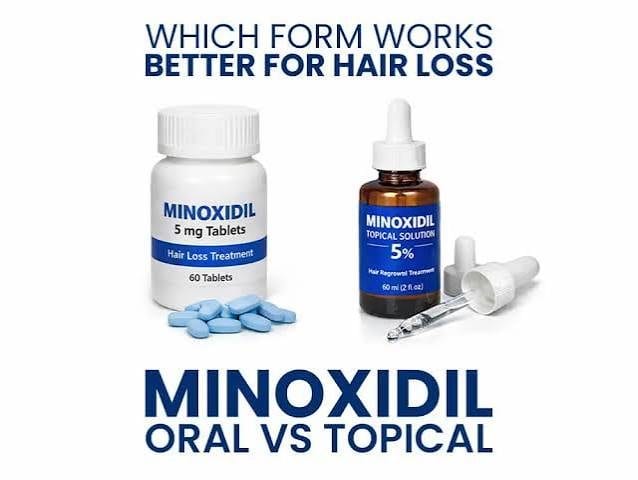
Oral or topical minoxidil: what does the randomised trial show?
Only one randomised trial has compared them head to head. After 24 weeks, 5 mg of oral minoxidil a day did not beat the topical solution (5 per cent, applied morning and evening) on the trial's primary outcome.
Only one randomised trial has compared them head to head. After 24 weeks, 5 mg of oral minoxidil a day did not beat the topical solution (5 per cent, applied morning and evening) on the trial's primary outcome. What the tablet has going for it is that people actually take it. It has not been shown to be stronger.
How was the trial designed?
The trial by Penha and colleagues was published in 2024 in the journal JAMA Dermatology. It was randomised, double-blind and placebo-controlled. Men with hereditary hair loss received either 5 mg oral minoxidil once a day or a 5 per cent minoxidil solution morning and evening. Ninety men were randomly assigned, 45 to each group, and 68 completed all 24 weeks. The primary outcome was terminal hair density.
Did the tablet work better than topical minoxidil?
No, the trial showed no clear advantage. The density difference was 3.1 terminal hairs per cm² at the front and 23.4 per cm² at the crown. Neither was significant. Only a secondary outcome, a photo assessment, gave the tablet a 24 per cent lead at the crown (interval 0 to 48), and the front was unchanged. That counts as a hint, not a finding.
The trial could not show that. At the front, the groups differed by 3.1 terminal hairs per cm² (p = 0.27). At the crown, the difference was 23.4 hairs/cm² (p = 0.09). Neither difference reached statistical significance.
One secondary outcome, an assessment of photos, gave the tablet a lead at the crown: 24 per cent, p = 0.04, but the 95 per cent confidence interval ran from 0 all the way up to 48. At the front there was no difference. A secondary endpoint whose interval reaches down to zero is a hint, not a finding.
What side effects did the two groups have?
Hypertrichosis affected 49 per cent on the tablet and 25 per cent on the solution. In addition, 14 per cent of the tablet group had headaches, while 16 per cent of the solution group had scalp eczema and 11 per cent had itching. Three participants stopped the topical treatment because of side effects, compared with one who stopped the tablet.
- Tablet group: 49 per cent developed hypertrichosis (more hair on the body and face), and 14 per cent had headaches
- Solution group: 25 per cent developed hypertrichosis, 16 per cent had scalp eczema, and 11 per cent had itching
- Side effects led three participants to stop the topical treatment, compared with one in the tablet group
What does this mean for you in practice?
The tablet has not proven superior to a product you can buy without a prescription. What the tablet solves is the hassle of applying something to your scalp every day. That very hassle is what most often makes topical treatment fail in everyday life. The case for the tablet is therefore that you actually take it, and the price is a side-effect profile that affects the whole body.
We cover dosing, safety and the consensus panel's recommendations in the main article on low-dose oral minoxidil. How tretinoin has been studied as a booster for topical minoxidil is covered in our review of the sulfotransferase studies.
Sources
- Gupta AK, et al. There Is a Positive Dose-Dependent Association between Low-Dose Oral Minoxidil and Its Efficacy for Androgenetic Alopecia. Skin Appendage Disorders, 2022. pmc.ncbi.nlm.nih.gov/articles/PMC9485924
- Vano-Galvan S, et al. Safety of low-dose oral minoxidil for hair loss: A multicenter study of 1404 patients. Journal of the American Academy of Dermatology, 2021. pubmed.ncbi.nlm.nih.gov/33639244
- Penha MA, Miot HA, Kasprzak M, Muller Ramos P. Oral minoxidil vs Topical minoxidil for Male Androgenetic Alopecia: A Randomized Clinical Trial. JAMA Dermatology, 2024. pmc.ncbi.nlm.nih.gov/articles/PMC11007651
- Akiska YM, Mirmirani P, Roseborough I, Mathes E. Low-Dose Oral minoxidil Initiation for Patients With Hair Loss: An International Modified Delphi Consensus Statement. JAMA Dermatology, 2025;161(1):87-95. pubmed.ncbi.nlm.nih.gov/39565602
This page summarises published studies. It offers general knowledge and is not a medical assessment of you. Nor is it a recommendation to start, stop or change any medicine. Prescription medicines have contraindications and can interact with other drugs, so talk it through with your doctor, who knows your conditions and the medicines you take.
Wondering what's possible for your hair?
Send three sharp photos of your hair, from the front, the top and the back. You'll get an honest answer on what can be done, roughly how many grafts it would take and what it costs.
- Free and with no obligation
- Photos are assessed by the clinic's medical team
- Replies usually within an hour in the daytime


A study tells you something about groups. Only a doctor who has seen your photos can say what applies to your hair. The medical team at the clinic at the top of our ranking offers a free assessment.
Goes to the clinic at the top of our ranking.