Red scalp after a hair transplant: when is it normal?
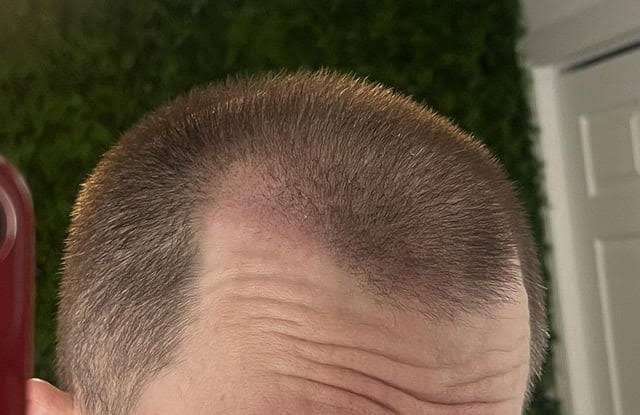
Even redness across the recipient area is normal and usually fades within a few weeks, sometimes only after a couple of months. It is a visible sign of healing: lots of tiny wounds are closing, and the area is getting extra blood.
The redness you see after the procedure comes from the many small wounds healing and the area getting more blood than usual. It usually fades within a few weeks, sometimes only after a couple of months, and fastest in people with fair skin. Redness that gets stronger, gathers in one spot or comes with warmth and pain is something else.
Why does the recipient area stay red for so long?
The holes the grafts sit in are small cuts, and the scalp responds by sending more blood to the whole area. The same reaction is what lets the grafts connect to the blood supply, so the redness shows that healing is working. It fades once the wounds have healed and the blood vessels have narrowed again.
How long does it take for the redness to fade?
In week 1 the area is clearly pink or red with scabs. For most people the redness fades within 2 to 4 weeks. For some it lasts several months. That isn't dangerous in itself, but tell your clinic, because it can be linked to inflammation of the hair follicles. It's common for some patches to return to normal before others, and it doesn't mean grafts have failed.
| Time | Usual appearance |
|---|---|
| Week 1 | Clearly pink or red skin, with scabs |
| Weeks 2 to 4 | The scabs are gone, and for most people the redness fades |
| Months 2 to 4 | For some the redness is still there. Tell your clinic |
| Later | Some people, especially those with fair skin, keep a faint pink tinge for a while |
The colour almost never fades evenly across the whole area. One patch can look normal long before another, and that doesn't mean grafts have failed.
What makes redness last longer?
Four things: fair skin, where the colour difference simply shows more, large high-density sessions, sun, which can make redness last and discolouration darken, and picking or other irritation of the recipient area.
- Fair skin, where the contrast is easier to see
- Many grafts placed densely
- Sun, which can make redness last and discolouration darker
- Picking, rubbing or other irritation
When should you call your clinic about redness?
Look at the direction. Redness that keeps getting weaker is healing, while redness that increases after the first few days is a warning. Contact your clinic if the redness is increasing, if it gathers around individual grafts with pus or a bump, if you feel warmth, clear tenderness or see the edge spreading, or if you get a fever, because it may be infection or folliculitis.
What counts is which way it's going. If the redness is gradually getting weaker, you're healing. If it gets stronger after the first few days, you're not.
- The redness is increasing rather than fading
- It gathers around individual grafts, and you see pus or a small bump
- The skin is warm, clearly tender, or the red edge is spreading outwards
- You get a fever as well as any of these
Signs like these can mean infection or folliculitis. Both can be treated, and the earlier the better.
How redness fits into the rest of healing is covered in the aftercare guide.
Sources
- Romera de Blas C, Vega Díez D, Ricart Vayá JM, Gómez Zubiaur A. Complications in follicular unit excision hair transplantation: current evidence and practical approaches. Frontiers in Medicine, 2026;13:1750989. pubmed.ncbi.nlm.nih.gov/41709896
- Zhang J, Zhao Y, Zhang J, Zhou Y, Yi Y, Lei R, et al. Risk Factors and Hazards of Recipient-Area Perifollicular Erythema After Hair Transplantation: A Multicenter Retrospective Cohort Study. Aesthetic Plastic Surgery, 2024;48(15):2771-2777. pubmed.ncbi.nlm.nih.gov/38849551
- Davis EC, Callender VD. Postinflammatory hyperpigmentation: a review of the epidemiology, clinical features, and treatment options in skin of color. The Journal of Clinical and Aesthetic Dermatology, 2010;3(7):20-31. pubmed.ncbi.nlm.nih.gov/20725554
This text brings together findings from published research and standard clinical practice. It is general information and not medical advice. The instructions from the team that operated on you come first. If they tell you something different from what is written here, follow their advice.
Wondering what's possible for your hair?
Send three sharp photos of your hair, from the front, the top and the back. You'll get an honest answer on what can be done, roughly how many grafts it would take and what it costs.
- Free and with no obligation
- Photos are assessed by the clinic's medical team
- Replies usually within an hour in the daytime


A study tells you something about groups. Only a doctor who has seen your photos can say what applies to your hair. The medical team at the clinic at the top of our ranking offers a free assessment.
Goes to the clinic at the top of our ranking.