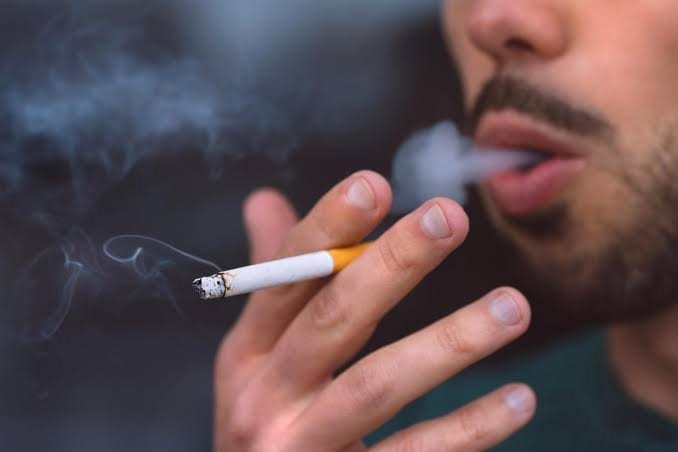
Does smoking affect a hair transplant? Why smokers heal more slowly
Yes. Smoking slows wound healing in two well-known ways. Nicotine constricts the small blood vessels, and carbon monoxide reduces the blood's ability to carry oxygen.
Smoking slows wound healing in two well-known ways. Nicotine constricts the small blood vessels, and carbon monoxide reduces the blood's ability to carry oxygen. Both hit the blood supply a fresh graft depends on completely, which is why clinics ask you to stop smoking around the procedure.
How does smoking reduce the oxygen reaching the grafts?
A graft has no blood supply of its own until the scalp has grown new vessels into it. For the first few days it lives entirely on oxygen and nutrients that seep in from the surrounding tissue. Nicotine constricts exactly those small vessels, and carbon monoxide binds to haemoglobin and pushes out oxygen. Together they mean less oxygen where the graft needs it.
Why do you need to stop before the procedure?
If you only stop after the operation, you've missed the very period when the channels are made and the grafts are placed. That's why the clinic will usually want you to stop smoking on both sides of the procedure, though how many weeks varies from surgeon to surgeon. Ask for the clinic's own figures, and be honest about how much you smoke so they can make a realistic plan.
What does smoking mean for the donor area and scarring?
Slower closure of the holes in both areas, more visible scars, more infection, folliculitis and scabs, and probably lower graft yield. Damage to the donor area cannot be undone. Most of this is based on surgery in general, because no good studies in hair transplant patients have quantified the effect.
After FUE, the back of the head is covered in hundreds, often thousands, of tiny holes through the full thickness of the skin, and each one has to close into a scar on its own. After FUT, there is a long wound line that has to heal while the skin is under tension. All of this happens at once, so poorer healing affects the whole area. Damage to the donor area also cannot be undone, whereas a poor result at the front can sometimes be corrected.
Several things point to smoking, but they are not equally well documented:
- Slower closure of both donor and recipient sites, as seen in surgery generally.
- More visible scars. When healing is slower and more inflamed, the strip scar can widen or the dots become more visible.
- Infection, folliculitis and scabs that last longer, because both the immune system and the blood supply are weakened.
- Lower graft yield. It's a reasonable explanation, but no good studies in hair transplant patients have put a number on it.
- Tissue death in the recipient area in large, dense sessions, where smoking is on the list of known contributing factors alongside high density and previous scarring.
It is well documented that smoking impairs wound healing after surgery in general. How much it reduces graft survival in hair transplants, however, has no clear figure in the literature.
Are snus, e-cigarettes and nicotine patches a safe alternative?
A nicotine patch is far better than cigarettes, but ask your surgeon before using any nicotine product. Most of the harm comes from the smoke, and when smokers were given nicotine patches while quitting, they had no more wound infections than those given placebo patches. There is little research on e-cigarettes and snus around surgery, so let your team decide.
Can hyperbaric oxygen or growth factors make a large plan safe for a smoker?
No. No add-on treatment, whether hyperbaric oxygen, growth factors or anything else, has been documented to neutralise the effect of smoking on a hair transplant. If you smoke and have been offered a large plan, the answer is to scale it down, take a lower percentage from the donor area and build in a smoke-free period.
There's a typical way to get this wrong. If a clinic offers an add-on treatment, such as hyperbaric oxygen or growth factors, so that a smoker can have a plan that is really too large, it's the plan that is wrong. No study has shown that such an add-on makes up for smoking in a hair transplant. The offer puts the risk on you and, at the same time, removes the motivation for the only change that truly helps.
What a smoker with a large plan needs is fewer grafts, a lower extraction percentage and smoke-free weeks. Not an extra bill.
What if you can't stop smoking before the operation?
Be honest at the consultation. The surgeon can then make a more cautious plan with lower density, and your expectations can be adjusted. If the surgeon only hears what you think he wants to hear, you're the one who bears the consequences.
Be upfront about it. If the surgeon knows you're going to smoke, the plan, the density and the expectations can be adjusted, both at the front and in the extraction at the back. If the surgeon only hears what you think he wants to hear, you're the one who pays the price.
What do we know about smoking and wound healing from surgery in general?
Surgeons have long known that smokers' wounds heal less well. That applies both to infections and to wound edges that reopen. The finding doesn't come from hair transplants specifically, but the mechanism weighs especially heavily in a procedure where the whole result depends on new, fine vessels reaching the grafts.
Ask the clinic for its own timelines, and read them alongside the aftercare advice.
Sources
- Sørensen LT. Wound healing and infection in surgery. The clinical impact of smoking and smoking cessation: a systematic review and meta-analysis. Archives of Surgery, 2012;147(4):373-383. pubmed.ncbi.nlm.nih.gov/22508785
- Guo S, DiPietro LA. Factors affecting wound healing. Journal of Dental Research, 2010;89(3):219-229. pubmed.ncbi.nlm.nih.gov/20139336
- Sørensen LT. Wound healing and infection in surgery: the pathophysiological impact of smoking, smoking cessation, and nicotine replacement therapy: a systematic review. Annals of Surgery, 2012;255(6):1069-1079. pubmed.ncbi.nlm.nih.gov/22566015
- Sørensen LT, Karlsmark T, Gottrup F. Abstinence from smoking reduces incisional wound infection: a randomized controlled trial. Annals of Surgery, 2003;238(1):1-5. pubmed.ncbi.nlm.nih.gov/12832959
- Romera de Blas C, Vega Díez D, Ricart Vayá JM, Gómez Zubiaur A. Complications in follicular unit excision hair transplantation: current evidence and practical approaches. Frontiers in Medicine, 2026;13:1750989. pubmed.ncbi.nlm.nih.gov/41709896
- Kerure AS, Patwardhan N. Complications in Hair Transplantation. Journal of Cutaneous and Aesthetic Surgery, 2018;11(4):182-189. pubmed.ncbi.nlm.nih.gov/30886471
- Parsley WM, Perez-Meza D. Review of factors affecting the growth and survival of follicular graft. Journal of Cutaneous and Aesthetic Surgery, 2010;3(2). jcasonline.com
- Thom SR. Hyperbaric oxygen: its mechanisms and efficacy. Plastic and Reconstructive Surgery, 2011;127 Suppl 1:131S-141S. pubmed.ncbi.nlm.nih.gov/21200283
- Rassman WR, Bernstein RM, McClellan R, Jones R, Worton E, Uyttendaele H. Follicular unit extraction: minimally invasive surgery for hair transplantation. Dermatologic Surgery, 2002;28(8):720-728. pubmed.ncbi.nlm.nih.gov/12174065
This article summarises published studies and standard clinical practice. It is general information, not medical advice. The instructions from your own surgical team always come first, including where they differ from what is written here.
Wondering what's possible for your hair?
Send three sharp photos of your hair, from the front, the top and the back. You'll get an honest answer on what can be done, roughly how many grafts it would take and what it costs.
- Free and with no obligation
- Photos are assessed by the clinic's medical team
- Replies usually within an hour in the daytime


A study tells you something about groups. Only a doctor who has seen your photos can say what applies to your hair. The medical team at the clinic at the top of our ranking offers a free assessment.
Goes to the clinic at the top of our ranking.