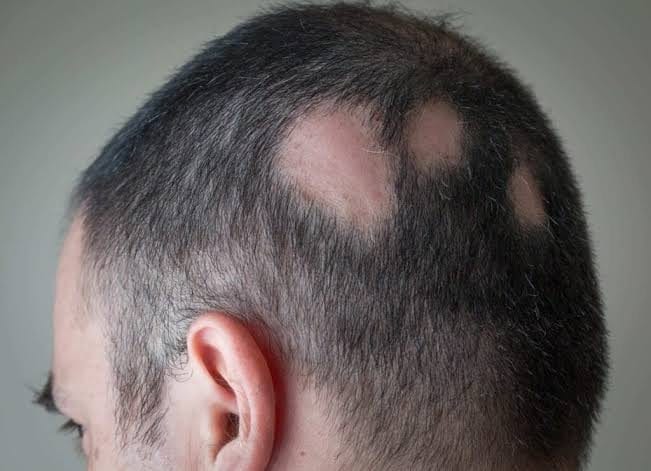
Steroid injections for alopecia areata: when do they help?
Injecting corticosteroid straight into bald patches is one of the oldest first-line options for limited alopecia areata. Against hereditary hair loss, they do nothing.
For limited patchy hair loss (alopecia areata), corticosteroid injected into the patches is a long-established first-line treatment. The steroid calms the immune reaction that is attacking the hair follicles at that exact spot. It has no place in hereditary hair loss, where the mechanism is completely different.
What is alopecia areata, and how does it differ from hereditary hair loss?
Patchy hair loss, or alopecia areata, is an autoimmune disease: the body's own immune system attacks the hair follicles. The result is sharply defined bald patches, and in some people it spreads to all the hair on the scalp or body. It's a different disease from hereditary hair loss and responds to different treatments. The hair follicles aren't destroyed, so the hair can grow back.
How are the steroid injections given?
The doctor injects corticosteroid directly into the skin of each patch, often with several injections per patch, and repeats the treatment after a few weeks. The method works best when the disease is limited to a few patches, not when large areas are affected. If new growth comes, it usually shows one to two months later.
- Several small steroid injections into each bald patch
- A new round every few weeks
- Works best with a few, well-defined patches
- If the hair grows back, you'll usually see it after one to two months
What are the limitations?
When large parts of the scalp are affected, it simply takes too many injections. Repeated injections can thin the skin at the site. The treatment deals with the patches you have now, not the disease itself, so new patches can appear. The injections are uncomfortable, and because patchy hair loss often clears up by itself, it's hard to know what was down to the treatment.
- Large areas: with widespread disease, the area is too big to treat injection by injection
- Thinner skin: repeated use can leave small, visible dents where the steroid was injected
- No protection against new flare-ups. The existing patches are treated. The underlying disease remains.
- Uncomfortable: lots of injections in the scalp hurt
- Hard to interpret: many people improve without treatment, so it's unclear how much the injections contributed
Can you have a hair transplant with patchy hair loss?
Usually not while the disease is active. If you move healthy hair follicles into a scalp where the immune system is attacking follicles, you move them straight into the attack. Surgery is only considered when the disease has demonstrably stayed quiet for a long time, and even then with great caution. For widespread disease, or disease that doesn't respond to treatment, tablets such as JAK inhibitors have opened up new options.
Hereditary hair loss, a completely different condition, is explained on the page about causes of hair loss.
Sources
- Spindler A, Maas D, Zappi I, Brinks A, Kearney CA, Nohria A, et al.. Alopecia areata: Emerging therapies and up-to-date management strategies. Journal of the American Academy of Dermatology, 2026 (ahead of print). pubmed.ncbi.nlm.nih.gov/42607954
- Ariya-Atthaya P, Pureesrisak P, Meephansan J, Charoensuksira S, Sirithanabadeekul P, Thanasarnaksorn W, et al.. Localized corticosteroid delivery in alopecia areata using microneedle patch technology. Archives of Dermatological Research, 2025;317(1):804. pubmed.ncbi.nlm.nih.gov/40488775
- King B, Ohyama M, Kwon O, Zlotogorski A, Ko J, Mesinkovska NA, et al.. Two Phase 3 Trials of Baricitinib for Alopecia Areata. New England Journal of Medicine, 2022;386(18):1687-1699. pubmed.ncbi.nlm.nih.gov/35334197
- Civaş E, Aksoy B, Aksoy HM, Eski M, Yucel K. Hair transplantation for therapy-resistant alopecia areata of the eyebrows: is it the right choice? Journal of Dermatology, 2010;37(9):823-826. pubmed.ncbi.nlm.nih.gov/20883369
This page summarises published research as general information. It is not medical advice and not a recommendation to start, stop or change any medicine. Prescription medicines have contraindications and can interact with other medicines, so discuss them with your doctor, who knows your medical history.
Wondering what's possible for your hair?
Send three sharp photos of your hair, from the front, the top and the back. You'll get an honest answer on what can be done, roughly how many grafts it would take and what it costs.
- Free and with no obligation
- Photos are assessed by the clinic's medical team
- Replies usually within an hour in the daytime


A study tells you something about groups. Only a doctor who has seen your photos can say what applies to your hair. The medical team at the clinic at the top of our ranking offers a free assessment.
Goes to the clinic at the top of our ranking.