PRP and exosomes after a hair transplant: worth the add-on?
The clinic offers a "growth boost" after surgery. Before you say yes, here's what we know about PRP and exosomes, and what we don't.
Do you need PRP or exosomes to get a good result?
No. Neither has been shown to be necessary for a transplant to succeed. PRP has promising but moderate evidence. For exosomes, the research is even thinner. At best they're small boosters. The foundation is something else.
What decides your result is the surgeon's technique, how many grafts survive, and how well you follow the aftercare. No injection can rescue an operation that was done badly.
What are they actually supposed to do?
Both PRP and exosomes carry growth factors, signalling substances that help steer healing and growth. The idea is that injections into the scalp around the time of surgery will help the skin heal faster, help the new grafts survive and give the existing hair around them a little extra strength.
Some clinics include it in the package. Others sell it as an add-on. It's usually given around the time of the procedure and in the months when the hair starts to grow.
What's the difference between PRP and exosomes?
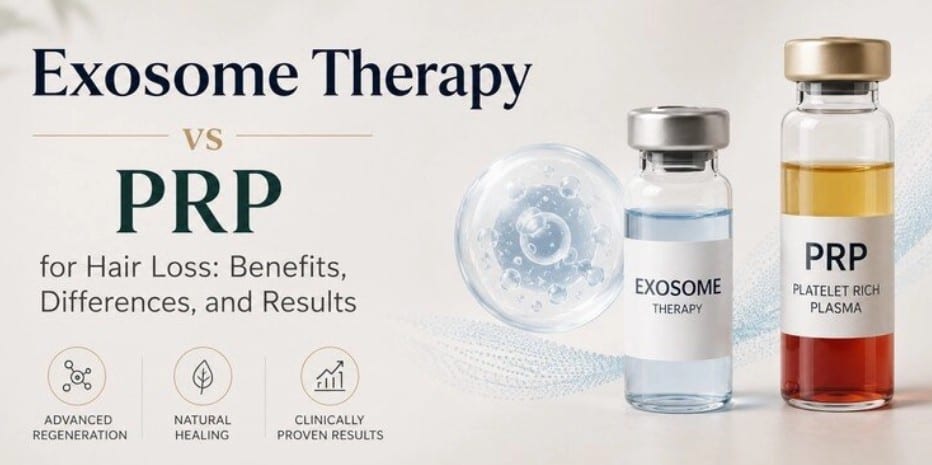
PRP stands for platelet-rich plasma and is made from your own blood. The blood is spun in a centrifuge so the platelets, and the growth factors they hold, are gathered in a concentrated fluid. Because it comes from you, the risk is low and the method is well established. Read more about PRP and PRF.
Exosomes are much newer. They're tiny vesicles that cells use to send signalling substances, and they're often taken from stem cells. They're marketed as the next generation, but they're less standardised, cost more, and their regulatory status is unclear in many countries. There's more on this in the article on exosome treatment.
What does the research show so far?
For PRP, several studies point to better hair density and healing, but the protocols vary a lot from study to study, and so do the results. The evidence is promising and moderate, not strong.
For exosomes, it's early days. Much of it rests on theory and a few small trials, and solid clinical data are missing. What you can say with reasonable confidence is that PRP may help a little, and that nobody knows how much exosomes do.
Are PRP and exosomes safe?
The two aren't on equal footing. PRP is made from your blood, so the risk is low and its use is well established. Exosomes are a newer and less uniform product. Rules and safety requirements differ from country to country, and in some places they aren't approved for this use at all.
If a clinic sells expensive exosomes as something you "must" have, be extra critical. Ask where the product comes from, whether it's approved, and what evidence exists. It may be more business than medicine.
When should you say yes, and when should you say no?
Say yes only if you've decided in advance, knowing the price and the evidence. Ask the clinic what the add-on costs, which studies it's based on and how much experience they have with it themselves. The quality factors that matter most should be in place first.
Say no if the offer turns up on the day of surgery. By then you're sitting in the chair, perhaps already under local anaesthetic, and in a poor position to negotiate or think clearly. A reputable clinic doesn't push choices like this on you at that moment.
What should you do now?
If you have surgery coming up, email the clinic a question today: is PRP or exosome treatment included in the price, what does it cost otherwise, and what evidence do you base it on? Decide based on the answer, at home. And follow the aftercare carefully whatever you choose, because it matters more than any add-on.
Good aftercare starts with a good plan. The medical team at the clinic at the top of our ranking will go through the whole process with you before you decide.
Goes to the clinic at the top of our ranking.