Hyperbaric oxygen after a hair transplant: what does HBOT get you?
The clinic offers a hyperbaric chamber as an add-on. We look at what pressurised oxygen does to fresh grafts, what the studies have actually measured, and when the money does more good elsewhere.
Should you pay extra for a hyperbaric chamber after your hair transplant?

Maybe, but know what you're buying. Hyperbaric oxygen therapy, usually just called HBOT, seems to make the first two weeks easier: less redness, less pain, better sleep. No study has yet shown that it leaves you with more surviving grafts and denser hair a year later.
The offer tends to turn up in the clinic's package, next to PRP and saline spray, as a "boost" meant to improve the result. Sometimes it's a reasonable extra. Other times it's decoration to make the package look exclusive. The difference lies in who you are, how big your session is, and what the clinic promises.
We go through what the chamber actually does, what the research has found, and how to judge whether it's worth the money for you in particular. The aim is neither to dismiss the treatment nor to sell it to you.
What happens in a hyperbaric chamber?
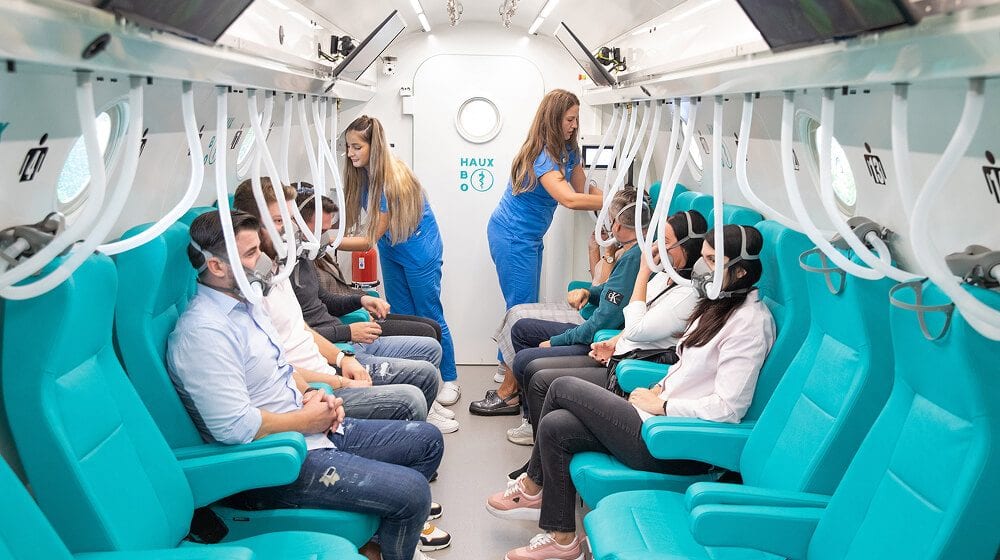
You lie or sit in a closed chamber where the pressure is higher than normal air pressure, and you breathe pure oxygen, that is, 100 % oxygen. Under pressure, the oxygen dissolves directly into the blood plasma instead of only binding to red blood cells. Your blood therefore carries far more oxygen, and tissue with a poor blood supply gets more to work with.
The treatment wasn't invented for hair clinics. Hospitals have long used it for decompression sickness and carbon monoxide poisoning, and for wounds that won't heal in people with diabetes. Some infections are also treated this way. It's well-documented medicine. The only new thing is that it's now marketed as an aid for grafts and for faster healing after a transplant.
Why would extra oxygen help newly implanted grafts?
Because a graft has no blood supply of its own for the first few days. When the follicle is removed from the donor area, its connection to the blood vessels is cut. In the recipient area it survives for a while on the oxygen and nutrients it picks up from the surrounding tissue. The technical term is imbibition. Only after roughly 24 to 72 hours has the body formed new capillaries that reach it, and the graft is connected again. This is called revascularisation.
This window is when the graft is most vulnerable. The idea behind HBOT is simple: saturate the surrounding tissue with extra oxygen right then, so more grafts make it until the new vessels work. It makes biological sense, and that's why the idea deserves to be taken seriously. But a mechanism that sounds sensible is not the same as an effect someone has measured.
What have the studies actually found?
They show a clear benefit in the early recovery and nothing certain about the final result. The research field is young. For crusting, red skin and discomfort we now have numbers to go on. On whether more grafts survive, the answer is missing.
The largest study so far is a prospective observational study of 220 men. The patients were enrolled between April 2025 and June 2026, and all were operated on by the same surgeon, with the same technique, the same medication and the same aftercare. That set-up is what makes the study interesting. On day 11 the patients rated their own pain, sleep and redness, and how the wound was healing. In parallel, a team of doctors with no connection to the operations looked at standardised photos from day 10, blinded to who had received the treatment.
The two measurements pointed the same way and were close to each other. The blinded team scored healing at 5.3 out of 10 in those who didn't have HBOT. With one session the average was 8.6, with two sessions 9.7. The patients themselves noticed it most in their sleep during the first nights.
Keep one caveat in mind. The patients chose their group themselves and weren't randomly assigned. The study therefore shows a strong association, not that the chamber is the cause. Two smaller pieces of work still point in the same direction. A randomised study by Fan and colleagues found that fewer people lost hair early on and that folliculitis was less common. In a case series of five patients, the scabs had come off within three to five days.
Knowledge has grown in recent years. If someone promises you a guaranteed and dramatically better final result thanks to HBOT, they're stretching the research further than it goes. What the data supports, ever more clearly, is two easier weeks.
What can HBOT realistically do for you?
- More oxygen while the grafts are vulnerable. The most likely benefit, in the hours before the new blood vessels have grown in.
- Faster wound healing. HBOT has a well-documented effect on wounds in general. That may mean fewer scabs and cleaner healing in both the donor and the recipient area.
- Calmer skin and less pain. This is where the evidence is strongest. In the cohort of 220 patients, redness faded faster and pain was lower. Sleep improved most of all during the first nights.
- The biggest theoretical gain in large sessions. When a great many grafts are packed densely over a large area, the oxygen supply is under extra pressure.
- A logical rationale for smokers and people with poor circulation. Where the tissue is already poorly supplied, extra oxygen makes sense. By far the best step for a smoker is still to quit.
Notice what the list is about. Most of it concerns healing and comfort, not ending up with significantly more surviving grafts. That distinction is exactly what marketing tends to blur.
What are the downsides of HBOT?
- The price. The price per session depends on the pressure, the type of chamber and the provider, and is roughly between 200 and 600 euros depending on the country. Several sessions come on top of the operation itself. That's money that could do more good elsewhere.
- The time. A session usually lasts 60 to 90 minutes, and you'll often need several. That takes up a lot of time in the days right after the procedure, when you already have enough to think about.
- You're paying for comfort, not for a result proven to be better. The data on the first weeks stands up. A study designed to measure hair density a year after the procedure doesn't exist yet.
- Side effects. Most people tolerate HBOT well. The pressure changes can still cause ear problems (barotrauma), temporary short-sightedness and, rarely, oxygen toxicity. Some lung diseases rule out the treatment.
- Risk of upselling. Now and then HBOT is added to a package to make it look more exclusive, at a price out of proportion to what you get.
How does HBOT compare with other add-ons clinics sell?
Weaker than the advertising suggests, and stronger than many sceptics think. All the add-ons compete for the same kroner in your budget, so it helps to see them side by side.
| Add-on | What it's meant to do | How strong the evidence is | Typical price level |
|---|---|---|---|
| Hyperbaric oxygen (HBOT) | More oxygen, better healing | Good for the first weeks, unresolved for graft survival | High |
| PRP | Growth factors, healing | Moderate | Medium |
| LLLT (red light) | Stimulate the follicles | Weak to moderate | Medium (one-off purchase) |
| Thorough aftercare | Get the grafts through the first days | Solid, based on practice | Free |
The measure that protects the grafts best is at the bottom and costs nothing. Follow the aftercare instructions, skip smoking and alcohol, and look after your scalp in the first days. Only once that's in place is there any point in considering add-ons you pay for.
Who has the most to gain from a hyperbaric chamber?
In theory, three groups stand out. The first is people getting a very large number of densely packed grafts, where oxygen runs short. The second is patients with reduced circulation, for example some people with diabetes. The third is patients having repeat surgery in an area with scarring and poor tissue. For a healthy person with an ordinary session, the extra benefit is probably small.
Picture two patients. One needs around 4,500 grafts spread over the front and crown, and wonders whether to buy a course of chamber sessions costing somewhere between 200 and 600 euros each. An honest answer is that there's a theoretical advantage when so many grafts are packed densely over a large area, and that he can choose to pay for it. Nobody can guarantee him that the result will be decisively different.
The other is a healthy non-smoker who needs 2,000 grafts. He'll probably get a very good result without a chamber. The money does more for him if it goes on medical maintenance of the hair he has left, because that protects the whole head over time. So the answer is personal. A clinic that sells the same expensive add-on to everyone isn't giving you individual advice.
What matters more for the grafts than any chamber?
The surgeon and the technique. What really determines how many grafts survive is far less spectacular: gentle extraction, a short time outside the body, grafts placed at the correct angle and depth, and you following the aftercare carefully. A skilled surgeon with good technique does more for your grafts than a hyperbaric chamber ever can.
If the clinic has the basics right, the chamber can add a sensible extra margin in special cases. But be wary if the chamber is the clinic's big selling point while it stays unclear who is standing at the operating table. Then the add-on is being used to draw your eye away from what counts. It's worth looking through the warning signs at a clinic before you decide.
If you want to give your grafts better odds without paying anything, the advice is well documented. Don't smoke before and after the operation, leave alcohol alone in the first phase, and follow the instructions you're given to take home. That moves the needle more than most extras.
Questions people often ask about HBOT and hair transplants
Do I need HBOT to get a good result? No. The vast majority of procedures worldwide are done without a hyperbaric chamber, with very good results. It's a possible add-on, never a requirement. Don't let anyone convince you otherwise.
How many sessions are we talking about? It varies from clinic to clinic. The usual pattern is several sessions spread over the days before and after the procedure, each taking 60 to 90 minutes. Factor in both the time and the cost from the start if you're considering it.
Can everyone have the treatment? No. Certain lung diseases, an untreated pneumothorax (air between the lung and the chest wall) and some ear problems rule out HBOT, and the treatment should always take place under professional supervision. That's another reason it's more than a harmless extra you tack on without thinking.
What would be a sensible choice? With an ordinary session and good circulation, it makes most sense to spend the budget on a very good surgeon and to be disciplined about aftercare. In large and complicated cases, the chamber can be an extra margin. It never replaces what actually makes the difference.
What should you do before saying yes to the package?
Ask the clinic straight out: what do you promise HBOT will do, and which study are you basing that on? A credible answer is about healing and comfort in the first weeks. An answer about guaranteed denser hair is a reason to ask more questions. Also ask who extracts and implants the grafts, and work out what the sessions will cost you in time and money.
If you're in one of the groups with the most to gain, raise it with the surgeon and decide based on your own situation, not a brochure. Unsure how many grafts you actually need? Start with a free hair analysis, and you'll know whether you belong in the large or the moderate group.
This article is general information and does not replace a medical assessment of you.
Good aftercare starts with a good plan. The medical team at the clinic at the top of our ranking will go through the whole process with you before you decide.
Goes to the clinic at the top of our ranking.