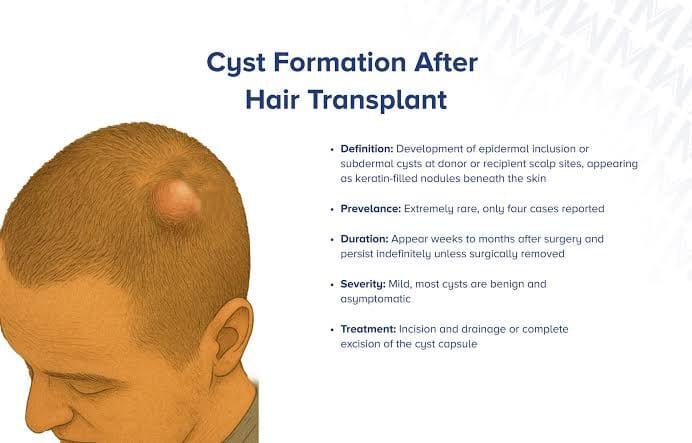
Are cysts after a hair transplant dangerous?
Small cysts where the grafts sit are a known side effect and usually harmless. They tend to appear weeks later as small, hard bumps. Either a hair hasn't made it out, or a bit of tissue sits too deep.
Small cysts where the grafts sit are a known side effect of the procedure and usually harmless. They tend to appear weeks later as small, hard bumps. Either a hair hasn't made it out, or a bit of tissue sits too deep. Most go away on their own or after simple treatment at the clinic.
What is a cyst in the recipient area?
A small, closed pocket in the skin. Often it's a new hair that can't get out and curls up under the surface. Other times a tiny remnant of graft tissue sits too deep. You feel it as a firm bump a few millimetres across, sometimes tender.
When do cysts appear?
Usually after a few weeks, around the time the hair starts growing again. Scabs and swelling belong to the first two weeks, cysts come later. Some people get one or two, others a whole cluster, and if you have many, contact your clinic as soon as you can.
How are they treated?
Often watching them is enough, because many go away once the trapped hair finds its way out. The clinic may suggest warm compresses, have a healthcare professional drain a cyst that won't settle or bothers you, and treat inflammation if the cyst has become inflamed.
- Wait and see. Many clear up once the trapped hair gets out.
- Warm compresses can help, if your clinic recommends them.
- Draining by a healthcare professional is an option when a cyst persists or is bothersome.
- Anti-inflammatory treatment is needed if the cyst has become inflamed.
What should you avoid?
Don't squeeze, prick or pick at the cyst. The recipient area is full of fresh follicles, so pressure can damage them, cause infection and leave a mark that lasts longer than the cyst. If it grows, becomes warm or painful, or you get a fever, get in touch straight away.
Cysts are not common. What is normal during recovery is covered under aftercare.
Sources
- Romera de Blas C, Vega Díez D, Ricart Vayá JM, Gómez Zubiaur A. Complications in follicular unit excision hair transplantation: current evidence and practical approaches. Frontiers in Medicine, 2026;13:1750989. pubmed.ncbi.nlm.nih.gov/41709896
- Kerure AS, Patwardhan N. Complications in Hair Transplantation. Journal of Cutaneous and Aesthetic Surgery, 2018;11(4):182-189. pubmed.ncbi.nlm.nih.gov/30886471
This article brings together findings from published research and standard clinical practice. It is general information, not medical advice. The instructions from the team that operated on you come first. If they say something different from what you read here, follow their advice.
Wondering what's possible for your hair?
Send three sharp photos of your hair, from the front, the top and the back. You'll get an honest answer on what can be done, roughly how many grafts it would take and what it costs.
- Free and with no obligation
- Photos are assessed by the clinic's medical team
- Replies usually within an hour in the daytime


A study tells you something about groups. Only a doctor who has seen your photos can say what applies to your hair. The medical team at the clinic at the top of our ranking offers a free assessment.
Goes to the clinic at the top of our ranking.