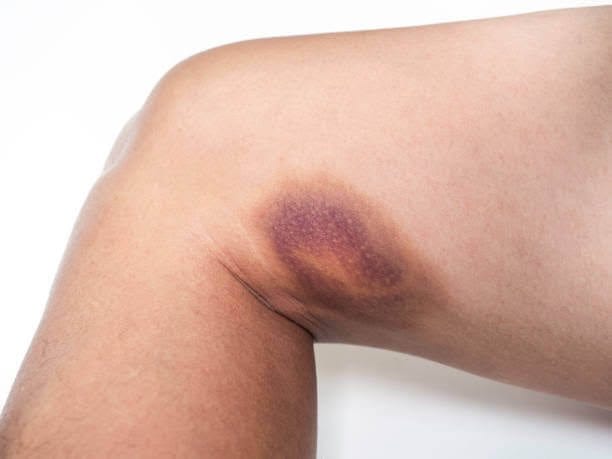
Haematoma after a hair transplant: how to spot it and get help
A haematoma is blood that has collected under the skin. It is rare after a hair transplant, but it is a well-known complication.
A haematoma is blood that has collected under the skin. It is rare after a hair transplant, but it is a well-known complication. Small collections go away on their own, while large ones have to be drained. It pays to know the difference between a haematoma and ordinary swelling.
What exactly is a haematoma, and where does it form?
A haematoma is blood that has settled in a pocket under the skin and stayed there, rather than spreading out through the tissue. The donor area is the most common site, and the risk is highest after strip surgery (FUT), where the surgeon closes a longer incision, but it can appear elsewhere too. The complication is rare, and if you know the signs, it means a quick call to the clinic instead of a frightening evening.
How can you tell a haematoma from ordinary swelling?
If you feel a hard, distinct lump, it is more likely to be a haematoma. Ordinary swelling is soft and diffuse. A haematoma tends to sit on one side rather than both, becomes steadily more painful, gets bigger instead of shrinking after ordinary swelling has peaked around day two to four, and the skin over it is blue or discoloured.
- Hard, not soft. Normal swelling after surgery is diffuse and soft. A haematoma is a lump with clear edges.
- Localised, not spread out.
- Often one-sided, whereas ordinary swelling is the same on both sides.
- Painful, and often worse each day.
- Growing, when ordinary swelling should be easing after day two to four.
- Blue or discoloured skin over the area.
How is a haematoma treated after a hair transplant?
A small haematoma is usually just monitored, and the body breaks it down over a few days or weeks. A large or growing haematoma is drained by a health professional, because if it is left, it can press on the tissue and become infected. The clinic may also apply a compression bandage and review blood-thinning medicines with the doctor who prescribed them, and all of this is done by professionals, not by you at home.
- A small haematoma is usually just monitored, and the body reabsorbs it over days or weeks.
- A large or growing haematoma is drained by a health professional. Left alone, it can press on the tissue and become infected.
- A compression bandage may be applied.
- Blood-thinning medicines are reviewed together with the doctor who prescribed them.
This is where the clinic should take over. Don't try to deal with it yourself at home.
What can you do to avoid a haematoma?
Tell the clinic about all medicines and supplements that can increase bleeding, and never stop a prescribed blood thinner without the go-ahead from your doctor. Stick to the advice on alcohol and strenuous physical activity for the first few days, make sure your blood pressure is under control if it is high, and call promptly if you get a hard swelling on one side that is growing.
- Give the clinic a full overview of your medicines and supplements, especially anything that can cause bleeding
- Never stop a prescribed blood thinner unless the doctor who prescribed it has said yes
- Follow the advice on alcohol and hard exercise for the first few days
- If you have high blood pressure, make sure it is well controlled
- Get in touch straight away if a hard swelling on one side gets bigger
What a normal recovery looks like, day by day, is set out in the aftercare guide.
Sources and caveats
- Kerure AS, Patwardhan N. Complications in Hair Transplantation. Journal of Cutaneous and Aesthetic Surgery, 2018;11(4):182-189. pubmed.ncbi.nlm.nih.gov/30886471
- Romera de Blas C, Vega Díez D, Ricart Vayá JM, Gómez Zubiaur A. Complications in follicular unit excision hair transplantation: current evidence and practical approaches. Frontiers in Medicine, 2026;13:1750989. pubmed.ncbi.nlm.nih.gov/41709896
This article is based on published research and standard clinical practice. It is general information, not medical advice. Instructions from your own surgical team come first: if they tell you something different from what you read here, follow them.
Wondering what's possible for your hair?
Send three sharp photos of your hair, from the front, the top and the back. You'll get an honest answer on what can be done, roughly how many grafts it would take and what it costs.
- Free and with no obligation
- Photos are assessed by the clinic's medical team
- Replies usually within an hour in the daytime


A study tells you something about groups. Only a doctor who has seen your photos can say what applies to your hair. The medical team at the clinic at the top of our ranking offers a free assessment.
Goes to the clinic at the top of our ranking.