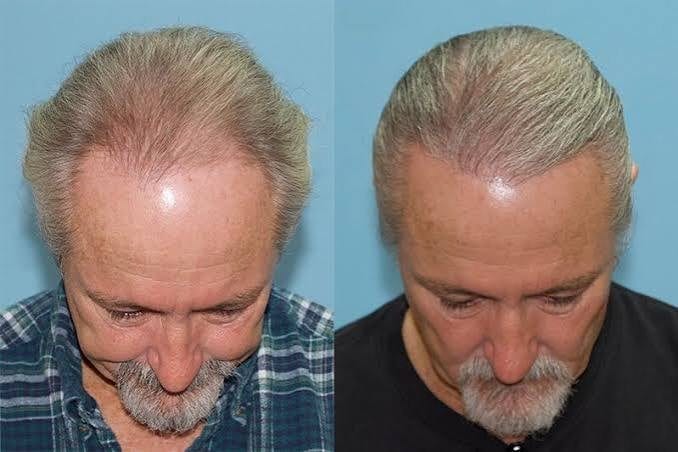
Does transplanted hair go grey? How grafts turn grey
Grafts go grey on the schedule they had at the back of the head, because colour is controlled by the follicle itself.
Grafts go grey on the same schedule as the hair at the back of the head, because colour is determined by the follicle itself. For most people this means the transplanted area turns grey at roughly the same time as the sides and back, and it looks natural.
Why do grafts go grey in step with the donor area and not where they're implanted?
Because colour belongs to the follicle, not the surrounding skin. Pigment cells in the hair bulb produce the colouring, and as they become fewer, the hair goes grey. A transplant moves the whole follicle, so its schedule comes too. If the follicle was set to turn grey at fifty, it will, wherever it is placed.
A hair's colour is decided in the follicle, not in the surrounding skin. Pigment cells deep in the hair bulb make the colouring. As they become fewer over the years, the hair turns first grey and then white.
A transplant moves the follicle as a whole, and it brings its own clock with it. If it comes from an area at the nape that was going to turn grey at fifty, it turns grey at fifty, even when it sits at the front of the head.
The same principle applies to thickness, curl and how long the hair grows before it falls out. The donor follicle's characteristics move with it, and that is the whole basis for why the procedure works.
Do grafts go grey earlier or later than the rest of your hair?
Usually neither. The hair at the back and the front of the head generally greys at about the same time, so hair moved from one place on the head to another turns grey at the same time and looks natural. The exception is grafts from the beard or body. In the same person, beard and scalp hair often go grey at different times, which is one reason to place beard hair behind the visible front.
For most people it happens without anyone noticing. The donor area and the front usually follow roughly the same schedule anyway.
The transplanted area turns grey at about the same time as the sides and back. That's how most people's hair greys, which is why the result still looks like perfectly ordinary hair.
Visible differences arise in two cases:
- Beard grafts. In many people the beard greys at a different pace from the hair on the head. If your beard went grey early but your hair didn't, beard hair placed on the crown can turn grey before the hair around it. That's one reason beard hair should go behind the front, where it shows less.
- Body hair grafts, for the same reason.
Does a transplant look fuller or thinner once your hair goes grey?
Usually fuller. A scalp looks bare because dark hair contrasts with lighter skin. As hair greys, the contrast falls, and the same number of hairs looks denser. The same effect makes scars in the donor area less visible, and partly makes up for the hair of your own you lose over time.
Grey hair makes a thin or medium-density result look better, which is good to know.
We perceive a scalp as bare when dark hairs sit against pale skin. When hair goes grey, the contrast falls, and exactly the same density comes across as fuller. If two men have the same number of hairs, the grey-haired one often looks better covered than the one with dark hair.
The same happens at the back of the head, where grey hair makes the pale dot scars harder to spot.
So if you have surgery in your thirties or forties, time has two effects. Losing your own hair pulls things down, while lower contrast lifts them a little.
What should you know about grey hair after a transplant?
Expect the grafts to go grey on the donor area's schedule, not to keep their current colour. Ask the clinic when you can dye your hair. Once the grafts have anchored, they tolerate the same as any other hair. Micropigmentation needs adjusting as your hair goes grey, because pigment chosen for dark hair stands out more and more against grey.
- The grafts won't necessarily keep the colour they have today. They follow the donor area's clock.
- Hair dye after the operation is something you use once the clinic says it's safe. Once the hair has anchored, it can be treated like any other hair.
- Scalp micropigmentation needs adjusting as you go grey. Pigment chosen for dark hair looks increasingly wrong against grey. That is an ongoing cost you should know about before you start.
- If the surgeon suggests beard hair, ask whether your beard goes grey earlier or later than your hair, and where the grafts will be placed.
Has anyone researched how grafts go grey over many years?
No. The colour of transplanted grafts has never been followed over several decades in a published study, because the field generally lacks long follow-up. What's written here rests on the well-established principle of donor dominance and on consistent clinical experience. Nobody has measured it, so read it as a reasoned expectation.
In other words, we know what should happen based on how follicles work, and clinicians see the same in their patients. But nobody has counted grey hairs in the grafts of a group of patients twenty years after the procedure.
Sources
- Jimenez F, Ruifernández JM. Distribution of human hair in follicular units. A mathematical model for estimating the donor size in follicular unit transplantation. Dermatologic Surgery, 1999;25(4):294-298. pubmed.ncbi.nlm.nih.gov/10417585
- Zhao Y, Zhang J, Jiang B, Fan Z, Miao Y. Development of an Evaluation System to Classify Beard Donor Area for Hair Transplantation. Dermatologic Surgery, 2025;51(9):882-886. pubmed.ncbi.nlm.nih.gov/40323042
- Umar S, Khanna R, Maldonado JC, Chouhan K, Gonzales A. Beard and Body Hair Transplantation by Follicular Unit Excision Using a Skin-Responsive Device: A Multicenter Study. Dermatologic Surgery, 2024;50(3):306-308. pubmed.ncbi.nlm.nih.gov/38127669
- Maas D, et al. Rethinking the occipital scalp as a control in advanced androgenetic alopecia. Journal of the American Academy of Dermatology, 2026 (ahead of print). pubmed.ncbi.nlm.nih.gov/42398778
- Rassman WR, Bernstein RM, McClellan R, Jones R, Worton E, Uyttendaele H. Follicular unit extraction: minimally invasive surgery for hair transplantation. Dermatologic Surgery, 2002;28(8):720-728. pubmed.ncbi.nlm.nih.gov/12174065
This page brings together the published research and standard clinical practice. It is general information, not medical advice, and it cannot replace the advice of the team operating on you. If they tell you something different from what you read here, follow their advice.
Wondering what's possible for your hair?
Send three sharp photos of your hair, from the front, the top and the back. You'll get an honest answer on what can be done, roughly how many grafts it would take and what it costs.
- Free and with no obligation
- Photos are assessed by the clinic's medical team
- Replies usually within an hour in the daytime


A study tells you something about groups. Only a doctor who has seen your photos can say what applies to your hair. The medical team at the clinic at the top of our ranking offers a free assessment.
Goes to the clinic at the top of our ranking.