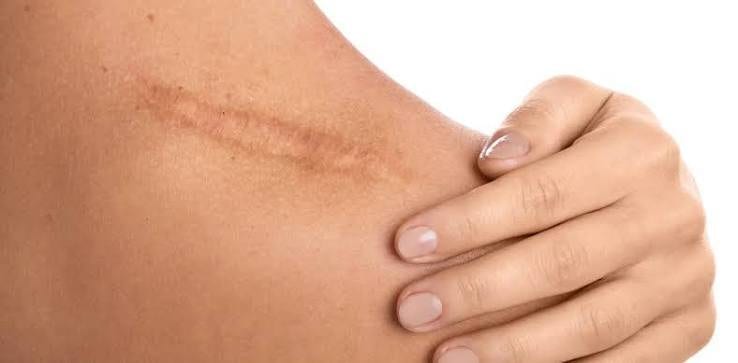
Sun and donor scars: why they become more visible over the years
Scar tissue doesn't tan in the sun the way normal skin does. So summer after summer, the contrast between pale scars and a tanned scalp grows.
Scar tissue doesn't take on colour in the sun the way normal skin does, so years of sun exposure make the contrast between pale scars and tanned skin steadily bigger. It's one of the few things in the donor area that you control yourself after surgery.
Why do donor scars become more visible in the sun?

Scars in the donor area, whether small dots from FUE or a strip from FUT, usually end up paler than the skin around them. Scar tissue has fewer working pigment cells, and this is a documented complication. The surrounding skin tans in the sun, but the scars mostly don't. A donor area that looks even in winter can therefore look speckled after a summer in the sun.
Whether you have dot scars from FUE or a strip scar from FUT, the scar usually heals a little paler than the surrounding skin. The healed tissue simply has fewer working pigment cells. Paler spots where grafts were extracted are described in the literature as a known consequence of follicular unit excision.
You notice the effect in summer. The scalp around the scars tans, while the scars themselves stay pale. The more sun, the bigger the difference.
If you've worked outdoors all summer, a donor area that looked completely even after winter can suddenly look speckled. The scars are the same as before. It's the skin around them that has darkened.
What does the sun do to donor scars over many years?
The contrast builds slowly over decades. It's most noticeable in men who keep their hair short and spend a lot of time outdoors. Long-term UV exposure can also change the surface of the scar. Scalp skin ages from the sun, and once hair no longer shields it, the risk of skin cancer on a sunburnt scalp goes up.
None of this happens quickly. What matters is the total of many summers.
- The colour difference grows with every season, most of all in people who keep their hair very short and spend their days outdoors.
- The scar itself can change. Long-term UV exposure can alter its surface so the scar becomes more visible in its own right.
- The surrounding skin ages from sun exposure over the decades, on top of donor hair naturally thinning somewhat with age.
- Skin cancer is a general concern on a scalp that gets a lot of sun, and the risk rises once there's no longer hair to cover it.
Why is sun protection especially important for the donor area?
After extraction, it's common for sensation in the donor area to be reduced for a while, and in a minority, more often after strip surgery, some numbness lasts a long time. That means you can get sunburnt without feeling it. Your body's usual warning signal is weakened exactly where the skin is most exposed.
How do you protect donor scars from the sun over time?
Wear a cap or hat when you're outside. It's simple and works best. Put sunscreen on your scalp when your hair is cut short. Take extra care in the first year, while the tissue is still healing. The same goes for places with strong UV, such as the mountains, the sea, snow and the tropics.
- Wear something on your head. A cap or hat is the simplest thing that works, and it's what most people end up doing.
- Sunscreen when your hair is short or shaved. Reapply regularly, and include the back and sides of your head, not just the top.
- Take extra care in the first year. The tissue is still healing and sensation is usually at its weakest during this period.
- Be careful where the sun is especially strong, for example in the mountains, on a boat, on the ski slopes or on holiday somewhere hot.
- Ask your doctor to look at your scalp when you have your skin checked, especially if you're fair-skinned and spend a lot of time outdoors.
In the first weeks after surgery, the clinic's own advice on sun comes before anything written here.
What can you do if the scars have already become visible?
Scalp micropigmentation works best, because it evens out the colour difference directly and takes nothing from your donor reserve. Longer hair and consistent sun protection from now on also help, but protection only stops things getting worse and doesn't remove the contrast you already have. In the long run grey hair helps, because pale scars stand out less once the hair is no longer dark against the skin.
The tools are the same as for other visible scars in the donor area.
- Scalp micropigmentation. It reduces the contrast directly and uses no donor hair. For this particular problem, nothing works better.
- Longer hair. A few extra millimetres hide a lot.
- Consistent sun protection from now on. It stops the contrast from growing further, but doesn't undo what has already happened.
Time actually works a little in your favour here. As your hair goes grey, the difference between hair colour and skin colour shrinks, and the scars blend in more. That offsets some of the effect of many summers in the sun.
Sources
- Romera de Blas C, Vega Díez D, Ricart Vayá JM, Gómez Zubiaur A. Complications in follicular unit excision hair transplantation: current evidence and practical approaches. Frontiers in Medicine, 2026;13:1750989. pubmed.ncbi.nlm.nih.gov/41709896
- Rassman WR, Bernstein RM, McClellan R, Jones R, Worton E, Uyttendaele H. Follicular unit extraction: minimally invasive surgery for hair transplantation. Dermatologic Surgery, 2002;28(8):720-728. pubmed.ncbi.nlm.nih.gov/12174065
- Jimenez F, Ruifernández JM. Distribution of human hair in follicular units. A mathematical model for estimating the donor size in follicular unit transplantation. Dermatologic Surgery, 1999;25(4):294-298. pubmed.ncbi.nlm.nih.gov/10417585
- Kim J, Ko YU, Yi KH. The condition of hair follicles produced by different punching methods during FUE surgery. Journal of Cosmetic Dermatology, 2024;23(12):4202-4207. pubmed.ncbi.nlm.nih.gov/39152658
- Maas D, et al. Rethinking the occipital scalp as a control in advanced androgenetic alopecia. Journal of the American Academy of Dermatology, 2026 (ahead of print). pubmed.ncbi.nlm.nih.gov/42398778
Here we bring together published research and common clinical practice for general information. This text is not medical advice and cannot replace what your surgical team tells you. If they tell you something different from what is written here, their advice is what counts.
Wondering what's possible for your hair?
Send three sharp photos of your hair, from the front, the top and the back. You'll get an honest answer on what can be done, roughly how many grafts it would take and what it costs.
- Free and with no obligation
- Photos are assessed by the clinic's medical team
- Replies usually within an hour in the daytime


A study tells you something about groups. Only a doctor who has seen your photos can say what applies to your hair. The medical team at the clinic at the top of our ranking offers a free assessment.
Goes to the clinic at the top of our ranking.