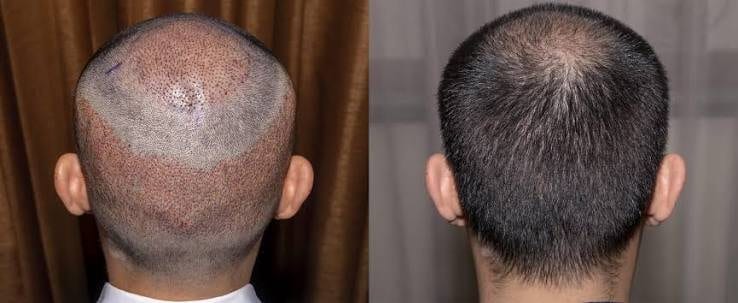
The donor area as you age: why scars can become easier to see
Hair at the back of the head thins with age just like the rest of the scalp, so it hides extraction scars a little less well with each decade.
Hair in the donor area gets thinner with age, just as it does on the rest of the head, and gradually covers the extraction scars less well. The scars themselves don't change. It's the hair over them that does.
Which three processes change the donor area as you get older?
The first is normal ageing, which gives everyone fewer and finer hairs, regardless of androgenetic alopecia. The second is androgen-driven thinning at the edges of the donor area, where some men thin from below, from the nape hairline and around the ears. The third is everything that has been extracted, which never grows back. Only the last is down to the operation, but all three leave less cover over the scars.
The donor area changes over the decades, and it helps to keep the causes apart, because they have different consequences.
- Normal ageing. In everyone, the number of hairs per square centimetre falls over the years and each hair gets finer, whether or not they have androgenetic alopecia. The donor area is no exception.
- Hormonal effects at the edges. In some men, thinning creeps upwards from the nape hairline and around the ears. Others are spared.
- What has been extracted. Follicles removed in one or more sessions never come back.
The operation is only responsible for the last point. Even so, all three mean there is less hair left to hide the extraction scars.
Do donor area scars become more visible with age?
The scars themselves are finished after about twelve months and don't change later. What changes is how easily you can see them, and that is governed by the hair on top. As the hair thins over the years, the same scars show more at the same hair length. A short clipper cut at thirty-five may not be possible at fifty-five.
Extraction scars, whether dots after FUE or a line after FUT, are fully formed after about a year. After that they stay as they are. How easy they are to see, however, does not.
It's the hair between and over the scars that decides how visible they are. When density at the back of the head falls with age, the same scars show more clearly at the same hair length. A man who has a number two clipper cut at thirty-five may find it no longer works at fifty-five. The scars are the same. The hair over them isn't.
The change is slow, and most people cope with it fine. It hits hardest those who were harvested heavily from the start, because they had less to work with even then.
Does grey hair make the scars more or less visible?
Less visible. Grey and white hairs stand out much less against the skin than dark hairs, and the small scars lack pigment and are pale already. As the hair at the back of the head greys, scars and hair blend together more, so both thinning and dot scars usually become less noticeable. That partly makes up for the density you have lost with age.
Grey hair does, admittedly, make scalp micropigmentation harder. It's more difficult to match the colour to greying hair, and the treatment has to be topped up at regular intervals.
What does sun do to the donor area over the years?
Year after year, sun makes unpigmented scars stand out more against tanned skin and can change how the scar tissue feels. A hat or sunscreen on the donor area therefore pays off in a way that builds up over time. It matters even more after FUE, because reduced sensation at the back of the head is common and can last, so you may not notice you're getting sunburnt.
Scar tissue doesn't tan the way the surrounding skin does. After many years of sun exposure, the difference between the pale scars and the tanned skin grows, and the scar tissue can change texture.
This is one of the few things you as a patient can influence yourself after surgery. A hat when you're outside, or sunscreen if you wear your hair short, has an effect that adds up over decades.
After FUE there is a particular reason to be careful. Sensation in the donor area is often reduced, possibly for a long time, so you won't necessarily feel it until you're already burnt.
How do you plan for a donor area that ages?
Choose conservative extraction, because a moderately harvested donor area has room for thinning with age, while an area emptied right to the limit lacks that margin. Tell the surgeon how short you want to be able to wear your hair before the operation, photograph the donor area every year and protect it from the sun. Micropigmentation may become an option later and uses no donor hair.
- Conservative extraction is your insurance. A donor area harvested moderately can handle the thinning that comes with age. An area harvested right to the limit has no margin left.
- Tell the surgeon how short you want to wear your hair. If you want the option of a short cut for the rest of your life, the plan has to allow for the donor area thinning over several decades, not just look at the year after the procedure.
- Photograph the donor area every year, with the same hair length and the same light.
- Keep the sun off it.
- Micropigmentation is still open to you, and it doesn't draw on your donor reserve. That matters a great deal on the day the reserve is used up.
Sources
- Romera de Blas C, Vega Díez D, Ricart Vayá JM, Gómez Zubiaur A. Complications in follicular unit excision hair transplantation: current evidence and practical approaches. Frontiers in Medicine, 2026;13:1750989. pubmed.ncbi.nlm.nih.gov/41709896
- Maas D, et al. Rethinking the occipital scalp as a control in advanced androgenetic alopecia. Journal of the American Academy of Dermatology, 2026 (ahead of print). pubmed.ncbi.nlm.nih.gov/42398778
- Jimenez F, Ruifernández JM. Distribution of human hair in follicular units. A mathematical model for estimating the donor size in follicular unit transplantation. Dermatologic Surgery, 1999;25(4):294-298. pubmed.ncbi.nlm.nih.gov/10417585
- Rassman WR, Bernstein RM, McClellan R, Jones R, Worton E, Uyttendaele H. Follicular unit extraction: minimally invasive surgery for hair transplantation. Dermatologic Surgery, 2002;28(8):720-728. pubmed.ncbi.nlm.nih.gov/12174065
- Xu Y, et al. Case Report: Paired vertex-occipital assessment reveals donor-area involvement in diffuse unpatterned alopecia. Frontiers in Medicine, 2026;13:1797275. pubmed.ncbi.nlm.nih.gov/41982548
This page brings together the published research and standard clinical practice. It is general information, not medical advice, and it cannot replace the advice of the team operating on you. If they tell you something different from what you read here, follow their advice.
Wondering what's possible for your hair?
Send three sharp photos of your hair, from the front, the top and the back. You'll get an honest answer on what can be done, roughly how many grafts it would take and what it costs.
- Free and with no obligation
- Photos are assessed by the clinic's medical team
- Replies usually within an hour in the daytime


A study tells you something about groups. Only a doctor who has seen your photos can say what applies to your hair. The medical team at the clinic at the top of our ranking offers a free assessment.
Goes to the clinic at the top of our ranking.