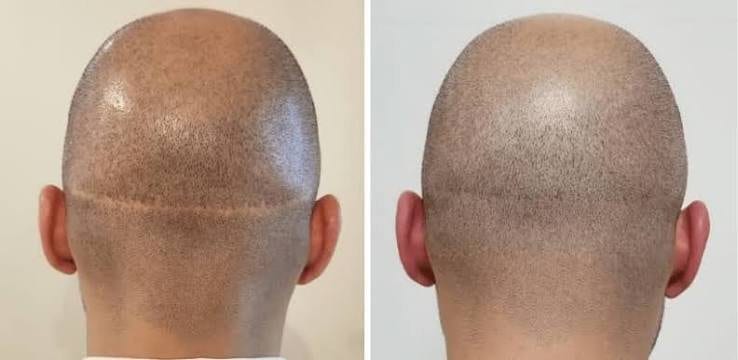
FUE and FUT scars: why they can become more visible years later
A scar has finished forming after about a year and changes little after that. The hair that hides it doesn't stay the same.
A scar reaches its final form during the first year and changes little after that. The change happens in the hair around it. A scar that didn't show after one year can therefore become visible after ten, simply because the donor area has got thinner.
Do the scars get worse over the years?
No, the scars themselves don't get worse. They're fully formed after about twelve months, and that's how they stay. What changes over the following decades is the hair over them. Donor density falls with age, and further sessions take more hair. Both mean less coverage over the scars.
This surprises many people. A scar in the donor area, whether it's a line after FUT or thousands of tiny dots after FUE, has fully matured in size, shape and colour after around twelve months. Then it stays put.
What changes in the years after is the hair over it. Density at the back drops slowly with age. Further sessions take even more. Together, some of the hair that hid the scars at the end of the first year disappears.
If you ask whether scars get worse over time, the honest answer is that the scars don't, but they can become easier to see. The mechanism is different, but the experience is the same.
What happens to a FUT strip scar over time?
Its appearance was mostly decided while the scar healed during the first year. If the line stayed narrow, it remains narrow and is hidden by medium-length hair for many years. A scar that has stretched stays wide. Years of sun and thinner hair at the back with age can still make a line easier to see later.
What a strip scar looks like many years on was mostly decided while it healed: either it stayed a narrow line, or the skin gave way to the tension and the scar became a wider band.
- A narrow line that healed well stays narrow. Medium-length hair hides it, in practice, for good.
- A scar that has stretched won't get narrower. The scar stretches during the first few months, and it doesn't contract again.
- Sun year after year can make a pale scar stand out more, because scar tissue doesn't tan when the surrounding skin does. If you wear your hair short and spend a lot of time outdoors, you should know this.
- Thinner hair at the back of the head with age means less coverage over the line.
If another strip is taken later, which is common in multi-stage plans, it also uses up scalp elasticity, and that can affect how the old scar sits.
What happens to FUE dot scars over time?
Each dot stays the same, but the overall picture changes, because it depends on the density between the dots. Thinner hair at the back with age, further sessions that add more dots and take more hair, thinning from below along the edges of the donor area, and sun all make the dots easier to see over the years. Sometimes you need to wear your hair longer than before to hide them.
The individual dot doesn't change. The overall picture does, since it depends on how densely the hair grows between the dots.
- Thinner hair at the back with age gradually gives less coverage over the dots.
- Further sessions add more dots to the same area and at the same time remove hair that was covering them. The effects multiply.
- Thinning from below along the lower and outer edge of the donor area, where it happens, exposes dots in the parts of the area that show most.
- Sun over the years makes the pale dots stand out more against the surrounding skin.
In practice this means you might have been able to wear a number two clipper cut in the first year, but not fifteen years later, even though nothing has gone wrong.
Why should you protect your scars from the sun?
Because scar tissue doesn't take on colour the way normal skin does. Year after year of sun widens the difference between a pale scar and the tanned skin around it. With short hair, the back of your head needs a hat or sunscreen. After FUE, reduced sensation in the area can mean you don't notice you're getting sunburnt.
Scar tissue doesn't tan the way normal skin does. Year after year of sun increases the contrast between a pale scar and the tanned skin around it, and it can also change the surface of the scar tissue itself.
With short hair it's therefore a good idea to shield the back of your head, with a hat outdoors or sunscreen on a shaved head. It's a small habit, but it counts over decades.
After FUE there's another reason: many people have reduced sensation in the donor area after extraction, and it can last. Then you may not feel yourself burning until the damage is done.
What can you do when the scars start to show?
Scalp micropigmentation makes the scar less obvious even with closely cropped hair, but it needs topping up, and the colour gets harder to match as you go grey. Grafts planted along a strip scar make the line less noticeable, but fewer grafts survive, and they use up donor reserve. You can grow your hair longer. And a really wide strip scar can be corrected surgically.
- Scalp micropigmentation makes the scar less obvious even with closely cropped hair. It takes nothing from the donor reserve, which matters once the reserve is used up. The pigment needs topping up, and once you go grey the colour is harder to match.
- Grafts planted along a strip scar make the line less noticeable. The caveat is that fewer grafts survive in scar tissue, and that they're taken from the donor reserve.
- Longer hair, the solution most people choose.
- Surgical scar revision when the strip scar is very wide and the skin has good elasticity, carried out by an experienced surgeon.
Sources
- Romera de Blas C, Vega Díez D, Ricart Vayá JM, Gómez Zubiaur A. Complications in follicular unit excision hair transplantation: current evidence and practical approaches. Frontiers in Medicine, 2026;13:1750989. pubmed.ncbi.nlm.nih.gov/41709896
- Rassman WR, Bernstein RM, McClellan R, Jones R, Worton E, Uyttendaele H. Follicular unit extraction: minimally invasive surgery for hair transplantation. Dermatologic Surgery, 2002;28(8):720-728. pubmed.ncbi.nlm.nih.gov/12174065
- Jimenez F, Ruifernández JM. Distribution of human hair in follicular units. A mathematical model for estimating the donor size in follicular unit transplantation. Dermatologic Surgery, 1999;25(4):294-298. pubmed.ncbi.nlm.nih.gov/10417585
- Kim J, Ko YU, Yi KH. The condition of hair follicles produced by different punching methods during FUE surgery. Journal of Cosmetic Dermatology, 2024;23(12):4202-4207. pubmed.ncbi.nlm.nih.gov/39152658
- Maas D, et al. Rethinking the occipital scalp as a control in advanced androgenetic alopecia. Journal of the American Academy of Dermatology, 2026 (ahead of print). pubmed.ncbi.nlm.nih.gov/42398778
This text is based on published studies and on how specialists usually work. It is meant as general information, not as medical advice for you, and it never overrides what your surgical team has told you. If they say something different from what is written here, their advice is what counts.
Wondering what's possible for your hair?
Send three sharp photos of your hair, from the front, the top and the back. You'll get an honest answer on what can be done, roughly how many grafts it would take and what it costs.
- Free and with no obligation
- Photos are assessed by the clinic's medical team
- Replies usually within an hour in the daytime


A study tells you something about groups. Only a doctor who has seen your photos can say what applies to your hair. The medical team at the clinic at the top of our ranking offers a free assessment.
Goes to the clinic at the top of our ranking.