Does your hair clinic offer real HBOT, and how can you tell?
It is very rare for a hair clinic to have its own hyperbaric chamber.
It is very rare for a hair clinic to have its own hyperbaric chamber. Clinics that market HBOT usually refer patients on to a centre elsewhere, and some call a soft chamber HBOT even though it never reaches a clinical pressure. Start by finding out which of these set-ups you are actually being offered.
Why do almost no hair clinics have their own pressure chamber?
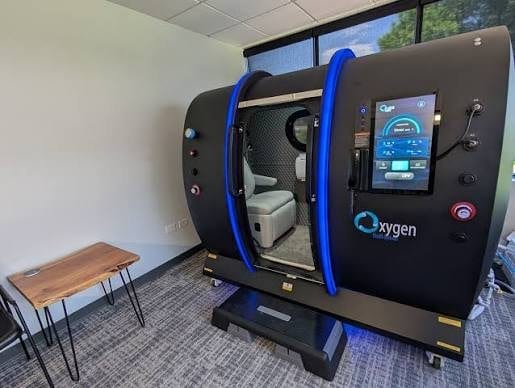
A hard pressure chamber is hospital equipment. It has to be managed as a pressure vessel, it needs fire protection because the air is full of oxygen, and it must be run by people with hyperbaric training who know what to do when ears cannot equalise, when the oxygen causes signs of toxicity, or when the pressure has to be released quickly. Outside HBOT, a hair clinic has no use for such a chamber. So it has to work with a centre that already exists, or buy something simpler.
A clinical pressure chamber is heavy equipment. A hard chamber, whether for one person or several, is a pressure vessel with its own rules for technical operation, maintenance and inspection. Because the air inside is rich in oxygen, fire safety requirements are strict. The staff must be trained in hyperbaric operation and be able to deal with ears that will not equalise, signs of oxygen toxicity and rapid decompression in an emergency.
That kind of capacity belongs in a hospital. A hair clinic has no other use for it. If the clinic still wants to offer HBOT, it has two options in practice: work with a hyperbaric centre that is already up and running, or buy a cheaper alternative that does not deliver the same thing.
What are the three ways clinics offer HBOT?
The first is that the clinic refers you to a hyperbaric centre outside the clinic. This matches the published protocols, with the right staff and the right pre-assessment. The second is a hard chamber at the clinic, which gives the same result if trained hyperbaric staff operate it. The third is a soft chamber at the clinic. It usually reaches only just above one atmosphere, gives concentrated but not pure oxygen, and comes nowhere near the dose in the published protocols.
1. You are referred to a hyperbaric centre
The clinic books sessions for you at a hospital or a stand-alone hyperbaric centre. Of the three set-ups, this is the one closest to the protocols that have been published. Hyperbaric staff monitor the sessions, contraindications are assessed thoroughly, and the pressure is a real clinical pressure.
The drawbacks are practical, not medical. You have to travel to a different address every day for a week, and the centre may send its own bill.
2. The clinic has its own hard chamber
A few large clinics have a hard chamber on their own premises. It is convenient, and with the right staffing it gives you the same as a referral. What you need to ask is who operates the chamber. Is it a trained hyperbaric technician, or someone from the surgical team who has had a quick introduction to which buttons to press?
3. The clinic has a soft chamber
This is what is most often sold as HBOT in a cosmetic setting, and it is rarely real HBOT. A soft chamber usually does not get much above one atmosphere, and the oxygen is often concentrated but not 100 %. With that combination you are a long way from the dose the hair studies tested.
What pressure do the studied protocols actually require?
Fan and colleagues gave 100 % oxygen for 60 minutes a day at a pressure of 2.0 ATA. In Giardiello and colleagues, the patient lay in a single-person chamber for 90 minutes a day at 2.4 ATA. Both pressures require a hard chamber. When a chamber cannot go higher than 1.3 or 1.4 ATA, it cannot deliver either of these protocols, whatever it is called. So ask about the pressure first.
Which questions reveal what kind of HBOT you are being offered?
Ask where the chamber is, how many ATA it reaches and whether the walls are hard or soft. Find out whether the oxygen is 100 % and how it is delivered, who operates the chamber and what hyperbaric training they have, and who checks for contraindications and when. If the answer about pressure is vague, that says a lot.
- Is the chamber here on site? If not, which centre do you use?
- How many ATA does it reach?
- Is the chamber hard or soft?
- Is the oxygen I breathe 100 %, and how is it delivered: in the chamber air, through a mask or under a hood?
- Who operates the chamber, and what hyperbaric training do they have?
- Who checks me for contraindications, and at what point?
If the clinic has a genuine service, the answers to all six questions come quickly. If the answer about pressure is vague, that tells you a lot.
How do you check a clinic's HBOT promises against the research?
In the randomised study, the HBOT group shed less early on and had folliculitis less often. The number of grafts surviving at nine months did not differ statistically significantly. If a clinic promises that HBOT gives more grafts in the end, it is claiming more than the research covers. If it says the first weeks will be more comfortable and the inflammation milder, that matches the finding. A clinic that embellishes one add-on usually embellishes others.
HBOT is prominent in marketing because it sounds technically advanced, and because it is easy to phrase things so it sounds as if hair grows better. Always hold the claim up against what has actually been shown.
The published randomised study found that patients given HBOT shed less in the first weeks and had folliculitis less often. The number of grafts surviving at nine months was not statistically significantly different. If a clinic markets HBOT as a route to more grafts in the end, it is describing something the research has not shown. If it promises easier first weeks and fewer inflammation-related complications, it is in line with the result of one small study.
The fact that a clinic offers HBOT does not, by itself, rule out either the treatment or the clinic. What matters is whether the description you are given stays within what the research supports. A clinic that oversells one add-on often oversells others.
Sources
- Fan Z, Gan Y, Qu Q, Wang J, Lunan Y, Liu B, Chen R, Hu Z, Miao Y. The effect of hyperbaric oxygen therapy combined with hair transplantation surgery for the treatment of alopecia. Journal of Cosmetic Dermatology, 2021;20(3):917-921. pubmed.ncbi.nlm.nih.gov/32770782
- Giardiello F, De Medeiros Quirino L, Brigante R, Chumak M. Hyperbaric Oxygen Therapy for Enhanced Postoperative Recovery in Hair Transplantation. Cureus, 2025;17(12):e99635. doi.org/10.7759/cureus.99635
- Undersea and Hyperbaric Medical Society. Indications for Hyperbaric Oxygen Therapy (approved indications list). uhms.org/resources/featured-resources/hbo-indications.html
- Heyboer M, Sharma D, Santiago W, McCulloch N. Hyperbaric Oxygen Therapy: Side Effects Defined and Quantified. Advances in Wound Care, 2017;6(6):210-224. pubmed.ncbi.nlm.nih.gov/28616361
This article summarises published research and standard clinical practice as general information. It is not medical advice and does not replace the instructions from the team operating on you. If they tell you something different from what is written here, follow their advice.
Wondering what's possible for your hair?
Send three sharp photos of your hair, from the front, the top and the back. You'll get an honest answer on what can be done, roughly how many grafts it would take and what it costs.
- Free and with no obligation
- Photos are assessed by the clinic's medical team
- Replies usually within an hour in the daytime


A study tells you something about groups. Only a doctor who has seen your photos can say what applies to your hair. The medical team at the clinic at the top of our ranking offers a free assessment.
Goes to the clinic at the top of our ranking.