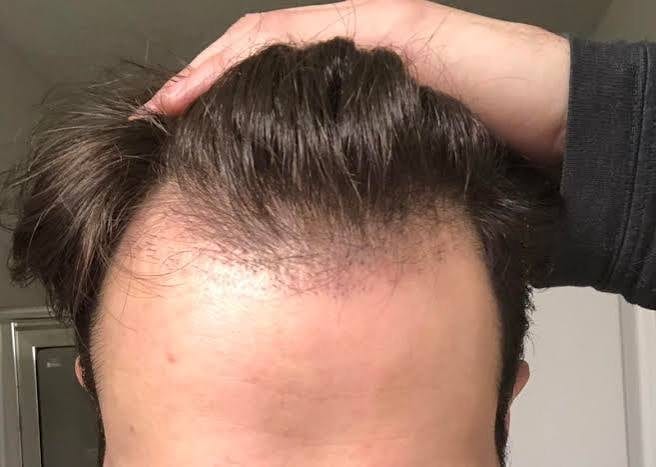
Hair transplant touch-up: fine-tuning or a new session?
A touch-up is either a correction of the first session or a response to continued hair loss. Those are two very different things.
A touch-up is one of two things: a correction of something from the first session, or a response to continued hair loss. Good surgery makes the first rare. The second is to be expected, and it should have been in the plan from day one.
What is meant by a touch-up?
The word is used for two different things. One is fine-tuning the result: a few hundred grafts for extra density, a softer hairline or a small irregularity evened out once the hair has finished growing. The other is a response to your own hair continuing to disappear, often between one and two thousand grafts. That is really a new session, not a touch-up.
The same word is used for two situations that have very little in common.
Fine-tuning. Extra density where it came out thinner than planned, a softer hairline, single hairs placed right at the edge, a small irregularity filled in. It is usually a matter of a few hundred grafts, and it is assessed once the result is complete.
A response to continued hair loss. The hair you had behind the transplanted area is thinner, a gap has appeared, and grafts are meant to fill it. That is a new session in everything but name, often between one and two thousand grafts. Calling it a touch-up makes both the price and the strain on the donor area sound smaller than they are.
Clinics tend to use the mildest word for both. Pay attention to that when you get a quote.
When can you judge whether a touch-up is needed?
At the earliest around twelve months after the procedure. The transplanted hair sheds after two to three weeks, starts growing again in the third and fourth month and looks finished at about twelve months. The final density of the donor area and how the scars turn out are not clear until then either.
Most people wait around twelve months, simply because the hair has not finished growing before then. The transplanted hair falls out after two to three weeks, comes back from about the third and fourth month and reaches the final result at about twelve months.
If you judge it at six months, you are judging something unfinished. Patients who book a correction that early often find the worry goes away on its own.
The back of the head also needs time. How dense it ends up, how visible the dot scars are, and whether any temporary hair loss has recovered are things you will not know after six months either.
When is a touch-up actually justified?
When a defined area is still thinner than the plan suggested after twelve months, when the hairline looks too sharp or too regular, when there is a small irregularity where growth was weak, or when the temple points are uneven. Not when you are unhappy after three months, are comparing yourself with someone else's photos, or simply want denser hair when the result is entirely normal.
- A defined area that is thinner than the plan suggested after twelve months, checked against the photos from before the procedure and not against memory.
- A hairline that looks too sharp or too even, which can be corrected with fine single-hair grafts in front of and between the ones already there.
- A minor irregularity or gap where growth was weak.
- Temple points that do not match.
What is not a good enough reason: unhappiness after three months, someone else's photos looking better, or a vague wish for denser hair when the result is within what can be expected.
What do you do when the real cause is that hair loss is continuing?
Then you need a full new assessment, not a small top-up. Find out whether the pattern has gone further than the plan assumed, what is left of the reserve, whether you are using medical treatment, and whether the reserve would do more good in the middle of the scalp. Skip this and a third session will probably follow.
If the wish for more surgery is because you have lost more of your own hair, the answer is not a little top-up. You need a fresh assessment from the ground up.
- Has the hair loss gone further than the first plan assumed?
- How dense is the back of the head now, and how much reserve do you have left?
- Are you using medical treatment, and if not, why not? Grafts planted into an untreated pattern that is still developing will send you back to the table later.
- Would the reserve do more good in the middle of the scalp than as extra density in an area that is already covered?
If you go through a second session and leave the hair loss itself alone, you will need a third.
How common are touch-ups?
There are no published figures. If the first procedure was well planned, though, fine-tuning should be rare and small. If many of a clinic's patients have large touch-ups, it suggests the first session delivers too little, or that the plans do not allow for further hair loss. Feel free to ask the clinic what proportion have another procedure.
Nobody has published figures. Nobody systematically records how often corrections or touch-ups are done after hair transplants. What can be said concerns the structure.
If the first procedure was well planned, fine-tuning should be the exception, and small. If many of a clinic's patients have large "touch-ups", it suggests either that the first session delivers too little, or that the plans do not account for hair loss continuing.
Ask the clinic directly: how many of your patients have another procedure, and why? Only a handful of clinics keep track of this, and whether they do or not is an answer in itself.
Sources
- Bernstein RM, Rassman WR. Graft Anchoring in Hair Transplantation. Dermatologic Surgery, 2006;32(2):198-204. pubmed.ncbi.nlm.nih.gov/16442039
- Romera de Blas C, Vega Díez D, Ricart Vayá JM, Gómez Zubiaur A. Complications in follicular unit excision hair transplantation: current evidence and practical approaches. Frontiers in Medicine, 2026;13:1750989. pubmed.ncbi.nlm.nih.gov/41709896
- Jimenez F, Ruifernández JM. Distribution of human hair in follicular units. A mathematical model for estimating the donor size in follicular unit transplantation. Dermatologic Surgery, 1999;25(4):294-298. pubmed.ncbi.nlm.nih.gov/10417585
- Gupta AK, Venkataraman M, Talukder M, Bamimore MA. Finasteride for hair loss: a review. Journal of Dermatological Treatment, 2022;33(4):1938-1946. pubmed.ncbi.nlm.nih.gov/34291720
- Maas D, et al. Rethinking the occipital scalp as a control in advanced androgenetic alopecia. Journal of the American Academy of Dermatology, 2026 (ahead of print). pubmed.ncbi.nlm.nih.gov/42398778
This text is based on published studies and on how specialists in the field usually work. It is meant as general information, not as medical advice for you, and it never overrides what your surgical team has told you. If they say something different from what is written here, their advice is what counts.
Wondering what's possible for your hair?
Send three sharp photos of your hair, from the front, the top and the back. You'll get an honest answer on what can be done, roughly how many grafts it would take and what it costs.
- Free and with no obligation
- Photos are assessed by the clinic's medical team
- Replies usually within an hour in the daytime


A study tells you something about groups. Only a doctor who has seen your photos can say what applies to your hair. The medical team at the clinic at the top of our ranking offers a free assessment.
Goes to the clinic at the top of our ranking.