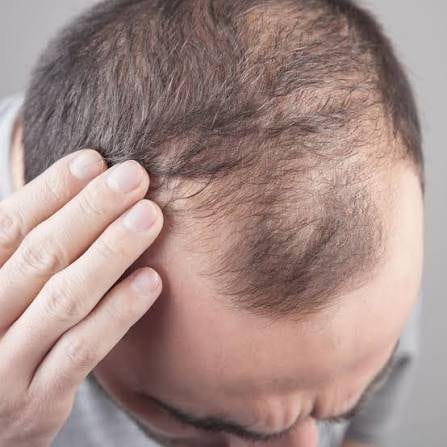
When hair around the grafts thins: your own hair after a transplant
The hair you already have, between and behind the grafts, keeps shrinking without treatment.
The hair you already have, between and behind the grafts, keeps shrinking if no one treats it. This, and only rarely lost grafts, is why many results look thinner over the years. It is also what clinics hear most often when patients come back.
Why can a transplanted area look thinner even though all the grafts grew?
Because density has two sources. The grafts do not shrink, but your own hair between them does. A year after the procedure, much of what you see in most recipient areas is hair you already had, and it responds to androgens. Density can therefore drop over the years even if every graft is alive. It feels as though the transplant is thinning.
How dense a transplanted area looks depends on more than the grafts. You see the grafts together with the hair that was already growing there and survived the procedure.
By twelve months, a good share of the hair you see in most recipient areas is your own. That applies especially to the mid-scalp and to any areas that were thin but not completely bald. Your own hair responds to androgens. The grafts do not.
That is why density can fall over the years even if 100 % of the grafts survived. One of the two sources gradually disappears. To the patient it looks as if the transplant is thinning. That is rarely what is actually happening.
How do you tell shock loss, graft failure and loss of your own hair apart?
By the timing. Shock loss is temporary and comes in the first months, with shedding in the second or third week and new growth from the third or fourth month. Graft failure shows within twelve months and does not get worse afterwards. Thinning of your own hair comes slowly from year two and keeps increasing.
- Shock loss. Your own hair falling out temporarily because the scalp has been through a procedure. It happens within the first weeks or months. The follicles are alive and the hair comes back in the familiar pattern: hair falls out in the second or third week, new growth starts in the third or fourth month, and things have settled after about twelve months.
- Graft failure. Grafts that never started growing. You see this within twelve months, and it does not get worse after that.
- Gradual thinning of your own hair. Androgenetic miniaturisation that continues over the years. It is slow, and of the three it is the only one that gets gradually worse.
The clock gives it away. If it appears early and corrects itself, it is shock loss. If an area is empty after twelve months and stays that way, it is graft failure. If it creeps in from year two onwards, it is your own hair disappearing.
Who loses the most of their own hair around the grafts?
It is most marked when the area was thin rather than bald before the procedure, because there was more of your own hair to lose. Of the things you can influence, going without medical treatment matters most. Young age, strong family history and a plan that only covered the front also raise the risk.
- The area was thin, not bald. The more of your own hair there was, the more can disappear.
- You use no medication. Of everything you can influence yourself, this matters most.
- You were young when you had surgery. More of your hair loss lies ahead of you.
- Hair loss is widespread in your family.
- Only the front was treated. If you only got a new hairline, the mid-scalp behind it will thin and create a clear contrast.
How does the thinning develop year by year?
What we know about the course is based on what clinicians see, not on published long-term data. For the first one to three years the result looks as planned. From year three to seven, the hair behind and between the grafts thins, so the transplanted area stands out as denser than the rest. After that the contrast either blends into normal ageing or locks in as a distinct band.
Which way it goes depends on two things: whether the design was cautious enough, and whether the hair you already had got treatment. With both in place, the result looks like normal hair ageing. Without them, the transplanted area is left as a dense strip in front of a thinner field.
What helps against losing your own hair around the grafts?
Talk to a doctor about medical treatment, because that is what acts on the cause itself. Make sure the mid-scalp is treated in the first operation, not just the hairline, and that some donor hair is held back. Photograph your whole scalp every year with the same hair length and light. Don't meet early thinning with more surgery.
- Medical treatment, assessed by a doctor who knows your health. This is the measure that tackles the problem itself.
- Include the mid-scalp in the first operation, not just the hairline. A hairline with nothing behind it is the design that ages worst.
- Save donor hair, so you have something in reserve if the hair loss continues.
- Photograph your whole scalp every year, with the same hair length and the same light. You don't notice a slow change from day to day, but in a series of photos it is obvious.
- Don't respond to early thinning with another operation. Within the first twelve months, shock loss is the likely explanation. Wait until twelve months have passed before drawing conclusions.
What should you ask about your own hair before surgery?
Ask how much of the density you see after one year comes from your own hair rather than grafts, and what is likely to happen to that hair later. When the mid-scalp is rebuilt, the share can be large. Once you know, you understand better what the one-year photo means and what the plan has to cover.
What thins around the grafts is entirely ordinary loss of your own hair, and we explain the mechanism in the guide to causes of hair loss. The answer to the question above tells you how much of the result rests on hair that can still disappear.
Sources
- Gupta AK, Venkataraman M, Talukder M, Bamimore MA. Finasteride for hair loss: a review. Journal of Dermatological Treatment, 2022;33(4):1938-1946. pubmed.ncbi.nlm.nih.gov/34291720
- Long-term (5-year) multinational experience with Finasteride 1 mg in the treatment of men with androgenetic alopecia. European Journal of Dermatology, 2002. pubmed.ncbi.nlm.nih.gov/11809594
- Maas D, et al. Rethinking the occipital scalp as a control in advanced androgenetic alopecia. Journal of the American Academy of Dermatology, 2026 (ahead of print). pubmed.ncbi.nlm.nih.gov/42398778
- Bernstein RM, Rassman WR. Graft Anchoring in Hair Transplantation. Dermatologic Surgery, 2006;32(2):198-204. pubmed.ncbi.nlm.nih.gov/16442039
- Romera de Blas C, Vega Díez D, Ricart Vayá JM, Gómez Zubiaur A. Complications in follicular unit excision hair transplantation: current evidence and practical approaches. Frontiers in Medicine, 2026;13:1750989. pubmed.ncbi.nlm.nih.gov/41709896
This page gathers the published research and common clinical practice. It is general information, not medical advice, and it cannot replace the advice of the team operating on you. If they tell you something different from what you read here, their advice is what counts.
Wondering what's possible for your hair?
Send three sharp photos of your hair, from the front, the top and the back. You'll get an honest answer on what can be done, roughly how many grafts it would take and what it costs.
- Free and with no obligation
- Photos are assessed by the clinic's medical team
- Replies usually within an hour in the daytime


A study tells you something about groups. Only a doctor who has seen your photos can say what applies to your hair. The medical team at the clinic at the top of our ranking offers a free assessment.
Goes to the clinic at the top of our ranking.