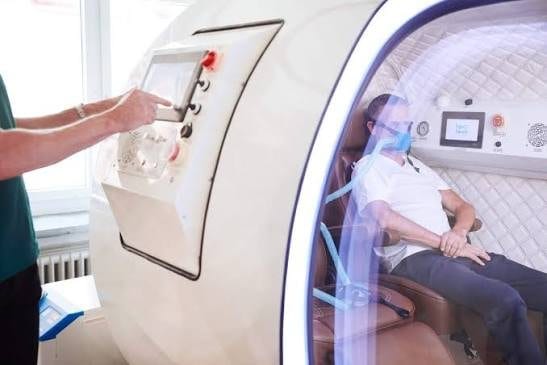
What are the side effects of HBOT, and how common is barotrauma?
The most common side effect of hyperbaric oxygen therapy is pressure injury to the middle ear, known as barotrauma.
The most common side effect of hyperbaric oxygen therapy is pressure injury to the middle ear, known as barotrauma. Most of the rest is sinus barotrauma, short-sightedness that wears off, anxiety in confined spaces and, in rare cases, seizures because the oxygen affects the central nervous system. When patients are properly screened beforehand, safety is good.
Is HBOT a safe treatment?
Yes, by and large. Heyboer and colleagues wrote the review of side effects that most people refer to, and they still count HBOT among the safest treatments in use. In patients who have been screened and are treated at normal clinical pressures, serious complications are rare. Even so, you need to be told about the small but real risks for your consent to be informed.
An article about side effects should start with the big picture. Heyboer and colleagues published (in the journal Advances in Wound Care) the review of HBOT side effects that is most often used as a reference, and it still describes hyperbaric oxygen therapy as one of the safest treatments we have. Serious problems are rare when patients have been screened and the pressure is at a normal clinical level.
At the same time, the authors argue that everyone who gives the treatment must be able to recognise, understand and properly quantify the side effects. That is needed to prevent them, to treat them and so the patient can give informed consent. For a cosmetic add-on, consent is exactly the point. You are agreeing to a small but real risk for a gain that has not been established for this use.
Why can HBOT damage the middle ear?
When the pressure in the chamber rises and you cannot equalise, the eardrum is pushed inwards. It hurts, and fluid or blood can collect in the middle ear. Sometimes the eardrum is perforated. No side effect of HBOT is more common. The risk rises if you are congested, have a cold or hay fever, or have recently had ear surgery. You prevent it by starting to equalise straight away, doing it often and letting the pressure build up slowly.
No other side effect of pressure treatment comes close to being this common, and the cause is pure physics. The oxygen has nothing to do with it.
As the pressure builds, the air in the middle ear is compressed. If you do not equalise, for example by swallowing, yawning or with the Valsalva manoeuvre, the pressure difference pulls the eardrum inwards. It hurts. If it continues, fluid or blood can collect in the middle ear, and occasionally the eardrum ruptures.
The faster and the more the pressure changes, the greater the risk, and it rises sharply when equalising does not work. Being congested, having a cold or hay fever, or recent ear surgery raises the risk. Many people are a little blocked up after a long hair transplant. Tell the staff, rather than gritting your teeth.
The most important prevention is technique and pace. Start equalising as soon as the pressure rises, and do it often. Tell the person operating the chamber as soon as you feel pressure in your ears, and accept that the pressure builds more slowly. A decongestant nasal spray that shrinks the mucous membranes is an option, but it is the hyperbaric centre that decides.
What happens with sinus barotrauma?
The mechanism is the same as in the ear. When the opening to a sinus is blocked, air is trapped and cannot be equalised as the pressure changes. This causes pain in the forehead or cheek and sometimes a little nosebleed. It happens less often than in the ear. A blocked nose is the biggest risk factor, so if you are congested the session should be moved.
Can the oxygen harm the nervous system or the lungs?
In rare cases. When the partial pressure of oxygen gets high, the oxygen can be toxic to the central nervous system and trigger a seizure. This risk determines how high a pressure and how long a time a protocol can use. The seizure stops without treatment, and it is not a sign of epilepsy. Oxygen toxicity in the lungs builds up over a long time with high doses and causes coughing and a feeling of tightness in the chest. It concerns long courses more than short protocols.
The central nervous system
It is oxygen toxicity in the central nervous system that sets the ceiling for all hyperbaric protocols. With a high enough oxygen pressure and a long enough session, hyperbaric oxygen can trigger a seizure. At the pressures and times used clinically, this is rare. The seizure stops when the oxygen dose is reduced, and it is not a sign of epilepsy. This very risk is why protocols always specify both pressure and time, and why a specialist must assess you if you have had seizures before.
Sometimes there are warning signs first. That is another reason the staff want you awake and able to report how you feel.
The lungs
In the lungs, oxygen toxicity works over time. It builds up with long exposure to high doses and causes coughing and a feeling of tightness in the chest. That matters for long courses with daily treatment, less so for six or seven sessions. Still, it partly explains why "maintenance courses" that stretch out over time should have a concrete justification.
Can HBOT affect your eyesight?
Yes, temporarily. Repeated sessions can make you slightly short-sighted, so you see less well at a distance. The change comes on gradually during the course and disappears over the weeks or months afterwards. Long courses are linked to the development of cataracts, but six sessions are not enough for that to be a real concern.
Is anxiety in the chamber a good enough reason to stop?
Yes. Claustrophobia and unease in confined spaces are among the most common practical reasons people stop HBOT, especially in single-person chambers. It is a genuine side effect, not a sign that you are weak. When the treatment is cosmetic and elective, it is a perfectly valid reason to stop.
Is the risk worth it when you are having a hair transplant?
For approved indications, the benefit clearly outweighs the risk. As an optional add-on to a hair transplant, the calculation is different. The published randomised study found early shedding of 69.1 % without HBOT and 27.6 % with it, and folliculitis and itching in 35.3 % without and 11.8 % with. Graft survival at nine months was 96.9 % with the treatment and 93.8 % without, and the gap was not statistically significant.
For an approved indication, such as a diabetic foot ulcer that will not heal or late damage after radiotherapy, the assessment is straightforward. The benefit is well documented, and the alternative is often serious.
When HBOT is an optional add-on to a hair transplant, the assessment looks different. In the published randomised study, 69.1 % in the control group shed early, against 27.6 % in the HBOT group. Folliculitis and itching affected 35.3 % without treatment and 11.8 % with it. At nine months, 96.9 % of grafts had survived in the HBOT group and 93.8 % in the control group, a difference that was not statistically significant. That is what you get in return for accepting a small risk from the treatment itself.
For some patients it may still be a sensible trade. But nobody should make it without knowing what sits on each side of the scale.
Sources
- Heyboer M, Sharma D, Santiago W, McCulloch N. Hyperbaric Oxygen Therapy: Side Effects Defined and Quantified. Advances in Wound Care, 2017;6(6):210-224. pubmed.ncbi.nlm.nih.gov/28616361
- Thom SR. Hyperbaric oxygen: its mechanisms and efficacy. Plastic and Reconstructive Surgery, 2011;127 Suppl 1:131S-141S. pubmed.ncbi.nlm.nih.gov/21200283
- Fan Z, Gan Y, Qu Q, Wang J, Lunan Y, Liu B, Chen R, Hu Z, Miao Y. The effect of hyperbaric oxygen therapy combined with hair transplantation surgery for the treatment of alopecia. Journal of Cosmetic Dermatology, 2021;20(3):917-921. pubmed.ncbi.nlm.nih.gov/32770782
- Undersea and Hyperbaric Medical Society. Indications for Hyperbaric Oxygen Therapy (approved indications list). uhms.org/resources/featured-resources/hbo-indications.html
This article summarises published research and standard clinical practice as general information. It is not medical advice and does not replace the instructions from the team operating on you. If they tell you something different from what is written here, follow their advice.
Wondering what's possible for your hair?
Send three sharp photos of your hair, from the front, the top and the back. You'll get an honest answer on what can be done, roughly how many grafts it would take and what it costs.
- Free and with no obligation
- Photos are assessed by the clinic's medical team
- Replies usually within an hour in the daytime


A study tells you something about groups. Only a doctor who has seen your photos can say what applies to your hair. The medical team at the clinic at the top of our ranking offers a free assessment.
Goes to the clinic at the top of our ranking.