Laser caps and red light after a transplant: what we know long term
LLLT has been tested in randomised trials for androgenetic alopecia, but follow-up is mostly measured in months, not years, and usually alongside minoxidil.
Low-level laser therapy (LLLT) has been studied in randomised trials for androgenetic alopecia, but almost only over months and usually together with minoxidil. After a transplant, it's your own native hair the treatment may help. The grafts don't need it.
What is LLLT, and does it do anything for the grafts?
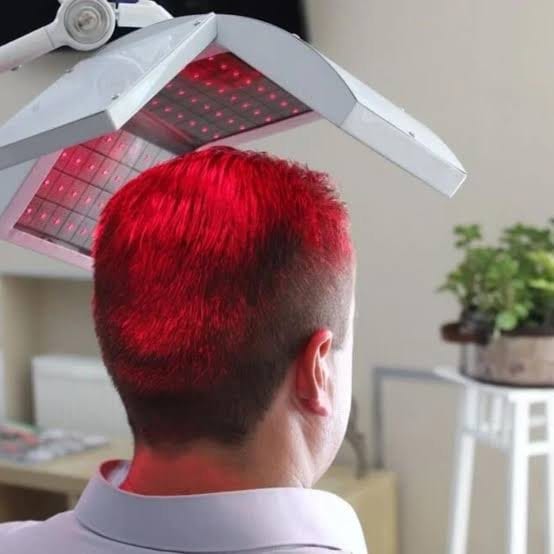
LLLT, also known as photobiomodulation or red light therapy, is meant to stimulate the hair follicles you already have in androgenetic alopecia. It's given with a cap, a comb or a clinic device over months or years. After a transplant, the target is your own hair around the grafts, not the grafts themselves, which largely tolerate DHT already.
Low-level laser is used for hereditary hair loss to get existing hair follicles to produce stronger hair. You can use a cap or comb at home, or a larger device at a clinic, and treatment usually runs over months and years.
If you've had a transplant, it's your own native hair the treatment may matter for. It's the hair between and behind the grafts that still responds to androgens and keeps thinning. The grafts come from an area that largely tolerates DHT, and they don't need the treatment.
The same distinction applies to medication, and it's worth remembering. An add-on product meant to protect your transplant can, at best, protect the hair around it.
What does the research say about LLLT for hereditary hair loss?
The best evidence is a 2025 meta-analysis by Mawu and co-authors that pooled seven randomised trials. When LLLT was added to minoxidil, hair became denser and thicker than with minoxidil alone, patients were more satisfied and safety was at the same level. Follow-up, however, was measured in months rather than years.
The work by Mawu and co-authors was published in 2025 in Lasers in Medical Science. It's based on seven randomised trials. The groups given LLLT on top of topical minoxidil saw bigger gains in both density and hair thickness than the groups on minoxidil alone. Patients were more satisfied, and safety was comparable.
That's real evidence, and it's better than what exists for most add-on hair loss treatments. For a question that spans many years, though, there are two caveats.
- The finding is mainly about the combination. The result tells us something about LLLT plus minoxidil. It says little about LLLT as a replacement for a medicine.
- Patients were followed for months, not years. As with almost every hair loss treatment, there are no published results over several years.
Where does LLLT fit in a long-term plan after a transplant?
Medical treatment has the best evidence for preserving your own hair over time, with five-year data for finasteride and randomised trials of minoxidil. LLLT has randomised trials over a shorter time frame, usually combined with minoxidil, and PRP is less well documented. The advantage of LLLT is that you use the device at home, with little hassle and side effects on a par with the control group.
If you want to keep your own hair over several decades, and that's exactly what decides whether a transplant still looks right in ten years, LLLT is one of several possible options. It isn't the best documented.
- Medical treatment has been followed the longest of anything in the field. Finasteride has five-year data from several countries, dutasteride has been compared in a meta-analysis, minoxidil has randomised trials, including head-to-head comparisons, and there's consensus guidance on low-dose tablets. Which treatment is right for you is something you decide with your doctor.
- LLLT is documented in randomised trials over a shorter time frame, mostly in combination with minoxidil.
- PRP has more research behind it, but it's methodologically weaker and mostly about hereditary hair loss rather than maintenance after a transplant.
LLLT has some practical advantages that count. You use the device at home, it asks little of you, and in the studies side effects were mostly on a par with the control group. For anyone who can't or won't take medication, that's worth something.
What does LLLT cost over many years?
You usually buy the device once rather than paying per treatment, so over ten years it works out cheaper than repeated PRP courses, even if the device has to be replaced at some point. The real challenge is keeping it up. A device that gets used for a few months and then ends up in a cupboard does nothing, and the studies only measured people who stuck to the routine.
What should you ask when someone promises results with LLLT?
Ask what result is being promised and which study it comes from, whether the evidence is about LLLT alone or together with minoxidil, and what the routine looks like. The most important point is whether LLLT is meant to replace medical treatment or be added to it. The studies behind the meta-analysis only looked at use together with minoxidil.
- What am I supposed to achieve, and which study shows it?
- Is the evidence about LLLT used alone, or LLLT on top of minoxidil?
- What's the routine? How often, for how long, and for the rest of my life?
- How will we know whether it works?
- Is this meant to replace medical treatment, or to be used alongside it?
Give the most weight to the answer to the last one. If LLLT is presented as a replacement for medication, the claim goes beyond what the researchers actually looked at. If it's presented as an add-on, it matches what was actually tested.
Sources
- Mawu FO, et al. Comparative efficacy and safety of low-level laser therapy and topical minoxidil combination vs. topical minoxidil monotherapy for androgenetic alopecia: a systematic review and meta-analysis. Lasers in Medical Science, 2025;40(1):338. pubmed.ncbi.nlm.nih.gov/40826200
- Long-term (5-year) multinational experience with Finasteride 1 mg in the treatment of men with androgenetic alopecia. European Journal of Dermatology, 2002. pubmed.ncbi.nlm.nih.gov/11809594
- Gupta AK, Venkataraman M, Talukder M, Bamimore MA. Finasteride for hair loss: a review. Journal of Dermatological Treatment, 2022;33(4):1938-1946. pubmed.ncbi.nlm.nih.gov/34291720
- Penha MA, Miot HA, Kasprzak M, Muller Ramos P. Oral minoxidil vs Topical minoxidil for Male Androgenetic Alopecia: A Randomized Clinical Trial. JAMA Dermatology, 2024. pmc.ncbi.nlm.nih.gov/articles/PMC11007651
- Sindhusen S, Tawanwongsri W, Eden C. Efficacy of Platelet-Rich Plasma as an Adjunct to Hair Transplantation: A Systematic Review. Cureus, 2025;17(10):e94116. pubmed.ncbi.nlm.nih.gov/41069573
Here we summarise published research for general information. This text is not medical advice, and it doesn't tell you to start, stop or change any medicine. Prescription medicines have contraindications and can interact with each other. Discuss this with your doctor, who knows your medical history.
Wondering what's possible for your hair?
Send three sharp photos of your hair, from the front, the top and the back. You'll get an honest answer on what can be done, roughly how many grafts it would take and what it costs.
- Free and with no obligation
- Photos are assessed by the clinic's medical team
- Replies usually within an hour in the daytime


A study tells you something about groups. Only a doctor who has seen your photos can say what applies to your hair. The medical team at the clinic at the top of our ranking offers a free assessment.
Goes to the clinic at the top of our ranking.