Laser helmets and laser caps for hair loss: what do studies show?
Low-level red and near-infrared light is approved for hereditary hair loss in several markets. The benefit is modest, and it depends on the device and on actually using it.
LLLT means shining low-level red or near-infrared light on the scalp. Several devices are approved for hereditary hair loss, and the body of research is real. Even so, the devices differ greatly from one another, the effect is moderate, and you have to keep up the treatment for as long as you want to keep the benefit.
What is LLLT, and how is the light supposed to affect the hair follicle?
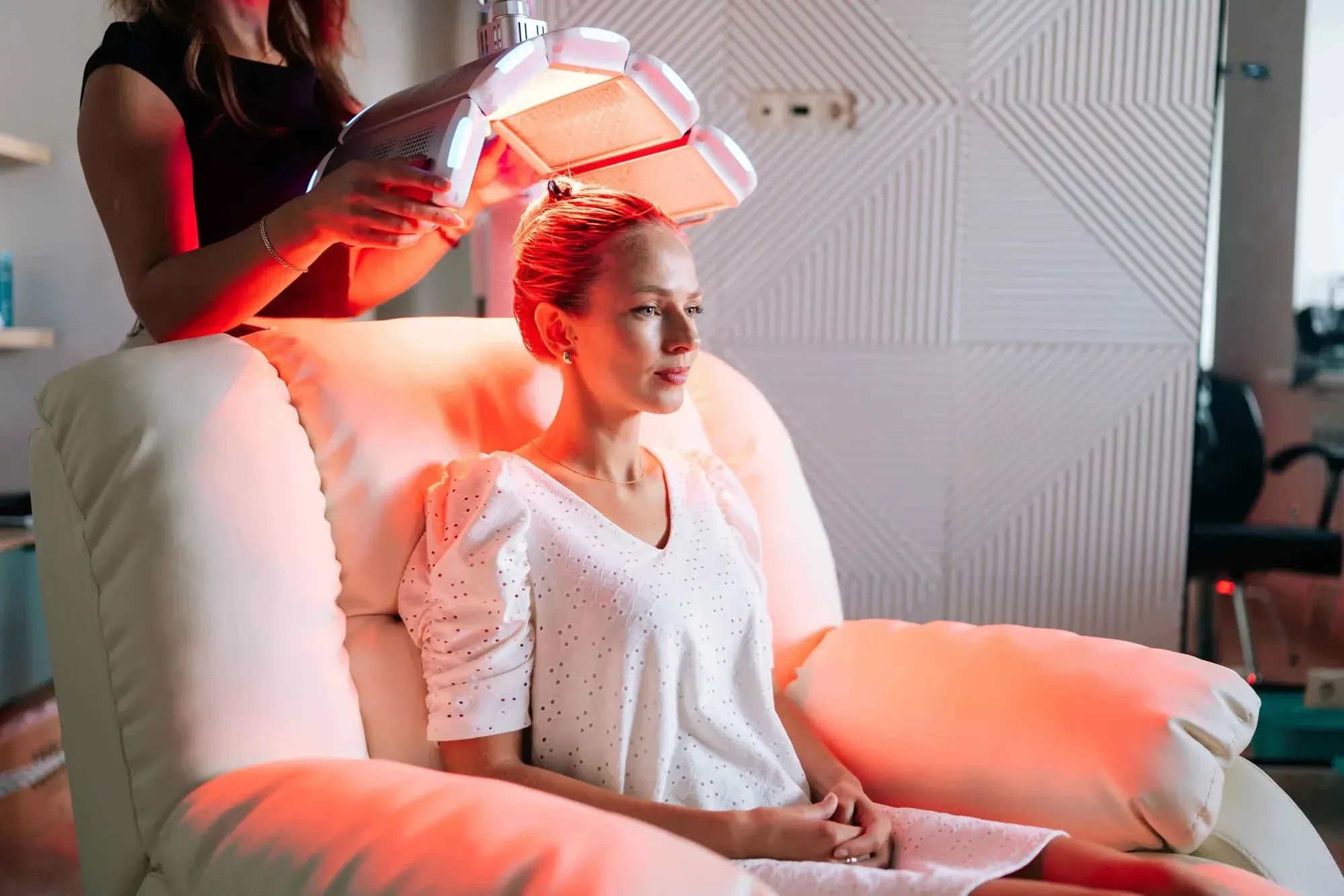
LLLT (low-level laser therapy) means low-level light, red or near-infrared, is directed into the scalp from a cap, a helmet, a comb or a panel at a clinic. The theory is that light-absorbing substances in the hair follicle, known as chromophores, alter cell signalling via nitric oxide and reactive oxygen species. The method is non-invasive and considered safe, and that genuinely counts in its favour.
How good is the evidence?
For hereditary hair loss there is a decent number of studies pointing in a positive direction, which is why several devices have been approved in some countries. The catch is that the devices aren't the same. Wavelength, power density, how long each session lasts and how often it's repeated all vary, so what one device has shown in studies can't simply be carried over to another. That applies especially to cheaper models.
So when you read about a product, the question isn't whether LLLT works in general. The question is whether this exact model, with this setting and this usage schedule, has been studied.
Is LLLT a main treatment or an add-on?
Usually an add-on. The evidence is thinner than for the established hair loss medicines, and in practice the light is used alongside them, not instead of them. If you can't tolerate medicines, or don't want to take them, LLLT is still a sensible drug-free, low-risk option.
What are the downsides in everyday life?
The routine is the biggest hurdle: several sessions every week, with no date when you can stop. The device itself costs a fair amount, and where results come, they come slowly and are small. After a hair transplant, nothing should rest against the healing recipient area until your clinic has said yes.
- Repeated sessions every week, month after month, with no end date
- The hard part is keeping the routine going for years
- The device is a noticeable expense before you've seen any result
- The effect, if it comes, is gradual and moderate
- Wait until your clinic has approved it before placing anything against a new recipient area
The devices themselves, the types and what to look for are covered on our page about laser and light devices.
Sources
- Lueangarun S, Visutjindaporn P, Parcharoen Y, Jamparuang P, Tempark T. A Systematic Review and Meta-analysis of Randomized Controlled Trials of United States Food and Drug Administration-Approved, Home-use, Low-Level Light/Laser Therapy Devices for Pattern Hair Loss: Device Design and Technology. The Journal of Clinical and Aesthetic Dermatology, 2021;14(11):E64-E75. pubmed.ncbi.nlm.nih.gov/34980962
- Mawu FO, Sondakh ORL, Kairupan TS, Christopher PM. Comparative efficacy and safety of low-level laser therapy and topical Minoxidil combination vs. topical minoxidil monotherapy in androgenetic alopecia management: a systematic review and meta-analysis of randomized controlled trials. Lasers in Medical Science, 2025;40(1):338. pubmed.ncbi.nlm.nih.gov/40826200
- Gupta AK, Taylor D, Nouri K. Lasers for treatment of androgenetic alopecia: an in-depth analysis. Lasers in Medical Science, 2025;40(1):108. pubmed.ncbi.nlm.nih.gov/39979533
- Guo Y, Qu Q, Chen J, Miao Y, Hu Z. Proposed mechanisms of low-level light therapy in the treatment of androgenetic alopecia. Lasers in Medical Science, 2021;36(4):703-713. pubmed.ncbi.nlm.nih.gov/33111207
- Vanaria RJ, Chaudry A, Nestor MS. The Use of Light-Based Therapies in the Treatment of Alopecia. Journal of Cosmetic Dermatology, 2025;24(9):e70434. pubmed.ncbi.nlm.nih.gov/40878907
This page summarises published research as general information. It is not medical advice and not a recommendation to start, stop or adjust any medicine. Prescription medicines have contraindications and can interact with other medicines, so discuss them with your doctor, who knows your medical history.
Wondering what's possible for your hair?
Send three sharp photos of your hair, from the front, the top and the back. You'll get an honest answer on what can be done, roughly how many grafts it would take and what it costs.
- Free and with no obligation
- Photos are assessed by the clinic's medical team
- Replies usually within an hour in the daytime


A study tells you something about groups. Only a doctor who has seen your photos can say what applies to your hair. The medical team at the clinic at the top of our ranking offers a free assessment.
Goes to the clinic at the top of our ranking.