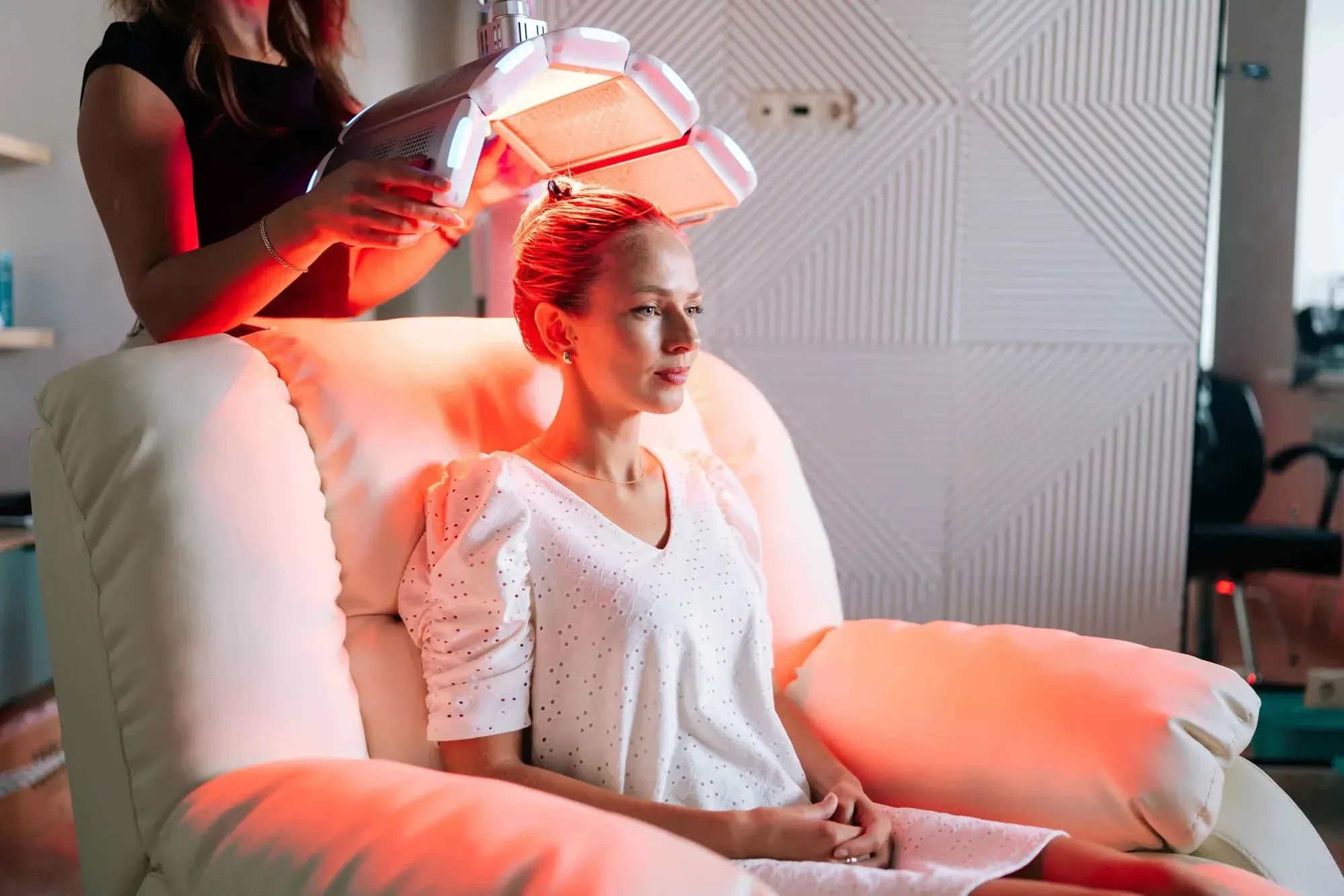
Laser caps and red light for hair loss: what can you expect?
Red light has better studies behind it than most alternative hair treatments. The effect is still mild. Here's what the light does, which device makes sense, and how to use it after a transplant.
Can a laser cap give you your hair back?
No, not where the hair follicles are already gone. Red light can slow hair loss and make weakened hairs a little thicker in some people, but the effect is modest and varies a lot.
People tend to have one of two impressions of red light. Either they've just bought an expensive cap and expect great things, or they've decided the whole thing is nonsense. Neither is quite right.
Red light therapy actually has better evidence than most of what's sold as alternative hair treatment. But there's a clear limit to what it can do. If the follicles in an area have stopped producing hair, there's nothing for the light to wake up. At that point, a hair transplant is the option to look at, if anything is.
What is LLLT, and how does the light act on the hair follicle?
LLLT stands for low-level laser therapy. You'll also see it called photobiomodulation or just laser therapy. The scalp is exposed to weak light in the red and near-infrared range, usually at wavelengths around 650 to 670 nanometres. The light is weak enough that the skin neither heats up nor gets damaged. The lasers a skin clinic uses for hair removal are something completely different and far stronger.
The idea is that an enzyme in the mitochondria, cytochrome c oxidase, absorbs the light. Mitochondria are the cells' power plants, and the absorption is meant to boost production of ATP, the energy cells run on. More energy is meant to make the cells in the hair follicle more active. The goal is a longer growth phase (anagen), resting follicles waking up, and stronger hair shafts.
There's also an idea that the light improves blood flow in the small vessels and dampens inflammation around the follicles. Lab experiments support the mechanism. What counts, though, is what happens on real people's heads, and there the results are more mixed.
What do studies show about red light for hair loss?
Several devices have been approved by the authorities, including FDA clearance in the USA, for treating hereditary hair loss. Several randomised studies find a statistically significant increase in hair density compared with sham treatment. That's more than most supplements and serums can show.
Statistically significant still only means the difference is probably real. It says nothing about it being large. The effect is mild to moderate, it varies between people, and the strongest evidence is that hair loss is slowed and the hair gets a little thicker. Bald patches don't fill in. Some of the research is also funded by the manufacturers themselves, which is a good reason to read the findings critically.
How much better does hair get in practice?
Compare it with the medicines. Finasteride and minoxidil give most users clear stabilisation and many visible thickening. Red light sits lower and is more uneven. Some get a modest increase in density. Others notice nothing. No test tells you in advance which group you'll fall into.
Think of the device as an investment with an uncertain return. You make it on top of a solid foundation, never as the only measure. Go in with that attitude and you'll rarely be disappointed, because you're not expecting miracles.
What are the benefits of red light therapy?
- Almost no side effects. It doesn't hurt, nothing is injected, and you don't get the kind of whole-body side effects finasteride can cause. For many people that's the main reason to try it.
- Reasonable evidence. Approved devices and several randomised trials put red light ahead of most alternatives.
- Works alongside medication. The light doesn't weaken the effect of minoxidil or finasteride, and it tackles hair loss in a different way from the tablets.
- May support healing. Better circulation and less inflammation are why some clinics use it after surgery.
- At home. Once you've bought the device, you don't need constant clinic visits.
What are the drawbacks of red light therapy?
- Small effect. Expect stabilisation or a mild improvement. Hair you've lost won't come back.
- Takes discipline. You have to use the device several times a week for months, and the gain disappears when you stop. Many people put the device away long before it had time to show anything.
- Expensive. A good device easily costs several thousand kroner, and the caps with the most diodes are at the top of the price range. A cheap comb with a handful of diodes is unlikely to emit enough light to make a difference.
- Uneven quality. The number of diodes, the wavelength and the output power vary enormously. Not everything called laser therapy delivers a dose that matters.
- No guarantee. Quite a few users notice no difference, and there's no test that tells you who will respond to the treatment.
Comb, cap or panel: which device should you choose?
What decides it is how much light at the right wavelength actually reaches the scalp. The name on the box means little.
| Type | What it covers | Worth knowing |
|---|---|---|
| Laser comb or brush | One small area at a time | Affordable, but often too little light. Has to be moved slowly and systematically over the head. |
| Cap or helmet | The whole scalp | Costs more, but treats everything at once. Usually the easiest to stick with. |
| Panel or clinic device | Large areas | Powerful, but you have to go to the clinic. |
Check the number of diodes and the stated wavelength before you buy. If the device has too few diodes, the light won't reach enough of the scalp, whatever the advertising says. A cap with dense diode coverage gives the most even treatment, and it also costs the most.
How do you use red light correctly?
Buy a device with enough diodes and a stated wavelength of 650 to 670 nm. Use it regularly as the manufacturer directs, usually several times a week. Give it at least 4 to 6 months before you judge whether it works, the same timescale as for medication. And remember this is an ongoing treatment. If you stop, the effect disappears.
Take dated photos once a month, in the same place and the same light. You won't see small changes in the bathroom mirror.
If you find it easy to keep up routines, a good device can be a sensible purchase. An expensive cap that ends up in the cupboard after four weeks is money wasted.
Can you use red light after a hair transplant?
There's a reasonable rationale. A healing recipient area benefits from good circulation and little inflammation, which is why some clinics include LLLT in their aftercare.
Wait until the skin has healed well enough that you can put the device on your head without disturbing the grafts. That usually takes a good while, and you agree the start date with the clinic. The light is a mild extra. Whether the transplant succeeds is decided by the technique and the aftercare. You can also read about the first few days after the operation.
Should you buy a laser cap or medication first?
Medication first, if your hair loss is hereditary. Finasteride and minoxidil have far stronger evidence, and red light belongs as an add-on.
Red light falls into the category of low risk and a small, uncertain gain. If you want to include everything sensible to keep your hair, and you can't tolerate or don't want to take medication, it's a reasonable add-on with acceptable studies and few drawbacks beyond price and time. There's rarely a reason to advise against it, but no reason to sell it as more than it is either.
Buying the cap instead of the medication means putting the weakest tool first. Used together with medication, the light may give some people the small extra margin that keeps a bit more hair. That combination is logical if you want to include everything with reasonable support.
What should you do now?
If you're standing card in hand in front of a cap costing several thousand kroner, stop for a moment. Has your hair loss been assessed, and have you talked to a doctor about medication that slows hair loss? If not, start there. If you have the basic treatment in place and want an add-on, choose a cap with plenty of diodes and the right wavelength, and set aside six months of regular use before you judge it.
This article is general information and does not replace a medical assessment of you.
If your hair loss has only just started, a procedure may not be the right step yet. The medical team at the clinic at the top of our ranking can look at your photos and tell you honestly whether to wait, start with treatment or consider more.
Goes to the clinic at the top of our ranking.