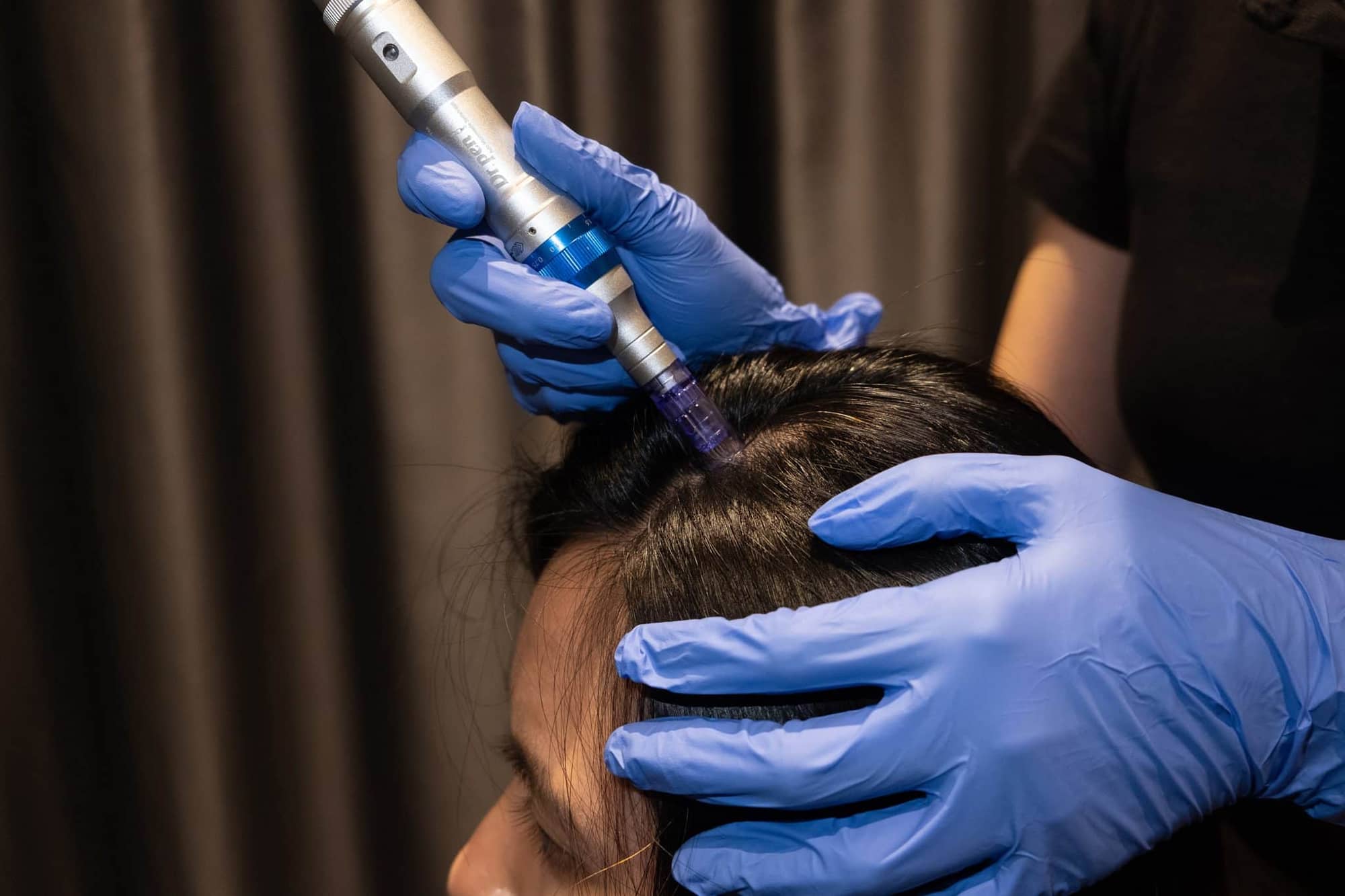
Does microneedling work for hair loss? When a dermaroller helps
A dermaroller costs little and has better studies behind it than many expensive treatments. The effect comes mainly in combination with minoxidil, and only if you use it correctly.
Is a dermaroller worth the money?
For most people with hereditary hair loss: yes, as an add-on to minoxidil. As the only treatment: hardly. That's the whole answer in one sentence, and the rest of the article is about why, and how to avoid doing more harm than good.
Microneedling is one of the few home treatments for hair loss where the research actually gives grounds for some optimism. The equipment is affordable, the treatment takes a few minutes, and the mechanism makes biological sense. The problem is rarely the method. The problem is that many people buy a roller with long needles, use it every evening and think more pain means more hair.
What happens in the scalp when the needles go in?
The needles make thousands of tiny punctures in the skin, and the skin responds by repairing itself. That repair is the point. Some use a handheld roller with needles all around the cylinder, a dermaroller. Others use an electric pen, a dermapen. The needles usually measure from just under one millimetre up to about two. It's also known as collagen induction therapy, and you'll see the terms dermarolling and microneedling used for the same thing.
Two things happen afterwards. First, the skin starts a healing process in which it releases growth factors and signalling molecules. There's reason to believe these same substances affect the hair follicles and may wake follicles that have gone dormant. Researchers have also seen signs that the punctures activate Wnt/β-catenin, a signalling pathway hair follicles depend on to grow.
Second, the scalp becomes more receptive to what you apply. Minoxidil reaches the follicles more easily when the skin has been microneedled. This probably explains much of why the combination does better in studies than minoxidil on its own. You can read more about the medicine itself in the guide to minoxidil.
How good is the research, really?
Stronger than for almost any other add-on treatment. Several studies, including randomised ones, have found that microneedling together with minoxidil gives more hairs and denser hair than minoxidil without needles. Few of the popular extras on the market can point to that.
But check the fine print. The evidence concerns microneedling as an add-on, not as a treatment in its own right. The studies use different needle lengths and different frequencies, so nobody can say for sure which protocol is best. Several of the trials are also small. The conclusion is still clear enough to take away: if you have limited money and patience, microneedling belongs high on the list of add-ons to consider.
Why isn't microneedling enough on its own?
Because it doesn't touch what drives hereditary hair loss. DHT keeps shrinking the follicles however many punctures the scalp gets. That's why it's more accurate to call microneedling an amplifier than a treatment.
Picture a staircase. The bottom step is the two well-documented medicines. Finasteride and minoxidil do the heavy lifting. Microneedling stands one step higher and makes minoxidil a little more effective. If you skip the bottom step and just roll, you're standing in the wrong place. If you roll on top of the medication, you get more out of what you're already doing, at almost no extra cost.
Many people who use the method correctly set up a fixed weekly routine tied to their minoxidil treatment. That small effort adds up over months. If you want to know how the medicines work together, see the article on combination treatment.
How do you use it without damaging your scalp?
Short needle, not too often, completely clean. When microneedling goes wrong, at least one of those three rules has usually been broken. The table shows a sensible starting point:
| What | Sensible choice |
|---|---|
| Needle length | Short needles used regularly are gentler than long needles used occasionally. Ask a professional about the length. |
| How often | Usually once a week. Never every day, because the punctures need to heal before the next round. |
| Hygiene | A cleaned tool and a washed scalp every single time, or the risk of infection rises. |
| Minoxidil afterwards | Don't apply it straight after rolling. Wait until the redness and irritation have settled. |
Every puncture is a small wound, however tiny. If you treat too often, the skin never gets to rest, and you end up with irritation, inflammation and a scalp in worse shape than before. The same logic applies to hygiene. When you make thousands of openings in the skin, you give bacteria a way in. A roller lying dirty in a drawer between sessions is a bad idea.
Long needles are tempting because they feel more effective. They go deeper, hurt more and bleed more, without anyone having shown that the result is better. For home use, short needles are the wisest choice, usually 0.5 to 1.0 mm, and longer needles belong with professionals. The worst case is scarring, because scar tissue can damage the very follicles you're trying to save. Pressing hard or rolling every day doesn't give faster results, just a sorer scalp. The roller is personal, so don't lend it out, and replace it at regular intervals. When the needles go blunt, they tear the skin and leave ragged wounds where there should be small, clean punctures. Unsure? Have the first sessions at a clinic or get guidance before you start on your own.
What are the pros and cons?
The benefits first:
- The research holds up: more studies than most add-ons can show, especially in combination with minoxidil.
- More out of minoxidil: increased absorption may make the treatment you already use more effective.
- Low price: a good roller costs a fraction of most clinic treatments.
- Can be done at home: with good technique and good hygiene, you don't need a clinic.
- The body's own response: you add no foreign substances, the skin does the work itself.
Then the drawbacks:
- Incorrect use causes harm: needles that are too long, sessions that are too frequent or unclean equipment can cause skin damage and infection.
- It's uncomfortable: tenderness, redness and a little bleeding are common, more so the longer the needles.
- You have to stick with it: the effect only comes with regular use over a long time.
- Minoxidil takes planning: increased absorption can also cause more irritation if you apply it too soon.
- Weak as the only measure: against hereditary hair loss, its strength lies in the combination.
Who should avoid microneedling?
Microneedling suits you best if you already use minoxidil and want to get a bit more out of it without spending much money. Done correctly, the risk is low. Avoid it if your scalp has an infection right now, if you have eczema or psoriasis where you'd be rolling, or if you easily develop large, hard scars (keloids). Then the needles may do more harm than good.
Be aware of the limits too. In hereditary hair loss, microneedling is no substitute for finasteride, and it doesn't create hair where the scalp is completely bare.
Can you microneedle after a hair transplant?
Yes, but long afterwards, and only by agreement with the clinic. A freshly transplanted area should never be microneedled. The grafts need many months to anchor and heal before the skin can tolerate that kind of treatment.
Once the area has fully healed, microneedling may support both the transplanted hair and the hair around it. That's a decision you make together with the surgeon, not something you try on your own a few weeks after the operation. If you've just had surgery, the advice for the first few days is what you need now.
What do people most often ask?
Does it work without minoxidil? A little, but the effect is modest. The best evidence is for the combination, where the two lift each other.
Which needle length should I choose? It depends on the protocol, and you should clarify that with a professional. Rule of thumb: short needles, used with the right technique and regularly, are safer and gentler than long needles used hard.
Can I do it myself? Yes, if your technique and hygiene are right. The wrong choice of needle length, frequency or cleaning can cause harm, so read up properly, or let a clinic handle it.
Is it risky? Not very, as long as you use it correctly. The two real dangers are infection from poor hygiene and skin damage from overzealous use. You can steer clear of both.
How do you get started?
If you already use minoxidil, the next step is simple: buy a roller with short needles, pick one fixed evening a week, and move that evening's minoxidil dose to a time after your skin has settled. Clean the roller after every use. Take a photo of your hairline and crown before the first session, so you have something to compare with in a few months.
If you're not using any medication yet, start there. Talk to your doctor about what suits you, and hold off on the roller until the foundation is in place. You'll find more about the method on the page about microneedling for hair loss.
This article is general information and does not replace a medical assessment of you.
If your hair loss has only just started, a procedure may not be the right step yet. The medical team at the clinic at the top of our ranking can look at your photos and tell you honestly whether to wait, start with treatment or consider more.
Goes to the clinic at the top of our ranking.