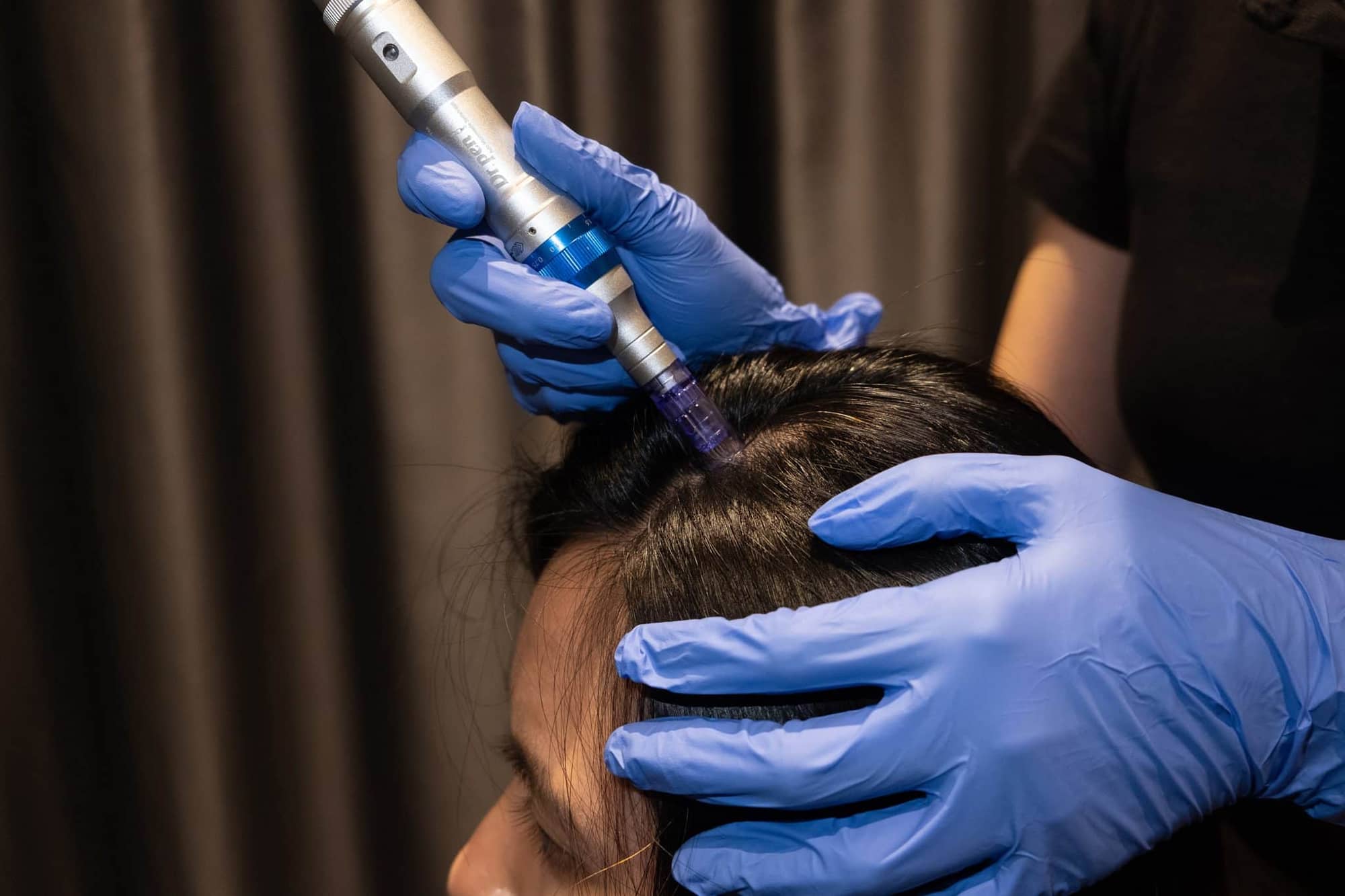
Microneedling and minoxidil: does the combination help?
Microneedling gives the scalp tiny, controlled puncture injuries. Around ten randomised studies with several hundred patients in total suggest topical minoxidil does more when the two are combined, but the quality of the studies varies a lot.
Microneedling gives the scalp tiny, controlled puncture injuries. Around ten randomised studies with several hundred patients in total suggest topical minoxidil does more when the two are combined, but the quality of the studies varies a lot. It is one of the more promising add-ons, but the evidence is still thin, and clean equipment matters.
How does microneedling work?
A roller or stamp with fine needles is passed over the scalp and creates small, controlled injuries. The skin starts wound healing, growth factors are released, and products you apply afterwards penetrate more easily. That last effect is the most tangible: a medicine that is better absorbed through the skin probably works better.
Do microneedling and minoxidil give better results than minoxidil alone?
Around ten randomised studies suggest so, but quality varies. The caveats are the same as elsewhere in this field: small groups, short follow-up, differing protocols and few independent trials confirming the findings. The combination is therefore a promising signal, not an established standard.
What do you need to watch out for with microneedling?
Keep the needle depth low to avoid scarring, and don't needle more than once a week, since the skin needs time to heal. The equipment must be completely clean because the skin is punctured over and over. Many people wait a little before applying minoxidil after needling, because applying it straight away can cause more irritation. And if the skin is inflamed or infected, it shouldn't be needled at all.
- Needle depth. Deeper doesn't work better, and needling too deep can cause scarring.
- Frequency. Once a week or less is typical. If you do it every day, the skin doesn't have time to heal.
- Hygiene. The equipment must be clean, since the skin is punctured again and again.
- When you apply minoxidil. More is absorbed right after needling, but it can also cause more irritation. Many protocols leave time between the two.
- Never on inflamed or infected skin.
Can you use microneedling on the recipient area after a transplant?
No, not unless your clinic has explicitly said yes. While the grafts can still be dislodged, needling does direct damage, and the skin keeps healing for a long time after that too. The method belongs in the medical treatment of thinning hair, not on a fresh transplant.
Microneedling is usually combined with the medicines we cover in the guide to treatment without surgery.
Sources
- Dhurat R, Sukesh M, Avhad G, Dandale A, Pal A, Pund P. A randomized evaluator blinded study of effect of microneedling in androgenetic alopecia: a pilot study. International Journal of Trichology, 2013;5(1):6-11. pubmed.ncbi.nlm.nih.gov/23960389
- Abdi P, Awad C, Anthony MR, Farkouh C, Kenny B, Maibach HI, Ogunyemi B. Efficacy and safety of combinational therapy using topical minoxidil and microneedling for the treatment of androgenetic alopecia: a systematic review and meta-analysis. Archives of Dermatological Research, 2023;315(10):2775-2785. pubmed.ncbi.nlm.nih.gov/37665358
- Ahmed KMA, Kozaa YA, Abuawwad MT, Al-Najdawi AI, Mahmoud YW, Ahmed AM, et al.. Evaluating the efficacy and safety of combined microneedling therapy versus topical minoxidil in androgenetic alopecia: a systematic review and meta-analysis. Archives of Dermatological Research, 2025;317(1):528. pubmed.ncbi.nlm.nih.gov/40056230
- English RS Jr, Ruiz S, DoAmaral P. Microneedling and Its Use in Hair Loss Disorders: A Systematic Review. Dermatology and Therapy, 2022;12(1):41-60. pubmed.ncbi.nlm.nih.gov/34854067
- Bernstein RM, Rassman WR. Graft Anchoring in Hair Transplantation. Dermatologic Surgery, 2006;32(2):198-204. pubmed.ncbi.nlm.nih.gov/16442039
This page summarises published studies. It offers general knowledge, not a medical assessment of you, and it is not a recommendation to start, stop or change any medicine. Prescription medicines have contraindications and can interact with other medicines, so talk it through with your doctor, who knows your medical conditions and what you take.
Wondering what's possible for your hair?
Send three sharp photos of your hair, from the front, the top and the back. You'll get an honest answer on what can be done, roughly how many grafts it would take and what it costs.
- Free and with no obligation
- Photos are assessed by the clinic's medical team
- Replies usually within an hour in the daytime


A study tells you something about groups. Only a doctor who has seen your photos can say what applies to your hair. The medical team at the clinic at the top of our ranking offers a free assessment.
Goes to the clinic at the top of our ranking.