Mesotherapy for hair: is it worth the money?
Tiny injections of vitamins straight into the scalp sound logical. We look at what actually gets injected, what the studies show, and where your money should go first instead.
Why is mesotherapy so tempting for so many people?
Because it feels like doing something, even though the evidence that it works for hair loss is weak. You turn up at the clinic, have a series of treatments and go home feeling you've tackled the problem. Compared with a tablet every morning and a foam that takes six months before you see anything, it's far more tangible. That feeling has real value for someone who is worried.
The trap is that tangible and effective aren't the same thing. Many people who have been through several rounds of mesotherapy have at the same time put off the medication that could have kept their hair. That's the trade-off this article wants to help you avoid. Sometimes the best thing you can do for your hair is the boring, invisible option.
What actually gets injected?
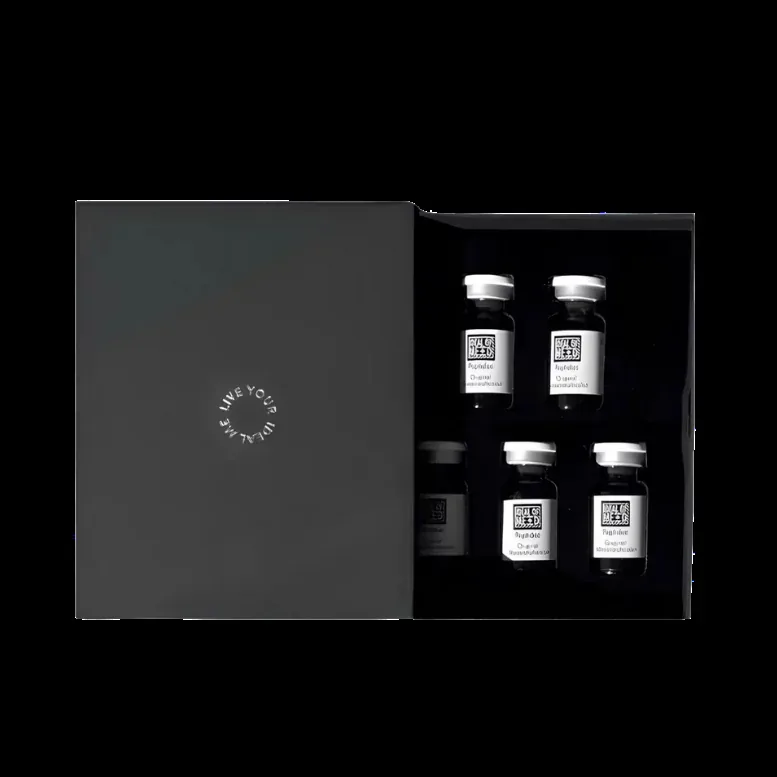
Mesotherapy means a very fine needle places small doses of a mixture into the outermost layer of skin on the scalp, close to the hair follicles. The mixture is often called a "cocktail". It may contain vitamins, minerals, amino acids, hyaluronic acid and caffeine, and some clinics add medicines or growth factors.
This is where the first problem lies. There's no fixed recipe. Every clinic mixes its own, so two people who both say they've had mesotherapy may have had completely different substances in their scalp. That makes it hard to say anything overall about the treatment, and even harder to know what you're paying for.
The method has its roots in French medicine. Today it's offered at many beauty and hair clinics, most often marketed for diffuse hair loss or to "strengthen" the hair.
Why does the theory sound so convincing?
The hair follicle is a small organ with big demands. It needs nutrients, a good blood supply and good conditions around it to make strong hair shafts. The idea is that when follicles weaken in diffuse hair loss, without DHT necessarily being the main cause, building blocks delivered right on the spot can give them new life and a longer growth phase.
Some mixtures include agents that, on paper, are meant to dampen DHT locally or improve blood flow in small vessels. The injections themselves may also trigger a mild wound-healing response, as microneedling does, and that releases growth factors.
So there are several possible mechanisms. But a mechanism that makes sense on paper is not the same as a proven result. That step is exactly what matters for you.
What does research show about mesotherapy for hair loss?
The evidence is weak and inconsistent. The studies are small, the results mixed, and because the contents vary from clinic to clinic, they can hardly be compared.
We lack the large, well-designed randomised trials needed to establish a real effect. What does exist points in different directions.
Some people do still see improvement. There's no reason to dismiss that. The question is what causes the improvement. Is it the mixture? Is it the needle pricks, which act much like microneedling? Or is it placebo and the natural variation in hair loss? Nobody can say for sure today.
Put this next to finasteride and minoxidil, which have far better evidence, and the difference is clear. It should shape where you put both your money and your expectations.
How does mesotherapy compare with PRP, microneedling and minoxidil?
Mesotherapy competes with other treatments that stimulate the scalp or are injected. Here's how they look side by side:
| Treatment | How it's meant to work | Evidence |
|---|---|---|
| Mesotherapy | Nutrient mixture delivered locally | Weak, inconsistent |
| Microneedling | Wound healing and better absorption of products | Moderate, especially combined with minoxidil |
| PRP | Growth factors from your own blood | Moderate |
| Minoxidil on the scalp | Prolongs the growth phase | Strong |
If you're going to spend money on injections or stimulation, both microneedling and PRP stand on firmer ground. Minoxidil as a liquid or foam has more evidence than all three. Mesotherapy ends up near the bottom of this group.
What speaks in favour of mesotherapy?
- The substances end up where they're needed. They don't have to travel through the blood to reach the hair follicle.
- Almost no downtime. You go straight home after a short outpatient appointment.
- The injections themselves may help. The wound healing may have a beneficial effect whatever the mixture contains.
- Works alongside medication. It doesn't counteract other treatment and is sometimes used as an add-on.
- Easy to get. Many clinics offer it, and it's relatively gentle.
Notice what the most certain benefits actually are: short downtime and the effect of the needle itself. Neither has anything to do with the special mixture. Remember that when the price tag is justified by what's in the syringe.
What speaks against mesotherapy?
- Uncertain effect. The evidence is thin and inconsistent, so you're buying a treatment nobody can promise you anything from.
- No standard. The word mesotherapy can cover almost any mixture.
- Many sessions. If it works, you usually need a series of treatments and then maintenance. It quickly gets expensive.
- Discomfort and some risk. Red, tender skin and the odd bruise are common. With poor hygiene there's a small risk of infection, as with any injection.
- It can crowd out what works. The biggest risk is that mesotherapy is chosen instead of proven treatment.
Can mesotherapy slow hereditary hair loss?
No. Hereditary hair loss is driven by the hormone DHT, and no vitamin mixture changes that process.
In androgenetic alopecia, hormonal influence is what makes the follicles shrink. A cocktail of vitamins and amino acids does nothing about that. Here proven medication is what counts, and the time you spend on mesotherapy is time without that protection. Read more about how to slow hair loss without surgery.
Be extra sceptical when the treatment is sold as expensive packages meant to "bring your hair back to life". The promises are bigger than the evidence.
What if your hair loss is caused by a lack of iron or vitamins?
Then there's even less reason to have vitamins injected into your scalp. Diffuse hair loss linked to nutrition or health should be investigated, so you find and correct the actual cause. Ferritin, vitamin D and thyroid function are the usual suspects, and a blood test at your GP gives the answer. Fixing a real deficiency does more for your hair than any cocktail. See also the article on iron deficiency and hair loss.
Does mesotherapy hurt, and who is it really for?
You feel the fine needle pricks, and you may be tender and get small bruises. Most people tolerate it fine, and you don't need to take time off afterwards.
The treatment may make sense for a few people: those with diffuse hair loss that isn't purely hereditary, who want gentle stimulation and who know the evidence is weak. If you have classic hereditary hair loss, other measures should come first. Compared with PRP, mesotherapy comes off worse. PRP uses growth factors from your own blood and has somewhat better evidence, while a mixture that changes from place to place is hard to put ahead of it.
Which questions should you ask the clinic first?
If you're offered mesotherapy, ask a few simple questions before you pay. The answers say a lot about the clinic.
- What's in the mixture, ingredient by ingredient? A reputable provider can tell you and explain why.
- How many sessions do you expect, and what does the whole course cost? Ask for the total price including maintenance, not just the price per session.
- How do you ensure hygiene? Single-use needles and a clean scalp are the minimum.
- What do you recommend if my hair loss is hereditary? If they say mesotherapy alone is enough, that's an answer you should be sceptical of.
No honest clinic will promise you a specific result. The evidence doesn't support it.
What would the same money get you elsewhere?
Do the sums before you say yes. A typical plan is a series of treatments followed by maintenance, and over one to two years the total is often considerable. What could the same amount buy with better evidence behind it?
If your hair loss is hereditary, the answer is usually several years' supply of medication that demonstrably slows thinning. Or a good start on saving for a hair transplant, if that ever becomes relevant. Looked at soberly, the choice is rarely hard.
Mesotherapy isn't dangerous. It can be a reasonable choice if you already have a diagnosis, have the basic treatment in place and want to try a gentle add-on with your eyes open. But only as an add-on, never as a replacement, and never in the hope that this particular mixture is the one that finally works.
What should you do before booking an appointment?
Do things in the right order. First book an appointment with your GP or a dermatologist and find out what type of hair loss you have: hereditary, diffuse or triggered by something like iron deficiency or your thyroid. If it's hereditary, talk to the doctor about medication. If it's a deficiency, correct it. If you then want to try something extra, look at microneedling or PRP before mesotherapy. Start with the first steps for hair loss if you haven't already.
This article is general information and does not replace a medical assessment of you.
If your hair loss has only just started, a procedure may not be the right step yet. The medical team at the clinic at the top of our ranking can look at your photos and tell you honestly whether to wait, start with treatment or consider more.
Goes to the clinic at the top of our ranking.