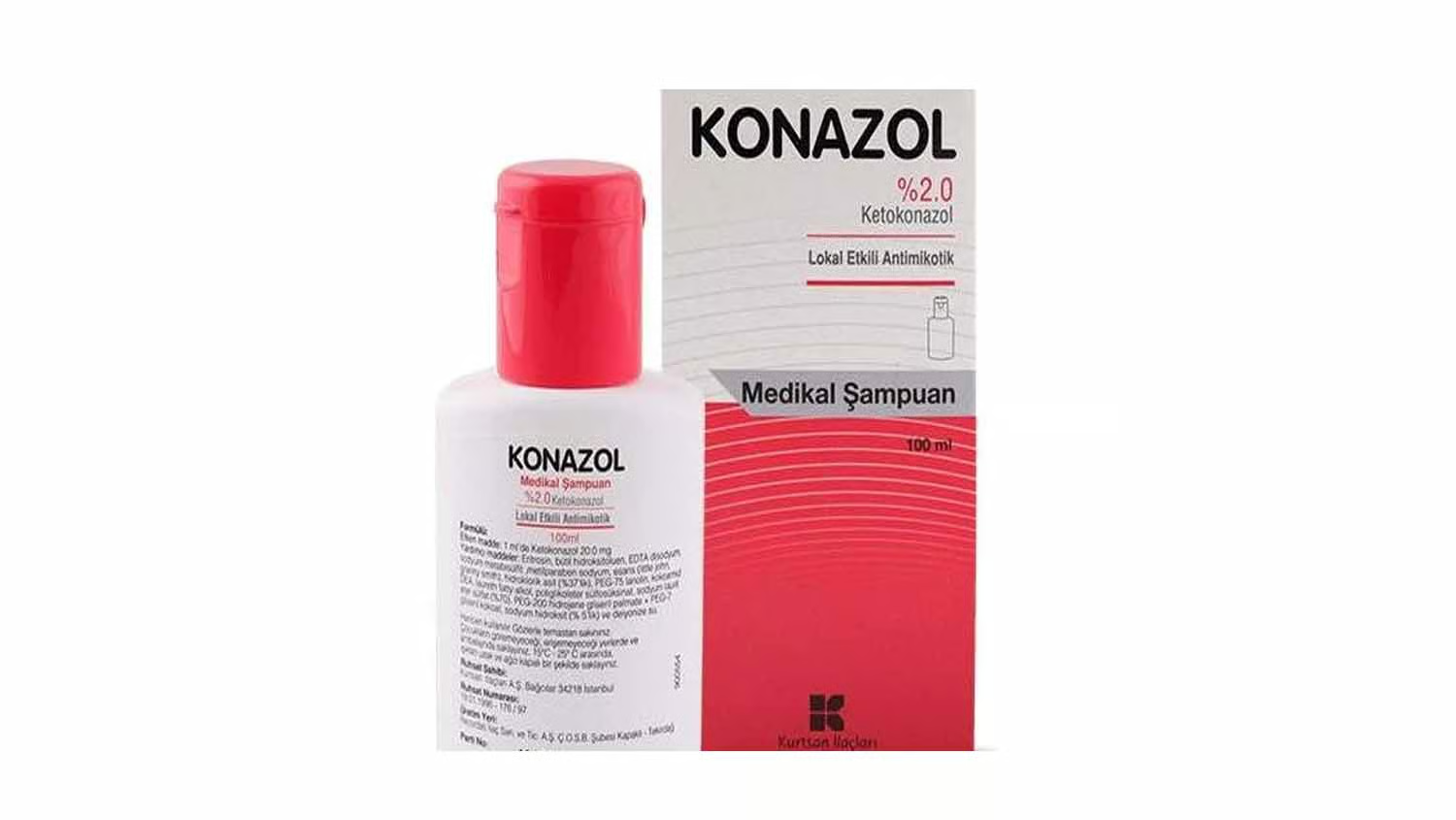
Does ketoconazole shampoo help with hair loss?
An inexpensive dandruff shampoo can give your hair a little extra help. Here's what ketoconazole can and can't do, and how to use it without drying out your scalp.
How much can ketoconazole do for hair loss?
Perhaps a little, and that little may be worth it. Ketoconazole doesn't stop hereditary hair loss on its own, but it seems to make a modest contribution when used alongside medication that works. The evidence is thin. Even so, the price and the risk are so low that it's among the most sensible add-ons you can choose.
So the order is clear. First the treatment that does the main work, then the shampoo as a cheap bit of extra help. Reverse that order and you're betting on the weakest card in the deck.
What is ketoconazole, and why do people with thin hair talk about it?
Ketoconazole is an antifungal agent. Many people know it from shampoo for dandruff and for seborrhoeic dermatitis, a condition where the scalp becomes greasy, red and flaky. It has been used against fungal problems of the scalp for decades and is sold as a shampoo in two strengths, 1 % and 2 %. In Norway you can get 2 % as a shampoo without a prescription at the pharmacy.
What has made it popular among people with hair loss is a side effect nobody expected from a dandruff shampoo. Ketoconazole appears to have a weak antiandrogenic effect where it's applied. That means it may locally, in the scalp, influence the hormonal system behind hereditary hair loss.
How can an antifungal shampoo affect your hair?
Two explanations are put forward, and they probably work together.
The hormonal one. Studies suggest that ketoconazole may dampen the effect of DHT in the skin where the shampoo sits. DHT is the hormone that makes genetically sensitive hair follicles shrink. Compared with a true DHT blocker such as finasteride this is small, but it may ease the pressure on the follicles a little, right where you wash.
The anti-inflammatory one. When dandruff and seborrhoeic dermatitis are kept down, a source of persistent irritation in the scalp disappears. There is much to suggest that mild, long-lasting inflammation can make hair loss worse. A calm scalp is a better place for hair to grow.
Neither makes ketoconazole a strong treatment on its own. But both give a biologically reasonable basis for thinking the shampoo can do some good for the environment around the hair follicles.
What do the studies show?
Not as much as we'd like. There are a few small studies suggesting better hair density and thicker hair shafts, and a couple of them have compared the shampoo with established treatment, with interesting findings. What's missing are large, well-designed trials. Without them, no one can say for sure how big the effect is.
So why recommend it? Because the maths is unusually good. When something is cheap, easy to get hold of, gentle and almost free of side effects, the benefit doesn't need to be large or entirely certain before it becomes a reasonable choice. Compare that with expensive treatments without evidence. There, weak evidence weighs far more heavily, because you pay a lot for the uncertainty.
What are the benefits of ketoconazole shampoo?
- Low price. A bottle costs little compared with almost anything else for hair loss, and 2 % shampoo is available without a prescription at the pharmacy.
- Dandruff treatment thrown in. The effect against dandruff and seborrhoeic dermatitis is well documented, whatever it does for your hair.
- Few problems. The vast majority use it without any trouble.
- A small dose of antiandrogenic effect. It targets the same mechanism as the medicines, just more weakly and locally.
- Easy to combine. It can be used side by side with both minoxidil and finasteride.
What are the downsides of ketoconazole shampoo?
- Small effect. The contribution is modest, even when things go well. Shampoo won't stop hereditary hair loss.
- Thin evidence. Promising, but far from proven.
- Dry scalp. Used too often, it can cause dryness or irritation in some people, so most stick to a couple of washes a week.
- Risk of the wrong priorities. If you use it instead of medication, you've passed over what works best.
- Strength matters. 1 % may have an even weaker effect than 2 %.
How do you use ketoconazole shampoo correctly?
| Question | Good starting point |
|---|---|
| How often? | Usually 2 to 3 times a week. Not every day, so your scalp doesn't dry out. |
| How long in the hair? | A couple of minutes. Rinse only once the active ingredient has had a chance to work. |
| Together with what? | Minoxidil and finasteride. The shampoo comes in addition, never instead. |
| Which strength? | 2 % is the strongest, and in Norway you can get it as a shampoo without a prescription at the pharmacy. Feel free to ask a doctor or pharmacist. |
If your scalp feels tight, dry or irritated, wash with it less often and use a mild shampoo on the other days. The big effect still comes from the documented foundation. Ketoconazole is a small bonus on top.
Who has the most to gain from it?
The shampoo makes the most sense if you have two problems at once: hereditary thinning and a scalp that itches, flakes or gets greasy quickly. Then you get a well-documented treatment for the dandruff, and a possible small benefit for your hair, in the same wash.
If you already use finasteride or minoxidil and want to do a bit more without spending much, it's also a decent choice. There's little to lose.
If, on the other hand, you haven't started anything at all and are just thinking of trying shampoo first to see, it's worth thinking again. Hereditary hair loss doesn't wait while you experiment. The time you spend on a weak remedy can cost hair that medication could have held on to. Read what to do first when your hair is thinning.
Where does the shampoo belong in your treatment?
Think of treating hereditary hair loss as layers. At the bottom are the best-documented medicines, finasteride and minoxidil, which carry most of the weight. Above them come inexpensive add-ons that give a little extra, for example microneedling and ketoconazole. At the top is surgery, for areas where the hair is gone for good.
Seen as a layer, ketoconazole is among the cheapest you can add. For a very small sum you get a probably small benefit and a well-documented dandruff treatment. That's a completely different purchase from the expensive courses where you pay a lot for a promise no one has proven.
If you already have a greasy or flaky scalp, the choice is almost obvious, however much it does for your hair. The most common mistake is to use the shampoo faithfully as the only remedy for the hereditary loss, while the medication that could have achieved far more is never tried. That's an expensive misunderstanding, even if the bottle is cheap.
Good hair care doesn't have to cost a fortune. Sometimes the smartest add-on is simply an inexpensive shampoo a couple of times a week, used with sober expectations.
How do you know if it's doing anything?
Honestly, it's hard to separate its effect from the rest of your treatment. If you use the shampoo alongside medication, you won't be able to see what comes from what. That's fine. The goal isn't to test the shampoo but to give your hair the best possible conditions.
What you may notice fairly quickly is your scalp. Less dandruff, less itching and less grease are signs that the anti-inflammatory part is doing its job. For the hair itself, the same rule applies as for all hair treatment: take photos in the same spot and the same light every month, and judge after several months, not after a few weeks.
Quick answers about ketoconazole shampoo
Is ketoconazole enough on its own? No. The effect is modest and doesn't stop hereditary hair loss. The shampoo is an add-on.
How often should I wash with it? Usually 2 to 3 times a week. Every day is too much for many scalps. Leave the lather in your hair for two minutes before rinsing it out.
Which strength should I choose? The strongest, 2 %, is available as a shampoo without a prescription at pharmacies in Norway, while 1 % is milder. Choose according to your needs, ideally on the advice of a doctor or pharmacist.
Can it be combined with minoxidil and finasteride? Absolutely. It's most useful in exactly that company, as an inexpensive, gentle helper alongside the medicines.
What should you do now?
Buy a bottle of 1 % the next time you're at the pharmacy, and use it on fixed days, for example Monday and Thursday. If you don't use medication for hereditary hair loss today, book a doctor's appointment and talk about that first, because that's where the big difference lies. You might like to read about how the medicines can be combined before the appointment.
This article is general information and does not replace a medical assessment of you.
If your hair loss has only just started, a procedure may not be the right step yet. The medical team at the clinic at the top of our ranking can look at your photos and tell you honestly whether to wait, start with treatment or consider more.
Goes to the clinic at the top of our ranking.