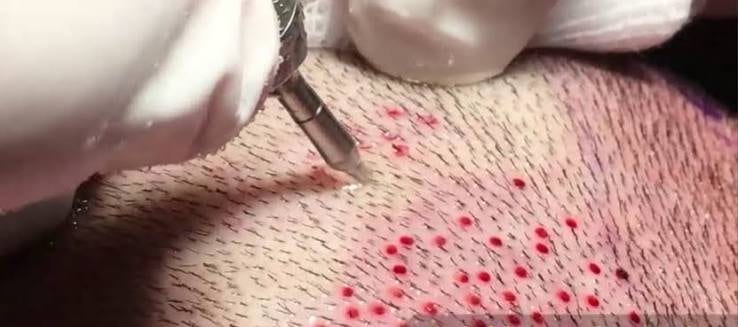
Robotic or manual FUE: does a robot give a longer-lasting result?
The studies comparing robot and hand have short follow-up. Nobody has followed the patients for several years.
Robot and hand have been compared in studies with short follow-up, but nobody has followed the patients for years. Both methods take follicles from the same donor area. What separates them in the long run is found at the back of the head, not in how long the grafts last.
What has research on robotic vs manual extraction actually looked at?
Only short technical comparisons. A robot takes over parts of extraction, such as finding the units, aiming the punch and cutting around the follicle, while an operator watches. In manual extraction, the operator does everything by hand and judgement. In 2024 the two were compared in a study of men with androgenetic alopecia, but no studies follow patients for years.
An extraction robot takes over some steps of FUE. It finds the follicular units, aligns the punch and cuts around the follicle while an operator supervises. In manual extraction, the operator's hand and judgement do the whole job.
Zhu and co-authors compared the methods in 2024 in a paper in Journal of Cosmetic Dermatology. They set robotic hair restoration technology against traditional FUE in men with androgenetic alopecia. Review articles on the development of modern FUE systems place the robot as one step in a longer history of punches and equipment.
None of these studies has followed patients over several years.
Should one method give a result that lasts longer?
No, not in theory. Whether a graft lasts is decided by donor dominance: which zone the follicle came from, and whether that zone really withstands hormonal influence. The equipment plays no part in that. If a follicle is taken intact from the safe zone and placed correctly, it should behave the same after twenty years, whether a robot or a person extracted it.
The whole field rests on donor dominance. A follicle keeps its characteristics when it's moved, and whether a graft survives for decades depends on which zone it was taken from and whether that zone really was resistant.
A machine doesn't change that. If a robot and a surgeon each take an intact follicle from the middle of the safe zone at the back of the head, and both are implanted well, the two should look the same twenty years later.
The honest answer to which method lasts longer is therefore that no mechanism points to a difference, and no data shows one.
Where do you see the difference between robotic and manual extraction years later?
The difference lies in the extraction and in the donor area. How long the grafts last is the same. How well extraction succeeds can be measured: one comparison of two punch types found roughly the same yield with both. A robot doesn't tire in long sessions, but curly hair is demanding whatever the equipment.
What counts is how well the extraction is done and what the back of the head looks like afterwards. Both have consequences for many years.
- Transected follicles. A follicle that's cut through leaves a scar without giving a usable graft. That's the worst trade you can make with a limited reserve. Equipment and technique matter here, but in one comparison of two punch types, both gave roughly the same yield.
- Consistent quality through a long day. An operator gets tired after many hours, and quality can slip. A machine doesn't tire, which is a genuine argument for a robot in large sessions.
- How extraction is spread. Spreading extraction evenly across the zone matters as much as the total amount. Nobody has established whether machine or human does this better.
- Hair type. Curved follicles, as in Afro-textured or very curly hair, are hard to extract. The operator's experience with your particular hair type may matter more than the equipment.
Does a robotic hair transplant give better results or fewer scars?
Not necessarily. Precision affects how many follicles are transected and how the scars at the back turn out, but not the hairline, the angle the grafts are placed at, how density is distributed or how the grafts are handled. That's where the result is won or lost. Scarring is governed by punch size, density and distribution, so the same settings give the same dots.
Robotic extraction is heavily marketed, partly because a large, expensive machine in the room gives an impression of something extra advanced. Two claims deserve a critical look.
"More precision gives a better result." Precision in extraction determines how many follicles are transected and how the scars at the back of the head turn out. It doesn't determine how the hairline is designed, what angle the grafts get, how density is distributed or how gently the grafts are handled. That's where most of the result is won or lost.
"Fewer scars." How much scarring you get depends on the punch diameter, how densely hair is extracted and how the extraction is spread. If the robot uses the same punch and the same density, the dots will be the same.
Either way, planning carries the most weight. A machine can't turn down a graft count that's too ambitious.
What should you ask a clinic about robotic or manual extraction?
Ask what share of follicles are transected with the machine and how that's checked, what punch size and density are used and over how large an area, who supervises the robot the whole time, and who makes the incisions and places the grafts, which no machine does. Photos of the donor area with short hair one year on say the most.
- What share of follicles are transected with your machine, and how do you measure it?
- What punch size do you use, and how densely do you extract over how large an area?
- Who supervises the machine, and is that person there the whole time?
- Who makes the incisions and places the grafts, the parts the machine doesn't do?
- Can I see photos of donor areas with short hair one year after the procedure?
As usual, the last question tells you the most, and it applies whatever equipment the clinic uses.
Sources
- Zhu Y, Yang K, et al. A Comparative Study on the Application of Robotic Hair Restoration Technology Versus Traditional Follicular Unit Excision in Male Androgenetic Alopecia. Journal of Cosmetic Dermatology, 2024;23(12):4213-4222. pubmed.ncbi.nlm.nih.gov/39297414
- Kim J, Ko YU, Yi KH. The condition of hair follicles produced by different punching methods during FUE surgery. Journal of Cosmetic Dermatology, 2024;23(12):4202-4207. pubmed.ncbi.nlm.nih.gov/39152658
- Chauhan K, Tandon M, Kumar A, Taneja N, Hamid SAT. A comprehensive review of evolution of advanced follicular unit excision systems. Journal of Cutaneous and Aesthetic Surgery, 2025;18(2):69-77. pubmed.ncbi.nlm.nih.gov/40212421
- Rassman WR, Bernstein RM, McClellan R, Jones R, Worton E, Uyttendaele H. Follicular unit extraction: minimally invasive surgery for hair transplantation. Dermatologic Surgery, 2002;28(8):720-728. pubmed.ncbi.nlm.nih.gov/12174065
- Romera de Blas C, Vega Díez D, Ricart Vayá JM, Gómez Zubiaur A. Complications in follicular unit excision hair transplantation: current evidence and practical approaches. Frontiers in Medicine, 2026;13:1750989. pubmed.ncbi.nlm.nih.gov/41709896
This page brings together the published research and common clinical practice. It's intended as general information and isn't medical advice. Nor can it replace the advice of the team operating on you. If they tell you something different from what's written here, their advice is what applies.
Wondering what's possible for your hair?
Send three sharp photos of your hair, from the front, the top and the back. You'll get an honest answer on what can be done, roughly how many grafts it would take and what it costs.
- Free and with no obligation
- Photos are assessed by the clinic's medical team
- Replies usually within an hour in the daytime


A study tells you something about groups. Only a doctor who has seen your photos can say what applies to your hair. The medical team at the clinic at the top of our ranking offers a free assessment.
Goes to the clinic at the top of our ranking.