FUE or FUT: which method gives the longest-lasting result?
No one has followed FUE and FUT side by side for five or ten years to see which holds up better.
No study has compared results after FUE and FUT five or ten years after the procedure. Grafts from the same safe zone should behave the same way, whether they were extracted with a punch or taken from a strip. What separates the methods in the long run is the donor area, not the transplanted result.
Does the harvesting method decide how long transplanted hair lasts?
Not directly. FUE and FUT take follicular units from the same safe zone and place them in the same recipient area, so they are the same follicles. As long as donor dominance applies, lifespan should not depend on the harvesting method. The lasting differences are found in the donor area.
The question of which method lasts longest rests on an assumption worth a closer look. FUE and FUT take follicular units from the same safe zone at the back of the head and place them in the same recipient area. So the follicles are the same.
The whole field rests on the principle of donor dominance. As long as that holds, it should make no difference to lifespan whether a follicle was removed with a punch or dissected from a strip.
The long-term differences, where they exist, therefore show up mainly at the back of the head, not in the result at the front.
Have FUE and FUT ever been compared over several years?
No. No one has published a comparison of FUE and FUT with five or ten years of follow-up, and no registries collect such data. The technical literature describes the methods separately, with reviews of extraction systems and tests of different punch types, but does not follow patients over years. Claims that one method lasts longer are therefore undocumented.
What exists is technical literature. Rassman and co-authors described FUE in 2002 as a minimally invasive method. Since then there have been reviews of how extraction systems have developed, comparisons of different punch mechanisms and studies of robot-assisted versus manual extraction. None of them follows patients long enough to say which method holds up better.
Where do FUE and FUT differ after many years?
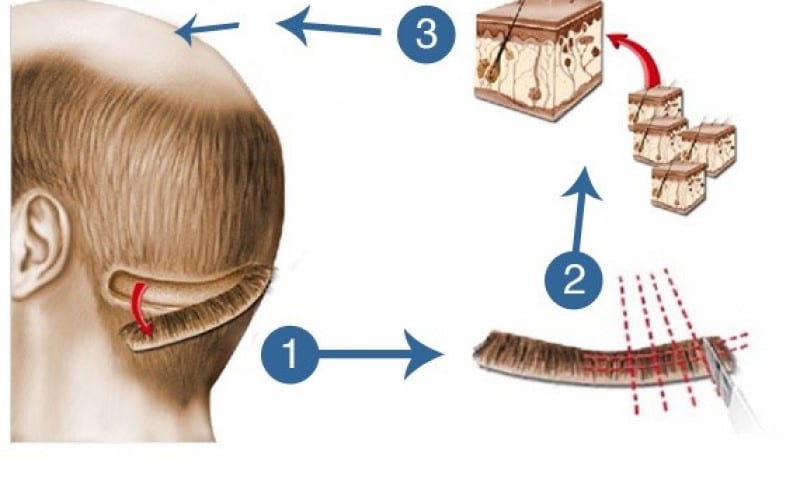
Mainly in the donor area. FUT leaves one long scar, FUE leaves thousands of small, round scars. After a strip you usually cannot wear very short hair at the back for the rest of your life, after FUE you can. FUT uses up scalp elasticity, which limits the yield, and causes more widespread and longer-lasting numbness.
What the scar looks like
After FUT you have one long scar. After FUE you have thousands of small, round scars. Both methods leave scars. The difference over time lies in what goes wrong. With a strip scar you usually cannot have your hair cut very short at the back for the rest of your life. After FUE you can, until so much has been extracted that the dots start to show.
The donor area after several rounds
With strip harvesting, a defined ellipse is removed from the densest part and the rest is left untouched. With FUE, extraction is spread across the whole zone. After three sessions the donor areas therefore look different, and which looks better depends on how long you usually wear your hair.
Scalp elasticity
Each strip uses up some of the scalp's elasticity, and that caps how many strips you can have. FUE has no such limit. There, the ceiling is instead how much extraction the zone can take before it looks thin.
Sensation in the skin
After strip surgery, numbness in the donor area is greater and lasts longer, and a few patients are left with an area where feeling never fully returns.
Which claims about the two methods should you take with a pinch of salt?
Four claims do not hold up as stated. FUE is not scar-free, the scars are just more numerous and smaller. Better graft survival with FUT is plausible but not shown over time. Whether FUE always spares the donor area depends on how much is taken. And FUT is not outdated, it is still standard when you need the greatest possible yield over a lifetime.
- "FUE leaves no scars." You get more scars than with FUT, but they are small and spread over a larger area.
- "Grafts survive better with FUT." The argument is that dissection from a strip is done with full visibility, while a punch works without a direct view. The mechanism is reasonable, but no one has confirmed it with comparative data over many years.
- "FUE is gentler on the donor area." That depends entirely on the amount. A heavily harvested FUE area is more damaged than one strip scar that has healed well.
- "FUT is old-fashioned." Experienced clinics still use it, especially for patients with long hair who need as much hair as possible from the donor area over a lifetime.
How do you choose between FUE and FUT when comparative data are missing?
Let your donor area and your hairstyle habits guide the choice, since the result at the front should not differ. FUE suits you if you might want very short hair, or if your scalp is tight. If you always wear a medium-length style, both work. If you need a great many grafts over your lifetime, many surgeons combine the methods. The surgeon matters more than the method.
When the result at the front is likely to be the same, the choice comes down to what your donor area can take and how you usually wear your hair.
- If you might want a very short cut one day: FUE, with cautious extraction per square centimetre.
- If you always wear a medium-length style: Both work. The strip scar is fully hidden, and FUT has clear advantages when you need a lot of hair over time.
- If your scalp is tight: FUE, because low elasticity gives a low yield from a strip.
- If you need a very high number of grafts over your lifetime: Many experienced surgeons use both methods in different sessions.
The choice of surgeon matters more than the choice of method. Poor FUE and poor FUT both leave a poor donor area in the long run.
Sources
- Rassman WR, Bernstein RM, McClellan R, Jones R, Worton E, Uyttendaele H. Follicular unit extraction: minimally invasive surgery for hair transplantation. Dermatologic Surgery, 2002;28(8):720-728. pubmed.ncbi.nlm.nih.gov/12174065
- Romera de Blas C, Vega Díez D, Ricart Vayá JM, Gómez Zubiaur A. Complications in follicular unit excision hair transplantation: current evidence and practical approaches. Frontiers in Medicine, 2026;13:1750989. pubmed.ncbi.nlm.nih.gov/41709896
- Chauhan K, Tandon M, Kumar A, Taneja N, Hamid SAT. A comprehensive review of evolution of advanced follicular unit excision systems. Journal of Cutaneous and Aesthetic Surgery, 2025;18(2):69-77. pubmed.ncbi.nlm.nih.gov/40212421
- Kim J, Ko YU, Yi KH. The condition of hair follicles produced by different punching methods during FUE surgery. Journal of Cosmetic Dermatology, 2024;23(12):4202-4207. pubmed.ncbi.nlm.nih.gov/39152658
- Zhu Y, Yang K, et al. A Comparative Study on the Application of Robotic Hair Restoration Technology Versus Traditional Follicular Unit Excision in Male Androgenetic Alopecia. Journal of Cosmetic Dermatology, 2024;23(12):4213-4222. pubmed.ncbi.nlm.nih.gov/39297414
This page gathers the published research and common clinical practice. It is general information, not medical advice, and it cannot replace the advice of the team operating on you. If they tell you something different from what you read here, their advice is what counts.
Wondering what's possible for your hair?
Send three sharp photos of your hair, from the front, the top and the back. You'll get an honest answer on what can be done, roughly how many grafts it would take and what it costs.
- Free and with no obligation
- Photos are assessed by the clinic's medical team
- Replies usually within an hour in the daytime


A study tells you something about groups. Only a doctor who has seen your photos can say what applies to your hair. The medical team at the clinic at the top of our ranking offers a free assessment.
Goes to the clinic at the top of our ranking.