HBOT explained: what pressurised oxygen does after a hair transplant
In hyperbaric oxygen therapy you breathe 100 % oxygen in a sealed chamber where the pressure is set higher than ordinary air, usually at 2.0 to 2.4 ATA. Below we look at how this works in the body and how far research on hair transplants has come.
In hyperbaric oxygen therapy you breathe 100 % oxygen in a sealed chamber where the pressure is set higher than ordinary air, usually at 2.0 to 2.4 ATA. Hospitals have used the method for a long time, and we understand well why it works. Research on hair transplants began with one small randomised trial. Today there is also a prospective cohort of 220 patients, in which the photos were scored by assessors who did not know who had received treatment.
What is hyperbaric oxygen therapy?
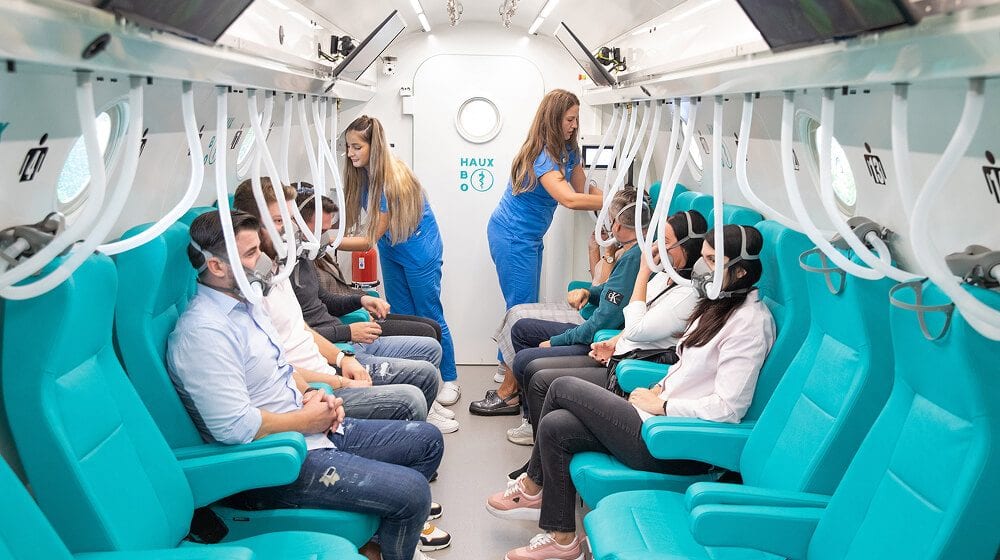
The treatment needs two things at once: near-pure oxygen, 100 %, and a chamber with higher pressure than at sea level. If either is missing, it is not HBOT. In hair research the pressure has been 2.0 to 2.4 ATA, roughly equal to a depth of 10 to 14 metres, and each session has lasted 60 to 90 minutes. The result is that more oxygen dissolves directly in the blood plasma.
The term hyperbaric oxygen therapy, HBOT for short, means something very specific. You lie or sit in a pressurised chamber and breathe oxygen that is close to 100 % pure. Pure oxygen through a mask at normal air pressure is not HBOT. Sitting in a pressure chamber breathing ordinary air is not HBOT either. Only when pressure and oxygen concentration are raised together do you get the effect that gives the treatment its name.
Pressure is measured in atmospheres absolute, ATA. At sea level the pressure is 1 ATA. The hair transplant studies have used 2.0 and 2.4 ATA. That is close to the pressure a diver feels at 10 to 14 metres. Sessions have usually lasted 60 to 90 minutes.
Why pressure matters is easy to explain. In ordinary air, almost all oxygen is carried bound to haemoglobin in the red blood cells, and they are already nearly full. There is no room for more there. Oxygen dissolved freely in the plasma behaves differently. The amount rises in step with the partial pressure of oxygen in the gas you breathe. Raise the pressure and the oxygen concentration at the same time, and the dissolved amount shoots up. This free oxygen reaches tissue that the blood cells otherwise supply poorly.
What is HBOT approved to treat?
The list most health systems use is drawn up by the American professional society UHMS (Undersea and Hyperbaric Medical Society). It includes decompression sickness, carbon monoxide poisoning, air embolism, certain severe soft tissue infections that destroy tissue, chronic bone marrow infection, injuries that appear long after radiotherapy, wounds that won't heal such as diabetic foot ulcers, and skin grafts and flaps with poor healing. The evidence is strongest for diabetic wounds and radiation injuries.
This is not alternative medicine but established hospital medicine. The professional society UHMS maintains a list of what the treatment is approved for, and both public health systems and insurers largely follow that list. It includes decompression sickness and carbon monoxide poisoning, air that has entered the bloodstream, some necrotising soft tissue infections, bone marrow infection where other treatment has failed, late radiation injuries, certain difficult wounds such as diabetic foot ulcers, and skin grafts or flaps that are not taking as they should.
In a review for plastic surgeons (Plastic and Reconstructive Surgery), Stephen Thom drew a clear line between two levels of evidence. For diabetic wounds that won't heal, and for radiation injuries, HBOT is supported by both randomised trials and systematic reviews. For flaps and grafts with poor healing, and for tissue damage after ischaemia and reperfusion, its use rests on animal studies and a handful of human studies. There he called for more research.
Hair transplantation takes its rationale from the weaker group. Each follicular unit can be compared to a tiny free graft that has to stay alive by oxygen and nutrients seeping in until new blood vessels are in place. The comparison is reasonable. But it remains a comparison, and even in mainstream surgery the evidence for flaps and grafts had already been described as lacking.
Is a hair transplant an approved reason to get HBOT?
No. No cosmetic operations are on the UHMS list, hair transplants included. HBOT after the procedure is therefore use outside the approved indications, and neither the health service nor insurance covers it. That status is about money and regulation and says nothing about the effect. On hair specifically we now have four studies: one randomised, one prospective cohort of 220 patients with blinded photo assessment, one case report on five patients and one on healthy volunteers.
If a clinic has suggested pressure chamber sessions to you, it is worth understanding this first. Hair transplantation is missing from the UHMS list, just like every other cosmetic procedure. Three things follow from that.
- You receive the treatment outside its approved uses. It is legal to give HBOT after a hair transplant, and the method is well tested in humans. It is a known treatment, used for something other than what the list covers.
- Nobody else pays. Health services and insurers pay for HBOT when the diagnosis is on the list. Elective cosmetic procedures are not on it, so you pay for the sessions yourself.
- The research is recent, but no longer thin. For hair transplants specifically there is now one randomised controlled trial. Alongside it sit a prospective cohort of 220 patients (assessed both by patient questionnaire and by separate assessors who looked at standardised photos without knowing the groups), a case report on five patients, an early study of healthy volunteers, and a few contributions in the form of letters. For the first weeks they all point the same way. Nobody has yet measured density at twelve months on a large enough scale to answer the long-term question.
What research is there on HBOT for hair transplants?
Four studies and one letter. In 2021 Fan randomised 34 patients: early shedding was 69.1 % without HBOT and 27.6 % with it, and itching and folliculitis 35.3 % versus 11.8 %. In a cohort from IdealofMeD Research Academy of 220 FUE patients, wounds healed faster, pain was lower and sleep improved, and blinded assessments of photos taken on day 10 confirmed this. In 2025 Giardiello described five patients who were free of scabs after 3 to 5 days. In 2026 Lee examined the hair follicles of nine healthy volunteers and saw changes in a positive direction. Dong and Jin criticised the methods of the Fan study in a letter.
The field is still so small that each study can be described on its own.
Fan and colleagues, 2021. The study was randomised and controlled and was published in the Journal of Cosmetic Dermatology. Thirty-four patients with grade II to IV hair loss had FUE. Half got nothing more, while the other half also breathed 100 % oxygen for 60 minutes at 2.0 ATA, every day for seven consecutive days. Early shedding affected 69.1 % of the control group but only 27.6 % of the HBOT group. Itching and folliculitis fell from 35.3 % to 11.8 %. Nine months after the procedure, 96.9 % of grafts had survived in the HBOT group. In the control group the figure was 93.8 %. The three percentage points were not statistically significant. That is no surprise: with 34 participants you can neither detect nor rule out such a small difference.
IdealofMeD Research Academy, 2025 to 2026. The largest study is a prospective cohort. From April 2025 to June 2026, 220 men were followed after FUE. The same surgeon operated on all of them, and technique, medication and aftercare were identical. The researchers measured recovery in two separate ways. On day 11 the patients rated their own healing, pain, sleep and redness. A different medical team, which had not taken part in the operations and did not know who had been in the chamber, scored standardised photos taken on day 10. Both measures favoured HBOT and agreed closely. On the photos, the group without HBOT scored 5.3/10, the one-session group 8.6/10 and the two-session group 9.7/10. Sleep in the first nights after the procedure was where patients themselves reported the biggest difference. Because patients chose their own group rather than being randomly assigned, the study shows a clear association, but not that HBOT is the cause. Still, when the patients and the blinded assessors reach the same answer, it is hard to explain by expectation alone.
Giardiello and colleagues, 2025. The case report in Cureus described five men who had 90 minutes at 2.4 ATA every day for six days after FUE. The first session came 4 to 6 hours after the operation. Scabs were gone after 3 to 5 days, and 97 to 99 % of the grafts are reported to have taken. With no control group and five patients, a report like this can describe an experience, but it cannot prove that the treatment works.
Lee and colleagues, 2026. The preliminary study in Bioengineering followed nine healthy volunteers through 50 sessions at 2.0 ATA over three months. Follicles per area, hairs per follicle and total hair volume increased, but with so few participants none of the changes was statistically significant.
Dong and Jin. In a letter they pointed out weaknesses in the methods of Fan and colleagues and presented laboratory findings on cell division in the dermal papillae. That is the entire hair-specific literature to date.
Is HBOT worth the money after a hair transplant?
If you look at the first two weeks, the findings are promising and consistent. In the randomised trial, patients shed less and had folliculitis less often. In the 220-patient cohort, healing was better, pain was lower and sleep clearly better, and blinded assessors of the photos agreed. No study has shown whether density at twelve months is any different, because none was designed for it or large enough to measure it. So judge HBOT on what it has been shown to do: make the first period after surgery easier.
The mechanism behind HBOT after a hair transplant makes sense, and the studies of the first weeks say the same. The randomised trial found less early shedding and less folliculitis. Among the 220 patients in the cohort, healing, pain and sleep were better, and the assessors who looked at the photos without knowing the groups reached the same conclusion as the patients. Different research groups and different methods give the same picture.
Even so, be precise on two points. First, none of this has been shown to produce more hair at twelve months. The Fan study found that 96.9 % of grafts survived in the treatment group and 93.8 % in the control group, but three percentage points cannot be settled with 34 patients. The figure therefore points in no direction. Second, the 220-patient cohort was observational, and participants decided for themselves whether to go in the chamber. A design like that can show an association, but not cause.
What does that mean in practice? If you pay for HBOT, what you are buying is the first two weeks, and there the findings are solid. Redness fades sooner, you get fewer scabs and they come off faster, discomfort is lower, and you sleep better in the days many people find the hardest. Whether HBOT makes hair denser over time is still unknown. If you are promised denser hair at your twelve-month check, that is a promise no study backs up.
Sources
- Undersea and Hyperbaric Medical Society. Indications for Hyperbaric Oxygen Therapy (approved indications list). uhms.org/resources/featured-resources/hbo-indications.html
- Thom SR. Hyperbaric oxygen: its mechanisms and efficacy. Plastic and Reconstructive Surgery, 2011;127 Suppl 1:131S-141S. pubmed.ncbi.nlm.nih.gov/21200283
- Fan Z, Gan Y, Qu Q, Wang J, Lunan Y, Liu B, Chen R, Hu Z, Miao Y. The effect of hyperbaric oxygen therapy combined with hair transplantation surgery for the treatment of alopecia. Journal of Cosmetic Dermatology, 2021;20(3):917-921. pubmed.ncbi.nlm.nih.gov/32770782
- IdealofMeD Research Academy. Hyperbaric oxygen therapy after FUE hair transplantation: a prospective cohort of 220 patients. 2026. Summarised in full on this site.
- Giardiello F, De Medeiros Quirino L, Brigante R, Chumak M. Hyperbaric Oxygen Therapy for Enhanced Postoperative Recovery in Hair Transplantation. Cureus, 2025;17(12):e99635. doi.org/10.7759/cureus.99635
- Lee HY, Lee JY, Kim SC, Lee Y. Preliminary Effects of Hyperbaric Oxygen Therapy on Hair Follicle Characteristics in Healthy Subjects. Bioengineering, 2026;13(2):240. doi.org/10.3390/bioengineering13020240
- Dong X, Jin X. The effect of hyperbaric oxygen therapy combined with hair transplantation surgery for the treatment of alopecia [letter to the editor]. Journal of Cosmetic Dermatology, 2021. doi.org/10.1111/jocd.14131
This article summarises published research and common clinical practice as general information. It is not medical advice and does not replace the instructions from the team operating on you. If they tell you something different from what you read here, follow their advice.
Wondering what's possible for your hair?
Send three sharp photos of your hair, from the front, the top and the back. You'll get an honest answer on what can be done, roughly how many grafts it would take and what it costs.
- Free and with no obligation
- Photos are assessed by the clinic's medical team
- Replies usually within an hour in the daytime


A study tells you something about groups. Only a doctor who has seen your photos can say what applies to your hair. The medical team at the clinic at the top of our ranking offers a free assessment.
Goes to the clinic at the top of our ranking.