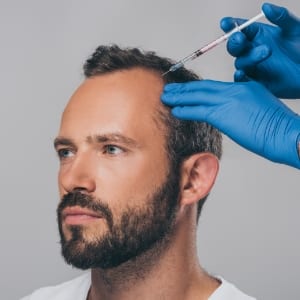
Stem cells for hair loss: do they work, and what do you get today?
Clinics sell stem cells as the future. Researchers are far more cautious. Here's how to tell promising lab work from expensive injections with no evidence.
Does stem cell treatment work for hair loss?
Not today, not with evidence that holds up. No stem cell treatment for hair loss has shown a reliable effect in humans on a par with finasteride or minoxidil. What exists are small studies, animal experiments and early observations. Some of them look interesting. None of them are the large randomised trials needed before anyone can say a treatment gives a lasting result.
So this is a field with plenty of potential and little maturity. You rarely get that answer in an advert, where the words "stem cells" tend to sit next to pictures of thick new hair and a price that reflects expectations more than evidence.
What are clinics really selling?
Ask three clinics what their stem cell treatment consists of, and you may get three completely different answers. The term is used for products made from stem cells, for injections based on fat tissue, for exosomes and for treatments that merely claim to "wake up" the stem cells in your own scalp. These are different things with very different evidence behind them.
A true stem cell can renew itself and turn into other types of cells. The idea in hair treatment is that such cells, whether added from outside or activated in the scalp, could get weakened or lost hair follicles to grow again. It's a thought-provoking hypothesis, and it is being researched seriously around the world. But what ends up in the syringe at a clinic is rarely the same as what researchers have been able to document.
A word that can mean whatever it needs to means you should ask more questions, not fewer. Find out exactly what the product is, where it comes from and which human studies support that specific product.
What are researchers hoping for?
Here there is reason for optimism. Regenerative medicine is among the most exciting areas of modern medicine. Researchers are working on growing new hair follicles, or multiplying a patient's own follicles in the lab. If they succeed, hair loss could one day be treated without the limit that the donor area sets today. For anyone who has been told there isn't enough donor hair to cover the whole top, that's a big thought. Read more about why donor capacity sets the limit for every transplant today.
How far away that is, no one knows. Research that works in a petri dish still has to show that it works in a human, that it's safe, that the result lasts, and that it can be produced the same way every time. Each of those steps can take years, and many promising leads stall along the way.
But the distance from the lab to the treatment room is enormous. What is sold under the stem cell label now rests mostly on theory, extrapolation and scattered observations. "It looks promising in the lab" and "this will give you more hair" are two completely different statements. The marketing depends on you mixing them up.
You can be glad about where the research is heading and still be sceptical of what's on offer today. The two attitudes don't rule each other out.
Is it safe, and is it legal?
Safety has not been well enough established. In many places, commercial stem cell products have no approval for hair treatment, and health authorities have repeatedly warned against stem cell treatments that haven't been properly tested. The warnings cover both lack of effect and risk.
In other areas of medicine, harm has been reported after stem cell treatment without proper oversight. Since the products aren't standardised, you as a patient rarely know exactly what is being injected into your scalp.
When the evidence is thin and regulation is lacking, a high price should make you stop and think. In practice you are then taking part in an experiment you pay for yourself, without anyone saying so outright.
What speaks in favour of stem cells?
- The potential is huge. If the research succeeds, the limit set by the donor area could one day shrink. That's the real prize.
- The goal is to build something new. Where today's treatments stimulate follicles that already exist, the stem cell idea aims to restore them or create new ones.
- No surgery. The offers are almost always injections into the scalp, and you're back to everyday life straight away.
- Serious researchers are involved. The field gets a lot of scientific attention, which raises the chance of real progress over time.
Notice the tense. Almost everything on this list is about what stem cells might do one day. Not about what any treatment you can buy today has been shown to do.
What speaks against stem cells today?
- No documented effect in humans. There is still no solid evidence that any stem cell treatment works for hair loss.
- Unclear regulation. Approval is missing in many places, and authorities have warned about both effect and risk.
- Safety questions. Unregulated versions have harmed patients in other fields, and no standard says what the syringe should contain.
- High price. This is among the most expensive offers out there, and the money goes towards a hope, not a documented effect.
- Vague terms. The word is used so loosely that you often don't know what you're buying.
How do you tell hope from evidence?
| What it is | Where it stands today |
|---|---|
| Basic research in the lab | Serious and promising |
| "Stem cell injections" at clinics | Not documented, often unregulated |
| Finasteride and minoxidil | Well documented and available |
| Hair transplant | Documented, works for permanent loss |
The table makes the choice easier. The top row is something you can follow with interest. The second you should be sceptical of. Your actual treatment belongs in the bottom two. That isn't pessimism. It simply separates what someone hopes from what someone has shown.
Why does it pay to wait?
The impatience is easy to understand. When your hair is thinning, it's far more tempting to picture one treatment that solves everything at the root than to take a tablet and apply foam every day for years. The marketing knows this well. It speaks to hope and sells tomorrow's promise at today's price.
Think long term instead. If stem cell research delivers, the treatments that eventually reach the market will have been properly tested and regulated, and will probably be better than the immature forerunners being sold now. By waiting, you protect both your finances and your health, and you lose nothing that has been shown to work.
It's especially sad to meet people who have put large sums into stem cell injections and left documented treatment aside, sometimes on the advice of a clinic that profits well from the expensive offer. If you hear the word "breakthrough" together with "you need to decide now", the sales pitch has got further than the science.
What can you use in the meantime?
While the research matures, there are tools that have already proven what they can do. Medicines such as finasteride and minoxidil slow hereditary hair loss, and a hair transplant can rebuild areas where the hair is gone for good. These aren't promises for the future. They're what works now.
A sensible plan uses these and keeps an eye on the stem cell field as a possible add-on later. Read more about what you can do to slow hair loss without surgery.
Quick answers about stem cells and hair loss
Can stem cells give me back the hair I've lost? Not today. No one has documented that stem cells restore lost hair in humans, and what's sold commercially lacks evidence.
Can anything go wrong? No one knows well enough. Many products lack approval, and in other medical fields such treatments without oversight have harmed people. No one can guarantee it's safe.
Are exosomes and stem cells the same thing? No, but they're linked. Exosomes are tiny vesicles that cells release, often stem cells. As a hair treatment they too are new and without proper regulation. Read more in the article on exosomes for hair loss.
When will it become a real option? No one knows. The research is moving, but no one can promise a timeline.
Have you been offered stem cell treatment?
Ask the clinic for three things in writing: exactly what the product contains, whether it is approved where you'll be treated, and which published human studies show that this specific product works for hair loss. If you don't get clear answers, say no thanks and book an appointment with a doctor instead to talk about documented treatment.
This article is general information and does not replace a medical assessment of you.
If your hair loss has only just started, a procedure may not be the right step yet. The medical team at the clinic at the top of our ranking can look at your photos and tell you honestly whether to wait, start with treatment or consider more.
Goes to the clinic at the top of our ranking.