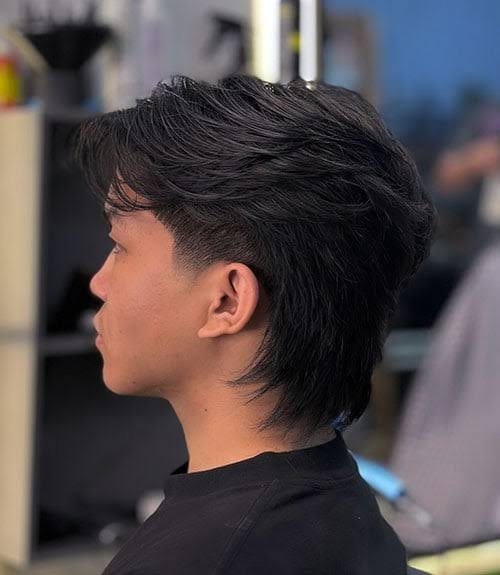
Asian hair as donor: thick hairs, low density and high contrast
Asian hair is usually strong and straight. The units have relatively few hairs, and density is below what is usual in European hair.
Typical Asian hair is thick and straight, but the units have few hairs and grow less densely than in European hair. Each graft covers well, but the colour contrast between dark hair and light skin makes scars in the donor area easier to see.
Which traits of Asian hair affect the donor plan?
The hair is thick, and that helps. It is straight, and that hides less than curls. The units are small, they grow sparsely and the colour contrast with the skin is large, and these three pull in the wrong direction for the donor area.
Asian scalp hair has a fairly recognisable profile, and it governs how the donor area should be used.
- Thick hairs. The diameter is usually larger than in European hair, so each hair covers a lot.
- Straight hair. A straight hair covers less scalp than a curly one and lies flat against the skin. It camouflages less well.
- Few hairs per unit. Small units of one or two hairs are more common than in Europeans, so the same number of grafts contains fewer hairs.
- Lower unit density. The number of follicular units per cm² is often lower.
- Strong contrast. Dark, strong hair against skin that is usually lighter gives a large colour difference.
The first two roughly cancel each other out. The thickness helps, the straightness counts against it. The last three all work against the donor area.
Why does the donor area become the bottleneck for Asian patients?
Lower density means less reserve from the same area, fewer hairs per unit means less hair per graft, and strong contrast means thinning and dot scars show earlier. Graft numbers that suit European patients therefore can't be transferred directly.
With lower density, the same safe area holds fewer grafts over a lifetime. With fewer hairs per unit, each graft gives less hair. And when dark hair meets light skin, both thin areas and white dot scars show sooner, and at a longer cut, than in someone whose hair and skin are closer in colour.
All three effects point the same way. Each graft takes a bigger bite of the reserve, covers less and leaves more traces visible.
In practice, extraction should therefore be more cautious and spread more evenly than in someone with high density. Numbers that are usual for European patients don't automatically apply.
Can beard hair supplement the donor area in Asian patients?
Yes, according to a 2020 retrospective study by Zhu and colleagues, in which extensive beard hair extraction, with a beard density of around 48 units per cm², improved the cosmetic result for East Asian men with far-advanced hereditary hair loss. In 2025 Zhao and colleagues proposed limits for density, hair thickness and exit angle that show when beard grafts are unsuitable.
This is where the Asian research is particularly useful. In 2020 Zhu and colleagues published a retrospective study in Dermatology and Therapy in which East Asian men with extensive androgenetic alopecia had large amounts of beard hair extracted. The beard served as an important additional source, and the authors concluded that it improved the cosmetic result. The beard had a density of around 48 units per cm².
In 2025 Zhao and colleagues presented a system for grading the beard as a donor area, published in Dermatologic Surgery. The system sets limits for density, hair thickness and exit angle, below which the beard should not be used.
Asian beard hair tends to be very coarse. It works well for adding fullness to the middle of the head and the crown, but poorly for the hairline itself.
How should the hairline and density be designed with Asian hair?
The hairline must be built from single hairs, because thick, straight multi-hair units at the front look clearly artificial. The angles must be precise, a cautious density at the front often gives the best result, and the crown drains the reserve quickly.
- Single hairs in the hairline are a must. Strong, straight multi-hair units at the very front look obviously operated on.
- Angle matters more. Straight, thick hair reveals a wrong exit angle that curls would have hidden.
- Moderate density at the front tends to give the best result, more than packing in as many grafts as possible. Thick, straight hairs look denser than the number would suggest.
- The crown is expensive. With low donor density and few hairs per unit, crown coverage quickly eats up the reserve.
What should you ask when the donor plan is drawn up?
Ask about your measured density and your average number of hairs per unit, how much of the donor area will be used, and how extraction is spread evenly. Ask for photos of the donor area with short hair twelve months afterwards in patients with similar hair, and for the criteria if beard hair is suggested.
- What is my measured density, and how many hairs do my units have on average?
- How much of the donor area will be used, given that density?
- How do you make sure extraction is spread evenly?
- Can I see the donor area with short hair twelve months afterwards in patients with the same hair type as me?
- If you suggest beard hair, which criteria decide whether it is suitable?
Sources
- Zhu DC, He Y, Fan ZX, Wang J, Qu Q, Hu ZQ, Miao Y. Large-Scale Beard Extraction Enhances the Cosmetic Results of Scalp Hair Restoration in Advanced Androgenetic Alopecia in East Asian Men: A Retrospective Study. Dermatology and Therapy, 2020;10(1):151-161. pubmed.ncbi.nlm.nih.gov/31784942
- Zhao Y, Zhang J, Jiang B, Fan Z, Miao Y. Development of an Evaluation System to Classify Beard Donor Area for Hair Transplantation. Dermatologic Surgery, 2025;51(9):882-886. pubmed.ncbi.nlm.nih.gov/40323042
- Jimenez F, Ruifernández JM. Distribution of human hair in follicular units. A mathematical model for estimating the donor size in follicular unit transplantation. Dermatologic Surgery, 1999;25(4):294-298. pubmed.ncbi.nlm.nih.gov/10417585
- Romera de Blas C, Vega Díez D, Ricart Vayá JM, Gómez Zubiaur A. Complications in follicular unit excision hair transplantation: current evidence and practical approaches. Frontiers in Medicine, 2026;13:1750989. pubmed.ncbi.nlm.nih.gov/41709896
- Rassman WR, Bernstein RM, McClellan R, Jones R, Worton E, Uyttendaele H. Follicular unit extraction: minimally invasive surgery for hair transplantation. Dermatologic Surgery, 2002;28(8):720-728. pubmed.ncbi.nlm.nih.gov/12174065
This article is based on published research and standard clinical practice. It is general information, not medical advice, and it never takes priority over what your own surgical team tells you. If they say something different from what you read here, follow their advice.
Wondering what's possible for your hair?
Send three sharp photos of your hair, from the front, the top and the back. You'll get an honest answer on what can be done, roughly how many grafts it would take and what it costs.
- Free and with no obligation
- Photos are assessed by the clinic's medical team
- Replies usually within an hour in the daytime


A study tells you something about groups. Only a doctor who has seen your photos can say what applies to your hair. The medical team at the clinic at the top of our ranking offers a free assessment.
Goes to the clinic at the top of our ranking.