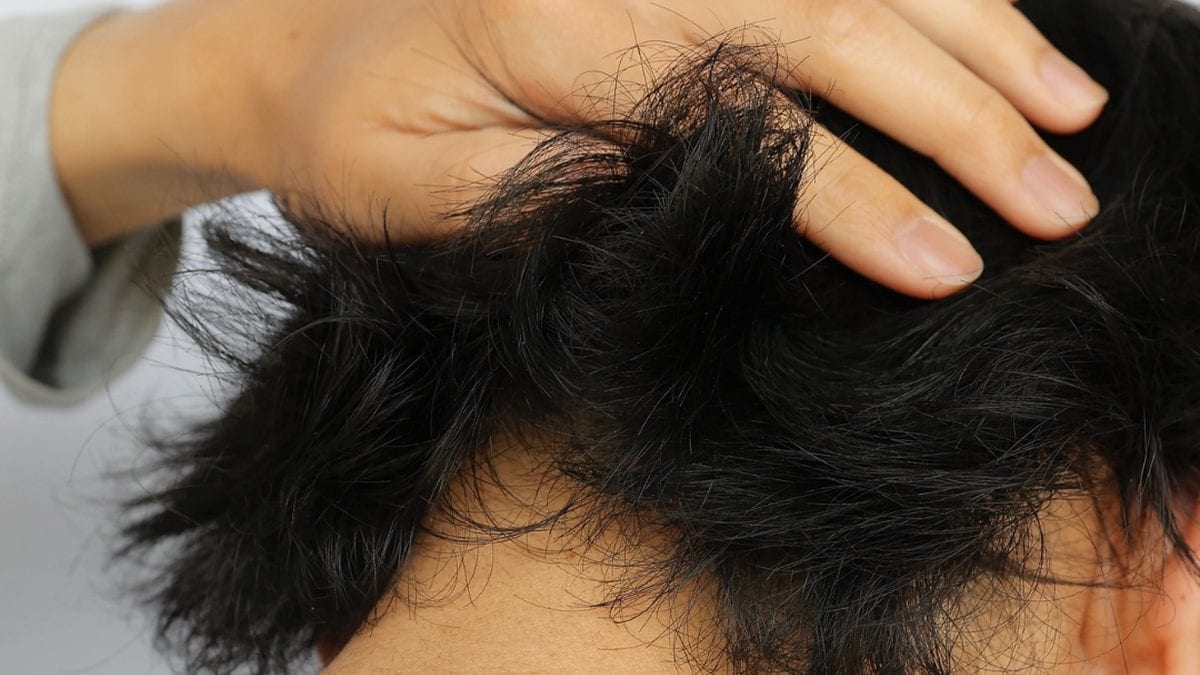
Hair thickness: why thick hair can beat a high graft count
How well your scalp is covered depends on the total amount of hair transplanted, not on how many follicles are moved.
How well a bald area is covered depends on the total amount of hair transplanted, not on the number of follicles. If you have coarse hair, fewer grafts can give a visibly better result than the same number in someone with fine hair. That's why hair thickness has to be part of every assessment of the donor area.
Why does the number of grafts tell you so little about the result?
Because coverage depends on the total amount of hair, and that is set by three things: the number of follicles, how many hairs each one has and how thick each hair is. The graft count only tells you about the first. With coarse hair, relatively few grafts can give good coverage, while the same number in someone with fine hair would look thin.
The graft count is the figure hair transplant advertising revolves around, because it's easy to state and easy to compare. But it says little about how you're going to look. A graft is packaging, and what counts is what's inside.
What hides bare scalp is hair mass: the combined cross-section of all the hairs in a given area. Hair mass is set by how many follicles there are, how many hairs each one produces and how thick each hair is. The graft count only tells you about the first of these.
If you have coarse hair, you can get convincing coverage from a graft count that would leave someone with fine hair looking sparse. It's one of the main reasons two patients promised the same number end up with very different results.
What is hair thickness, and how is it measured?
Hair thickness is the diameter of the hair shaft, measured in micrometres. Double the diameter and the cross-section becomes roughly four times larger, and so does the coverage. The surgeon checks it with the trichoscope during the same examination as density. Published criteria for beard donor hair treat grafts thinner than about 60 μm as unsuitable.
Hair thickness is how wide each individual hair is, given in micrometres. Fine hair sits low on the scale and coarse hair high, and the difference is easy to see. The explanation is geometry: the cross-section grows with the square of the diameter. A hair with twice the diameter therefore hides roughly four times as much skin.
The surgeon measures thickness with a trichoscope or densitometer, in the same examination as density. If the surgeon examines your donor area properly, you get figures for follicular units per cm², hairs per unit and hair diameter.
In research on beard hair as a donor source, thickness has been made an explicit requirement. Zhao and colleagues treat beard grafts with a diameter below about 60 μm as unsuitable. There, thickness is a formal criterion for which grafts are chosen. Gut feeling is taken out of the equation.
What does the combination of thickness and density mean for your plan?
Together they decide what the plan can achieve. High density and coarse hair is the best starting point. High density and fine hair gives poorer coverage than the count suggests. Medium density and coarse hair often gives a better result than the count would suggest. Low density and fine hair leaves the least to work with, and then it's wisest to treat a smaller area.
It's the combination of the two that decides what a realistic plan can promise.
- High density and coarse hair. The best you can have. Plenty of donor hair over a lifetime and good coverage from every graft.
- High density and fine hair. The numbers look promising, but coverage will be weaker than the count suggests. The plan should be more cautious than density alone would imply.
- Medium density and coarse hair. The result is often better than the graft count suggests. Extraction still needs to be careful, because the reserve is smaller.
- Low density and fine hair. This is where there's least room to manoeuvre. There's little to take from, and each graft covers little. An honest plan then treats a smaller area properly instead of spreading the grafts thinly over a large one.
Why does fine donor hair show extraction damage sooner?
Because there's less hair to cover the holes left by extraction. With fine hair you can therefore afford to lose a smaller share than someone with coarse hair, even at the same density. The back of the head looks thin sooner, and the dot scars show even with longer hair. Hair thickness works against you twice.
There's another effect that's rarely mentioned. Fine hair hides extraction sites less well than coarse hair, simply because there's less hair to lie over the scars.
With fine hair you therefore can't give up as large a share as someone with coarse hair, even if you start with the same density. The donor area looks sparse sooner, and the white dots show even when the hair is longer.
So fine hair gives you a double disadvantage. You have fewer grafts you can safely use, and each graft gives less coverage.
What can you expect if you have fine hair or low density?
Ask how thick your hairs are as well as how dense, and take it with a pinch of salt when clinics compete on graft numbers. With fine hair, expect a plan for the front third and middle of the scalp, not full coverage all the way back to the crown. Curly hair and low colour contrast with the skin help somewhat. Judge offers by how the result will look, not by the number.
- Ask how thick your hairs are, and don't settle for density alone.
- Graft counts from different clinics say far less than they seem to. Don't let that comparison drive your choice.
- If you have fine hair, expect a plan for the front third and middle of the scalp, not for full coverage that also includes the crown.
- Curls help. Waves and curls give more coverage from each follicle than straight hair of the same diameter, and that partly makes up for thin hairs.
- Colour plays a part too. When your hair is close to your scalp in colour, it looks denser than dark hairs against pale skin, even at the same actual density.
None of this means you should skip the procedure. It means you should judge the offer by how the result will look, not by the number written in the quote.
Hair thickness is one of the measurements behind a realistic estimate. Read more about the donor reserve.
Sources
- Zhao Y, Zhang J, Jiang B, Fan Z, Miao Y. Development of an Evaluation System to Classify Beard Donor Area for Hair Transplantation. Dermatologic Surgery, 2025;51(9):882-886. pubmed.ncbi.nlm.nih.gov/40323042
- Jimenez F, Ruifernández JM. Distribution of human hair in follicular units. A mathematical model for estimating the donor size in follicular unit transplantation. Dermatologic Surgery, 1999;25(4):294-298. pubmed.ncbi.nlm.nih.gov/10417585
- Parsley WM, Perez-Meza D. Review of factors affecting the growth and survival of follicular graft. Journal of Cutaneous and Aesthetic Surgery, 2010;3(2). jcasonline.com
- Maas D, et al. Rethinking the occipital scalp as a control in advanced androgenetic alopecia. Journal of the American Academy of Dermatology, 2026 (ahead of print). pubmed.ncbi.nlm.nih.gov/42398778
This article summarises published research and common clinical practice. It is meant as general information and is not medical advice. Nor does it replace the advice you get from your own surgical team. If your team tells you something different from what you read here, follow your team.
Read more in the knowledge guide
Wondering what's possible for your hair?
Send three sharp photos of your hair, from the front, the top and the back. You'll get an honest answer on what can be done, roughly how many grafts it would take and what it costs.
- Free and with no obligation
- Photos are assessed by the clinic's medical team
- Replies usually within an hour in the daytime


A study tells you something about groups. Only a doctor who has seen your photos can say what applies to your hair. The medical team at the clinic at the top of our ranking offers a free assessment.
Goes to the clinic at the top of our ranking.