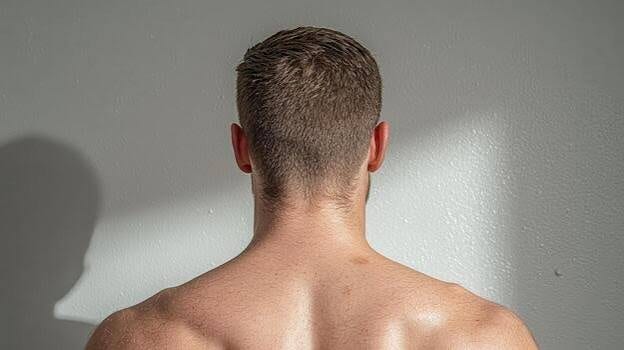
How is donor density measured for a hair transplant?
The surgeon counts follicular units per square centimetre, usually with a densitometer or trichoscope on a small area where the hair has been clipped short.
Donor density is given as the number of follicular units in one square centimetre and is usually counted with a densitometer or trichoscope on a clipped area. The number should be measured, not guessed from a glance at the back of your head. And it says most when read together with how thick the hair shafts are.
What exactly is counted when someone measures donor density?
How many follicular units there are in one square centimetre. Such a unit is a small bundle of one to four hairs, and this is the figure the surgeon plans the grafts from. Hairs per square centimetre is something else and always a higher figure, because the average unit holds more than one hair. If the two are mixed up, the offer looks bigger than it is. So ask which of the figures you are being given.
Your hair isn't spread out as single strands at equal spacing. It grows in follicular units, small natural bundles of one to four hairs that share a surrounding structure, sebaceous glands and a single arrector pili muscle. As early as 1999, Jimenez and Ruifernández mapped how human hair is distributed in such units. The paper appeared in Dermatologic Surgery, and from the distribution they built a mathematical model that estimates the size of the donor area when such units are transplanted.
When donor density is given, it is almost always in units per square centimetre. The surgeon uses the figure to calculate how many grafts there is room to take. Hairs per square centimetre is a higher figure, because you multiply by the average number of hairs per unit in your case.
Clinics that don't distinguish between the two can make an offer look more generous than it is. So be sure to find out which number you are looking at.
How is density measured at your consultation?
The surgeon clips the hair very short on a small patch of the donor area and counts the units with a densitometer or trichoscope within a known field of view. The count is repeated in two or three places, because density isn't the same everywhere. At the same time, the surgeon sees how thick the hair is and whether there are signs of miniaturisation. It takes a few minutes. If it isn't done, your density is only a guess.
The method isn't complicated. The surgeon clips a small patch of the donor area, holds a trichoscope or densitometer with a known field of view against the skin and counts the units inside it. Repeat the count in two or three places and you get a usable average, and you see whether density changes from spot to spot. It almost always does.
A trichoscope also shows far more than the count. With the magnification, the surgeon sees how thick your hair shafts are, what share of the units have only one hair and, not least, whether any of the hairs in the donor area are starting to miniaturise. A finding like that should change the plan.
The whole measurement takes a couple of minutes, and it belongs in the consultation. If nobody has clipped an area and put a lens to the back of your head, your density has been judged by eye. Eyes are poor measuring tools.
What counts as good donor density?
It normally lies at around 65 to 85 units per square centimetre. At 40 or fewer, the donor area is considered weak. If density is low, the surgeon has to take grafts from a larger area to get the same number, which increases the risk of the donor area looking sparse. Density varies between ethnic groups and between individuals, and it is highest in the middle of the back of the head. A single figure for the whole donor area is therefore always a simplification.
Why does density alone say little about how the result will turn out?
How well hair covers depends on the total amount of hair moved, not on how many follicles there are. If you have high density but fine shafts, coverage will be poorer than the figure suggests. If you have medium density and thick shafts, fewer grafts can cover better. Shaft thickness weighs as much as density. And a graft with three or four hairs covers more than one with a single hair.
Two people with exactly the same density can still have very different numbers of grafts to work with. What hides a bare scalp is the total amount of hair moved, not how many follicles it is spread across.
High density with very fine shafts gives less raw material than the figure suggests. Medium density with strong, coarse shafts can give more visible coverage with fewer grafts. Shaft diameter matters at least as much. It is read with the same magnifying device.
The third factor is how large the units are. If the donor area consists largely of bundles of three and four hairs, each graft delivers more hair than where single hairs dominate.
Which questions reveal whether your density has actually been measured?
Ask for your density figure and where on your head it was measured. Ask whether the figure refers to units or hairs, and how many hairs each of your units has on average. Find out whether the donor area has been checked for miniaturisation under magnification, and how much density varies. If the clinic can answer, it has examined you. If it can't, the figure came from a photo.
- How many follicular units per cm² do I have in the donor area, and where on my head did you measure?
- Does the figure refer to units or individual hairs?
- How many hairs do I have in each unit on average?
- Has anyone checked my donor area for miniaturisation under magnification?
- How big is the difference in density between different parts of the donor area?
If you get clear answers, the clinic has actually assessed you. If you don't, the number of grafts you've been promised has been worked out from a photo.
Sources
- Jimenez F, Ruifernández JM. Distribution of human hair in follicular units. A mathematical model for estimating the donor size in follicular unit transplantation. Dermatologic Surgery, 1999;25(4):294-298. pubmed.ncbi.nlm.nih.gov/10417585
- Rassman WR, Bernstein RM, McClellan R, Jones R, Worton E, Uyttendaele H. Follicular unit extraction: minimally invasive surgery for hair transplantation. Dermatologic Surgery, 2002;28(8):720-728. pubmed.ncbi.nlm.nih.gov/12174065
- Maas D, et al. Rethinking the occipital scalp as a control in advanced androgenetic alopecia. Journal of the American Academy of Dermatology, 2026 (ahead of print). pubmed.ncbi.nlm.nih.gov/42398778
- Parsley WM, Perez-Meza D. Review of factors affecting the growth and survival of follicular graft. Journal of Cutaneous and Aesthetic Surgery, 2010;3(2). jcasonline.com
This article summarises published research and standard clinical practice. It is meant as general information and is not medical advice. Nor does it replace the advice you get from your own surgical team. If your team tells you something different from what is written here, follow your team.
Wondering what's possible for your hair?
Send three sharp photos of your hair, from the front, the top and the back. You'll get an honest answer on what can be done, roughly how many grafts it would take and what it costs.
- Free and with no obligation
- Photos are assessed by the clinic's medical team
- Replies usually within an hour in the daytime


A study tells you something about groups. Only a doctor who has seen your photos can say what applies to your hair. The medical team at the clinic at the top of our ranking offers a free assessment.
Goes to the clinic at the top of our ranking.