Can beard hair be used as donor hair for your scalp?
Yes. With extensive hair loss, beard hair can give you far more donor hair to work with, and several published patient series support the approach.
If you have lost a lot of hair, the beard can add considerably to the donor reserve, and published patient series support its use. Beard hair is coarser than scalp hair and grows differently. That is why it is usually placed in the mid-scalp and crown, and rarely in the hairline.
Why do surgeons take hair from the beard?
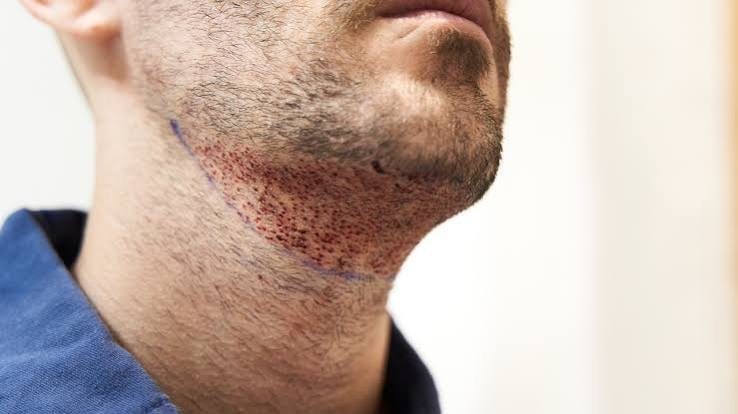
To get more donor hair when hair loss is so extensive, Norwood 6 to 7, that the safe zone on the scalp isn't enough. The grafts are usually taken from the neck and the underside of the jaw. The hair there is dense and strong, and the small scars heal well and are hidden in the beard or in the shadow under the jaw.
The scalp only has so much donor hair to give. In the most extensive patterns, Norwood stage 6 or 7, the bald area can be larger than the safe zone at the back of the head is able to cover. The beard is then the most useful back-up source. It is used precisely to increase the supply when the scalp alone isn't enough.
The surgeon usually takes the grafts from the neck and from the underside of the jaw. Density is often good there, the hairs are strong, and the small scars heal well and disappear into the beard or the shadow under the jawbone.
What does the research say about beard hair as a donor?
The studies that exist support its use. In 2020 Zhu and colleagues measured around 48 units per cm² in the beard of East Asian men and saw a better cosmetic result in advanced alopecia. In 2025 Zhao and colleagues graded beard grafts as poorly suited when there were fewer than about 8 units per cm², a diameter below 60 μm or an exit angle below 10°.
Zhu and colleagues looked back at patients in a 2020 retrospective study published in the journal Dermatology and Therapy. The patients were East Asian men with advanced androgenetic alopecia who received a large number of beard grafts. The authors concluded that the beard is an important additional source that gave a better cosmetic result. The beard had an average of around 48 units per cm².
The following year, in 2021, came a case series from Gupta and colleagues. The journal was Journal of Maxillofacial and Oral Surgery, and the topic was the beard as a donor in patients with stage 6 and 7 hair loss, where the scalp most often falls short.
In 2024 came a multicentre study from Umar and colleagues in Dermatologic Surgery. In it, beard and body hair was transplanted with FUE using a skin-responsive device.
Zhao and colleagues went a step further in 2025, also in Dermatologic Surgery. They presented a system for grading the beard as a donor area. The beard is considered poorly suited if it has fewer than about 8 units per cm², if the hairs are thinner than 60 μm, or if the hairs exit the skin at an angle below 10°.
The last paper is worth knowing about. It lets the surgeon assess your beard against published criteria rather than gut feeling.
How is beard hair different from scalp hair?
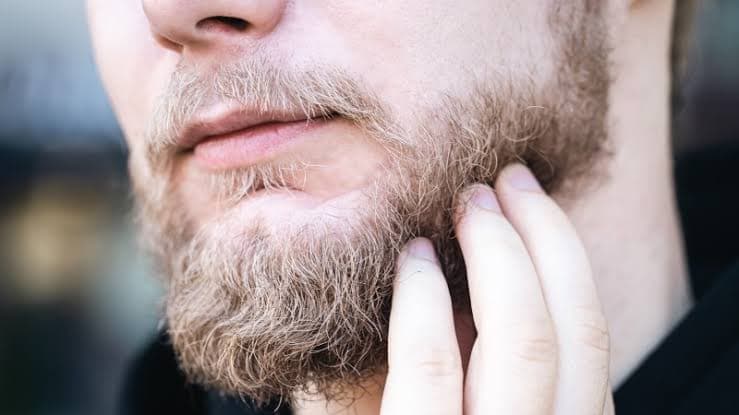
Beard hair is thicker and stands out if it sits on its own. It is coarser and often stiffer. The growth phase is different, so transplanted beard hair may not grow as long as scalp hair. It mostly grows as single hairs rather than in groups. And its colour, and how grey it is, often differ from the scalp hair.
- Thickness. Beard hairs are often clearly thicker than scalp hair. Each graft therefore covers a lot, but a beard hair stands out where fine hair should have been.
- Texture. It is often coarser, stiffer and curls differently.
- Growth cycle. The growth phase in the beard doesn't last as long as on the scalp. Transplanted beard hair may therefore not grow as long.
- Hairs per unit. The beard consists mostly of single-hair units. So a given number of grafts yields fewer hairs than the same number of grafts from the scalp.
- Colour. Beard and scalp hair often differ in colour and in how grey they are in the same man.
Where on the scalp does beard hair go, and where is it kept away from?
Beard hair is placed in the mid-scalp and crown, often mixed with scalp hair, to add volume. It is avoided in the hairline, because that needs fine single hairs, and a coarse beard hair there looks unnatural. Common practice is scalp hair in the front third and beard hair further back.
The surgeon usually places beard grafts where the coarse hair is useful and the difference is hardest to see: the mid-scalp and crown, often between or beneath scalp grafts, so that volume increases.
Beard hair is usually kept out of the hairline. That area needs the finest hair you have, placed as single hairs. A coarse beard hair right at the edge looks wrong, and it is hard to fix.
Combining is both common and sensible. Scalp hair goes to the front third, where everyone sees it. Beard hair adds fullness further back.
What should you consider before agreeing to beard harvesting?
Beard scars almost always stay hidden, but they can show if you shave clean and have high skin contrast. Too many extractions can make the beard visibly thinner. The beard should only be used when the donor hair on the scalp genuinely isn't enough, not to make a plan bigger than necessary. And expect coverage, not hair that looks the same.
- Extraction scars. The beard gets the same small dot scars as the scalp. Usually they don't show. If you go clean-shaven and your skin gives high contrast, ask to see photos of previous patients.
- Your beard after the procedure. With careful extraction nobody notices anything. With too many, the beard can become visibly thinner.
- Whether you really need it. The beard is the right choice when the scalp genuinely doesn't have enough. There is no reason to make a plan bigger when the scalp alone could cover it with care.
- What to expect. You get coverage. You don't get hair that looks exactly like your scalp hair.
Sources
- Zhu DC, He Y, Fan ZX, Wang J, Qu Q, Hu ZQ, Miao Y. Large-Scale Beard Extraction Enhances the Cosmetic Results of Scalp Hair Restoration in Advanced Androgenetic Alopecia in East Asian Men: A Retrospective Study. Dermatology and Therapy, 2020;10(1):151-161. pubmed.ncbi.nlm.nih.gov/31784942
- Gupta B, Banerjee P, Priyadarshini Y, Rathi P. BEARD - A Potential Donor Site in Grade 6 and Grade 7 Alopecia: A Case Series. Journal of Maxillofacial and Oral Surgery, 2021;20(4):545-550. pubmed.ncbi.nlm.nih.gov/34776682
- Umar S, Khanna R, Maldonado JC, Chouhan K, Gonzales A. Beard and Body Hair Transplantation by Follicular Unit Excision Using a Skin-Responsive Device: A Multicenter Study. Dermatologic Surgery, 2024;50(3):306-308. pubmed.ncbi.nlm.nih.gov/38127669
- Zhao Y, Zhang J, Jiang B, Fan Z, Miao Y. Development of an Evaluation System to Classify Beard Donor Area for Hair Transplantation. Dermatologic Surgery, 2025;51(9):882-886. pubmed.ncbi.nlm.nih.gov/40323042
- Jimenez F, Ruifernández JM. Distribution of human hair in follicular units. A mathematical model for estimating the donor size in follicular unit transplantation. Dermatologic Surgery, 1999;25(4):294-298. pubmed.ncbi.nlm.nih.gov/10417585
This article summarises published research and common clinical practice. It is meant as general information and is not medical advice. Nor does it replace the advice you get from your own surgical team. If your team tells you something different from what is written here, follow your team.
Wondering what's possible for your hair?
Send three sharp photos of your hair, from the front, the top and the back. You'll get an honest answer on what can be done, roughly how many grafts it would take and what it costs.
- Free and with no obligation
- Photos are assessed by the clinic's medical team
- Replies usually within an hour in the daytime


A study tells you something about groups. Only a doctor who has seen your photos can say what applies to your hair. The medical team at the clinic at the top of our ranking offers a free assessment.
Goes to the clinic at the top of our ranking.