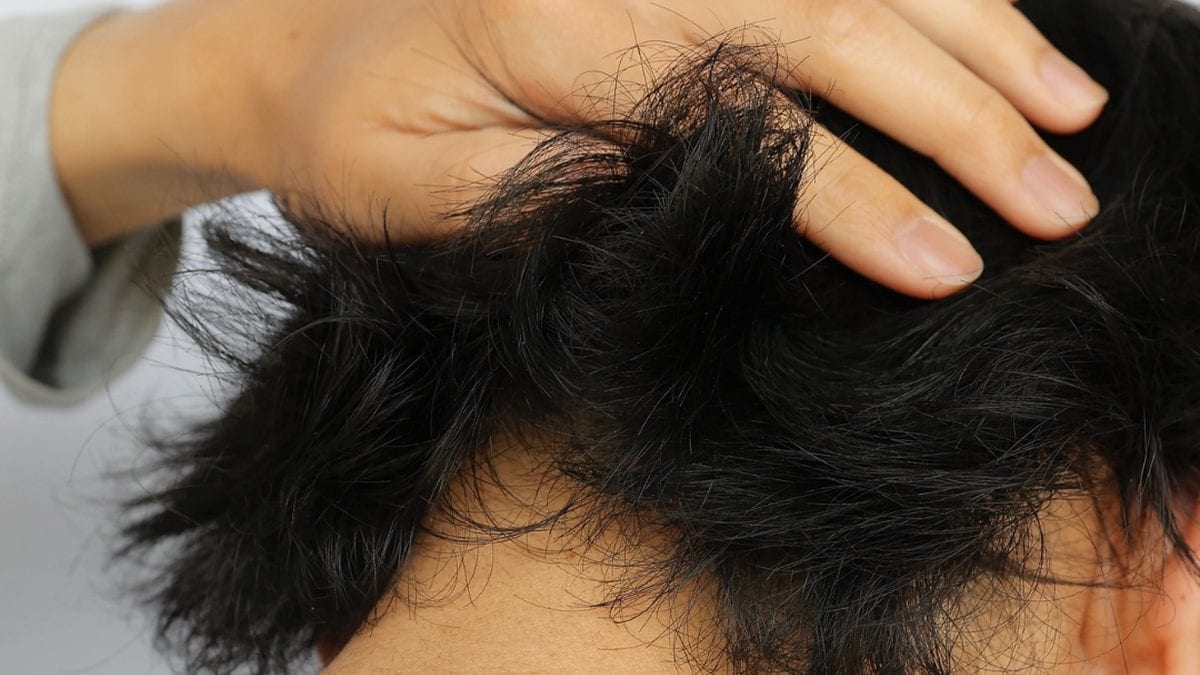
Body hair as a donor: short growth phase and fewer hairs per graft
Body hair follicles grow for a shorter time and rest more often than follicles on the scalp. That's why transplanted body hair never grows as long.
Body hair follicles have a shorter growth phase than scalp follicles, and more of them are resting at any given time. That's why transplanted body hair stays shorter. These traits largely sit in the follicle itself and move with it, so they determine how much body grafts can achieve.
Why does body hair grow differently from scalp hair?
Because body hair follicles spend much less time in the growth phase than scalp follicles. That explains why chest hair stops at a certain length while scalp hair can grow long. The trait sits in the follicle and goes with it when it's moved, so body hair transplanted to the scalp stays shorter than scalp hair at full length.
Scalp hair and body hair look alike under the microscope, but they lead different lives. Their growth cycles differ systematically, and it's these biological differences, not the surgeon's taste, that put body hair at the bottom of the list of donor sources.
What matters most is how long each hair gets to grow. A follicle on the scalp can stay in the growth phase for several years, and the hair becomes long as a result. A follicle on the chest leaves the growth phase much earlier, so the hair reaches a certain length and stays there.
How long the growth phase lasts is mainly controlled by the follicle itself and less by the area of skin it sits in. That's why the graft takes much of this trait with it. Body hair planted in the scalp usually stays shorter than scalp hair in the same area.
How does body hair differ from scalp hair in practice?
Six differences matter. The growth phase is shorter, so the hair is shorter. More follicles are resting at once, which creates variation. The cycles are less in step and can give an uneven look over time. The texture is often curly, which makes both blending in and extraction harder. Most units have one hair, so each graft gives less. And survival after transplanting is less predictable.
- Short growth phase. Puts a ceiling on length, which in turn affects which hairstyle you can have and how well the body hair blends with the scalp hair around it.
- More follicles at rest. At any given time, a larger share of body follicles are resting. That affects what the surgeon can extract on the day of surgery and gives more variation in what you see afterwards.
- The hairs don't keep the same rhythm. Body follicles are less well synchronised than those on the scalp. When the grafts move in and out of their phases at different times, the transplanted area can look patchy at times.
- Curly and different texture. That makes it harder to get the hair to blend in with scalp hair, and harder to extract it.
- Mostly single hairs. A body graft usually carries one hair. The same number of grafts therefore gives far fewer hairs than the equivalent from the scalp.
- Uncertain survival. How many grafts grow after transplanting is consistently described in the literature as less predictable than for scalp hair.
What do studies show about body hair transplants?
There are few studies, far fewer than for scalp hair and beard. The broadest recent data set is a multicentre study Umar and colleagues published in 2024, in which beard and body hair were harvested with FUE. Taken together, the evidence suggests body hair harvested with FUE can be used as an additional source when the scalp and beard aren't enough, but it doesn't show that body hair is as good as scalp hair.
Far less has been written about body hair than about transplants using scalp hair or beard. The broadest recent data set came in 2024, when Umar and colleagues published a multicentre study in Dermatologic Surgery on FUE of beard and body hair, in which extraction was done with a device that responds to the skin.
What the literature supports is this: body hair can be extracted with FUE, and it can work as an extra donor source for patients who have used up what the scalp and beard can provide. It doesn't support saying body hair is as good as scalp hair, and no sober review claims that.
Beard hair is better documented. Zhu and colleagues have written about large-scale beard extraction in men with advanced androgenetic alopecia. Gupta and co-authors have looked at the beard as a donor when hair loss has reached grade 6 or 7. Zhao and colleagues have published criteria for when the beard is suitable as a donor. In terms of both evidence and predictability, the beard sits between scalp hair and body hair.
What is a realistic result with body hair grafts?
Body grafts can fill in behind the part of the head people see first, in patients who would otherwise get no coverage there. They're not suited to hairlines, they don't blend in invisibly, and they don't grow as long as scalp hair. Expect shorter hair, a texture that shows when someone stands close, fewer hairs than the graft count suggests because almost every unit carries one hair, and more variation in how much grows.
The honest starting point: body hair can add fullness behind the area people see first, in a patient who would otherwise have no coverage there. It doesn't build hairlines. It doesn't blend in unnoticed, and it never reaches the length of scalp hair.
- Hairs from body grafts stay shorter than hairs from scalp grafts placed next to them.
- You'll see the difference in texture up close.
- The number of hairs ends up lower than the graft count makes it sound, since almost all units carry one hair.
- The proportion that grows varies more. Ask the surgeon what the plan is if little grows.
Why has my clinic suggested body hair for me?
Ask instead why the suggestion is being made. Body hair belongs where the safe zone on the scalp and the beard have genuinely been used up, for example with very extensive hair loss or in repair work. If you still have donor reserve on your scalp and are offered body hair just to push the total higher, the problem lies in the size of the plan, not in where the hair is taken from.
Sources
- Umar S, Khanna R, Maldonado JC, Chouhan K, Gonzales A. Beard and Body Hair Transplantation by Follicular Unit Excision Using a Skin-Responsive Device: A Multicenter Study. Dermatologic Surgery, 2024;50(3):306-308. pubmed.ncbi.nlm.nih.gov/38127669
- Zhu DC, He Y, Fan ZX, Wang J, Qu Q, Hu ZQ, Miao Y. Large-Scale Beard Extraction Enhances the Cosmetic Results of Scalp Hair Restoration in Advanced Androgenetic Alopecia in East Asian Men: A Retrospective Study. Dermatology and Therapy, 2020;10(1):151-161. pubmed.ncbi.nlm.nih.gov/31784942
- Zhao Y, Zhang J, Jiang B, Fan Z, Miao Y. Development of an Evaluation System to Classify Beard Donor Area for Hair Transplantation. Dermatologic Surgery, 2025;51(9):882-886. pubmed.ncbi.nlm.nih.gov/40323042
- Gupta B, Banerjee P, Priyadarshini Y, Rathi P. BEARD - A Potential Donor Site in Grade 6 and Grade 7 Alopecia: A Case Series. Journal of Maxillofacial and Oral Surgery, 2021;20(4):545-550. pubmed.ncbi.nlm.nih.gov/34776682
- Jimenez F, Ruifernández JM. Distribution of human hair in follicular units. A mathematical model for estimating the donor size in follicular unit transplantation. Dermatologic Surgery, 1999;25(4):294-298. pubmed.ncbi.nlm.nih.gov/10417585
This article is based on published studies and on how specialists usually work. It is meant as general information, not as medical advice for you, and it never takes precedence over what your surgical team has asked you to do. If they say something different from what is written here, their advice is the one to follow.
Wondering what's possible for your hair?
Send three sharp photos of your hair, from the front, the top and the back. You'll get an honest answer on what can be done, roughly how many grafts it would take and what it costs.
- Free and with no obligation
- Photos are assessed by the clinic's medical team
- Replies usually within an hour in the daytime


A study tells you something about groups. Only a doctor who has seen your photos can say what applies to your hair. The medical team at the clinic at the top of our ranking offers a free assessment.
Goes to the clinic at the top of our ranking.