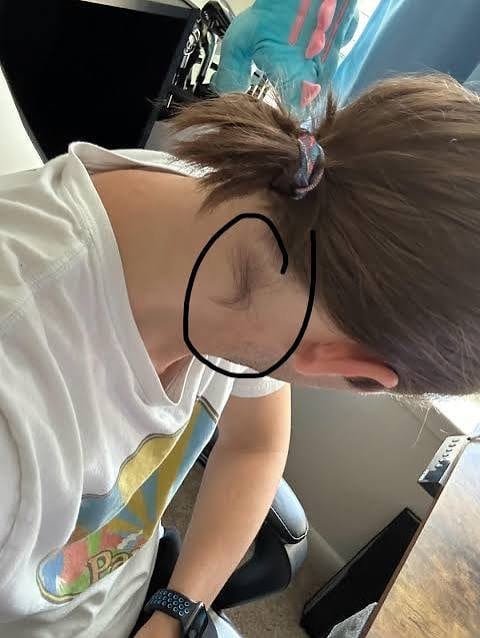
Hair at the nape of the neck: why good surgeons leave it alone
The fine hairs right down at the nape hairline sit below the safe donor area. They often thin from below, and they differ in texture and growth cycle from the hair on the back of the head.
The fine hair right down at the nape lies below the safe donor zone. It often thins from the bottom up, and it grows differently and has a different texture from the hair higher up on the back of the head. If grafts are taken from here, it is often a sign that the plan demands more than the donor area really has to give.
Where is the boundary between the nape and the safe donor area?
The nape lies below the lower edge of the safe donor area. Here the hairs are finer and often shorter, and growth differs from the dense hair above. The area is not usually considered part of the zone that is reliably resistant to DHT. That is why the nape hairline can creep upwards over the years, which is known as thinning from below.
Why is nape hair poorly suited as donor hair?
It lies outside the zone where the hair is resistant to DHT, so the follicles can shrink after they are moved, and the grafts may eventually disappear. The hairs are thinner than on the back of the head and cover less, and the growth phase is shorter. Extractions here leave visible scars, and the nape hairline can become uneven in a way that is hard to repair.
- It may not last. Everything in hair transplantation rests on donor dominance. A follicle from a site where the hair isn't resistant to DHT can start to shrink after it is moved. The graft you paid for, and which cost you a wound in the donor area, can then gradually disappear from the recipient area.
- The hairs are thinner. Nape hair usually has a smaller diameter than hair higher up, so each graft covers less.
- Growth is different. The growth phase is often shorter, and the hair doesn't grow as long.
- The scars show. With short hair, people can see the nape better than almost any other part of the donor area. Dots here sit close to the hairline, exactly where people look.
- The nape line is ruined. If the nape is thinned out, the hairline there can become ragged, and that is hard to do anything about.
Why do some surgeons take hair from the nape anyway?
Because the plan is too big. If more grafts have been promised than the safe zone can provide, the surgeon has three choices: take fewer grafts, take them closer together, or go outside the zone, down into the nape, up towards the crown or out towards the temples. The last choice is the least visible on the day of surgery and does the most damage in the long run.
Extraction from the nape is not usually a technical choice. It is a sign that something is wrong with the plan. It happens when the patient has been promised more grafts than the safe zone can deliver.
If the clinic has promised several thousand grafts and the donor area can't give that many at a careful density, the person operating faces three options. The number can be reduced. The extractions can be placed closer together within the zone. Or the extraction can be extended beyond it. The last option is the hardest to spot on the day and does the most damage over time.
The same thing happens at the upper edge, when extractions creep up towards the top of the head, and at the temples. In all three cases the surgeon is borrowing from hair that may not stay.
How can you tell whether hair has been taken from your nape?
Take photos of the back of your head before surgery, with the same hair length and the same lighting. Have the extraction boundaries marked out in advance. Look for extraction dots below the occipital bump or right down at the hairline after the procedure. Then compare the nape line with your photo after twelve months.
It pays to know, because clinics rarely tell you when they have taken hair from the nape.
- Take photos of the back of your head before surgery, from behind, with the same hair length and the same lighting as later.
- Have the clinic describe where the extractions will go, before surgery, and preferably mark the boundaries on your skin.
- Look for extraction dots below the occipital bump or right down at the hairline once the procedure is done.
- Compare the nape line with the earlier photo once twelve months have passed.
If the extraction went down into the nape, let the clinic know, even though in practice there isn't much that can be done about it.
Is nape hair ever a good choice?
Yes, in small amounts and deliberately. Because the hairs are fine, they can be used at the very front of the hairline or in eyebrows, where coarse hair from the back of the head would look wrong. That only applies if the nape hair is stable. It has nothing to do with harvesting the nape on a large scale because the back of the head is empty.
Nape hair isn't always off limits. The fine hairs can be useful for particular details. Some surgeons use a few fine hairs from the nape or temples at the very front of a hairline or in eyebrows, where coarser hair from the back of the head would look unnatural.
In that case it is a deliberate choice to use a few grafts for something they are well suited to, and only when the nape hair is stable. That is a far cry from stripping the nape of hair because the back of the head has nothing more to give.
What separates the two is purpose and quantity. If fine hair is suggested for your hairline, it is perfectly reasonable to ask where it will come from and how much.
You can read about which parts of the head are considered safe on the page about the donor reserve.
Sources
- Maas D, et al. Rethinking the occipital scalp as a control in advanced androgenetic alopecia. Journal of the American Academy of Dermatology, 2026 (ahead of print). pubmed.ncbi.nlm.nih.gov/42398778
- Xu Y, et al. Case Report: Paired vertex-occipital assessment reveals donor-area involvement in diffuse unpatterned alopecia. Frontiers in Medicine, 2026;13:1797275. pubmed.ncbi.nlm.nih.gov/41982548
- Jimenez F, Ruifernández JM. Distribution of human hair in follicular units. A mathematical model for estimating the donor size in follicular unit transplantation. Dermatologic Surgery, 1999;25(4):294-298. pubmed.ncbi.nlm.nih.gov/10417585
- Rassman WR, Bernstein RM, McClellan R, Jones R, Worton E, Uyttendaele H. Follicular unit extraction: minimally invasive surgery for hair transplantation. Dermatologic Surgery, 2002;28(8):720-728. pubmed.ncbi.nlm.nih.gov/12174065
- Romera de Blas C, Vega Díez D, Ricart Vayá JM, Gómez Zubiaur A. Complications in follicular unit excision hair transplantation: current evidence and practical approaches. Frontiers in Medicine, 2026;13:1750989. pubmed.ncbi.nlm.nih.gov/41709896
This article summarises published research and common clinical practice. It is meant as general information and is not medical advice. Nor does it replace the advice you get from your own surgical team. If your team tells you something different from what is written here, follow your team.
Wondering what's possible for your hair?
Send three sharp photos of your hair, from the front, the top and the back. You'll get an honest answer on what can be done, roughly how many grafts it would take and what it costs.
- Free and with no obligation
- Photos are assessed by the clinic's medical team
- Replies usually within an hour in the daytime


A study tells you something about groups. Only a doctor who has seen your photos can say what applies to your hair. The medical team at the clinic at the top of our ranking offers a free assessment.
Goes to the clinic at the top of our ranking.