The safe donor zone: how safe is the donor area really?
Surgeons take grafts from a band at the back and sides of the head, where the follicles resist DHT better. Better, but not invulnerable.
The follicles at the back of the head and above the ears resist DHT better than those at the front, and that is where the safe donor area lies. They are not immune. The surgeon has to use judgement to decide where the zone ends, because there is no anatomical line. Newer research also asks how safe the outer edges really are.
What makes transplanted hairs stay?
Hereditary hair loss doesn't affect the whole head equally. On the front and crown the follicles shrink under the influence of DHT, while the follicles at the back and above the ears mostly keep growing undisturbed. Put one of these follicles into a bald area, and it goes on behaving as it did in its old spot. This is called donor dominance, and the band where these follicles sit is called the safe donor area.
Everything rests on androgenetic alopecia following a predictable pattern. The follicles at the front and top respond to dihydrotestosterone and shrink little by little. Further back and lower down on the sides, the follicles are largely unaffected. Take one of these and plant it in a bald area, and it in a sense remembers where it came from and keeps growing. The phenomenon is called donor dominance. Without it, transplanted hair would disappear as quickly as the original hair.
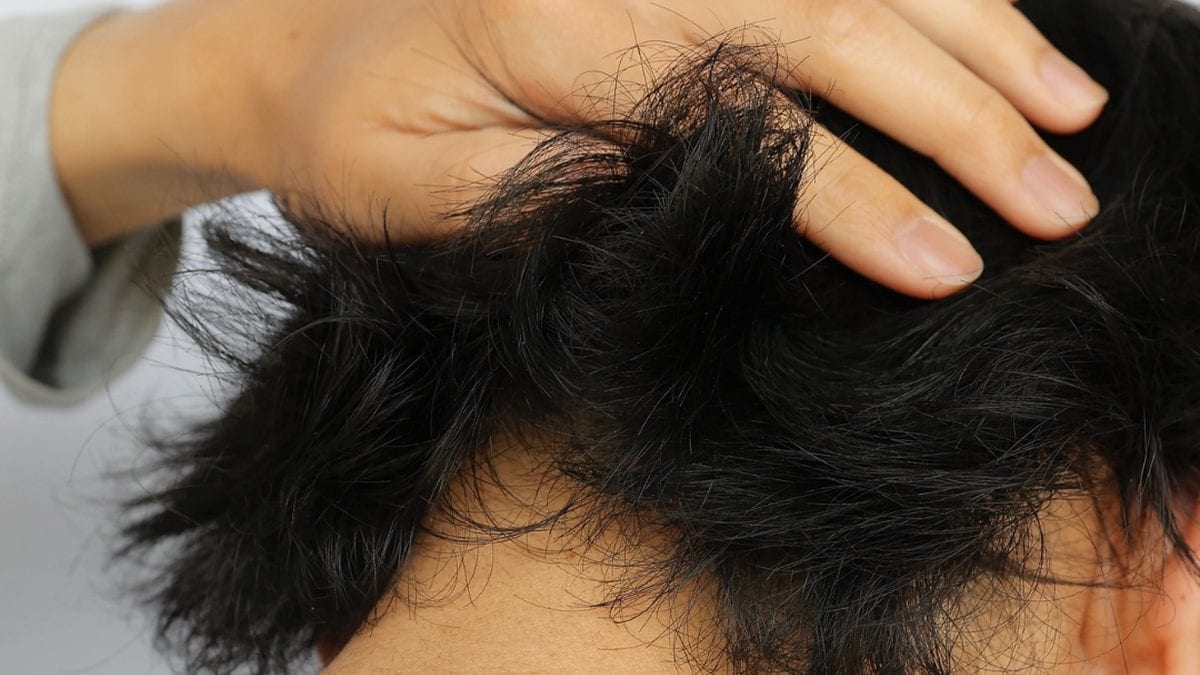
Surgeons call the zone where the resistant follicles are found the safe donor area. Roughly speaking, it is shaped like a horseshoe, a broad band around the back of the head from ear to ear. At the top it stops where thinning creeps downwards over the years, and lower down towards the nape the hair is less reliable. The safe donor zone is the same thing as the safe donor area, and the resistance travels with the follicle when it is moved. How high and wide the band is varies from person to person.
Does the safe donor area have a fixed boundary?
No. Nobody has drawn a line on the scalp. The surgeon assesses the area based on your hair loss pattern and what a magnifying device shows about the donor hair. That is why its size varies a lot between men, and when the patient is young and the pattern hasn't settled, nobody knows where it ends. If the surgeon takes hair right out to the edge as it looks today, some of it may thin later.
The safe area is an estimate, not a marking. The surgeon bases it on what your hair loss looks like now, what runs in your family, how old you are and what the trichoscope reveals.
The consequence is that the zone can be generous in one man and narrow in another. In a young patient, it also can't be fully known on the day of surgery. A 26-year-old has not yet shown his full pattern. If the surgeon takes grafts right out to the edge of what looks safe today, that may be hair that thins in fifteen years. You are then left with a sparse donor area and with grafts that don't last.
For that reason, careful surgeons take grafts from the middle of the zone, well away from the edges, especially in younger patients. It is also the background to the rule of thumb about waiting until around 25 for surgery, when the hair loss has settled.
Where in the donor area is the risk greatest?
The most uncertain part is the upper edge, which merges into the crown and is often lost when hair loss becomes extensive. Low on the nape the hair is finer and often thins from below. By the temples the hair tends to be finer and can recede. And behind the ears, in some men, the hair thins at the same pace as the temples.
- The upper edge. At the top, the band gradually merges into the crown, and with advanced hair loss this strip is the one that most often disappears. When a plan is too ambitious, this is typically where it takes hair that will later be lost.
- Low on the nape. Here the hair shafts are finer, follow a different growth cycle and often thin from the neckline upwards. That is why most experienced surgeons stay away from it.
- By the temples. Around the ears, especially in front of them, the shaft often has a smaller diameter than at the back of the head, and the hairline here can recede as part of the pattern.
- Behind the ears. Men differ a lot here. Some men lose density here in step with the temples.
Do researchers agree that donor hair is safe?
No. In 2026 Maas and colleagues argued for no longer using hair at the back of the head as an unaffected point of comparison. The same year, Xu and colleagues wrote, based on a single patient case, that nobody has actually checked that the back of the head is spared. It is simply taken for granted. Neither challenges hair transplantation as a method, but both weaken advertising that calls donor hair "permanent" rather than largely resistant to DHT.
Not all specialists regard the safe area as a settled matter. In a 2026 commentary, Maas and colleagues ask the field to rethink the hair at the back of the head as a control in advanced androgenetic alopecia. The piece appeared in the American dermatology journal Journal of the American Academy of Dermatology, and it goes straight against the custom of treating the hair at the back of the head as a reference that never changes.
Xu and colleagues made a similar point. They described one case where the crown and the back of the head were compared side by side, and pointed out that nobody has actually checked that the back of the head is spared. Disease in the donor hair can therefore go unnoticed, especially when hair thins evenly rather than in a clear pattern.
Neither paper changes the fact that transplantation works. But they undermine the casual use of the word "permanent" in clinic advertising. The honest position is that in the vast majority of people donor hair resists DHT well. It is not invulnerable, and nobody can promise you exactly where the boundaries run on your head.
Which questions about the donor area should you take to the consultation?
Ask the surgeon to show where the grafts will be taken from, and to explain why. If you get a concrete answer, that's a good sign. If grafts are to be taken right up by the crown or right down by the neckline to reach a high number, you should stop and think. If you are under 25, or your hair loss is still changing, a cautious plan is the right one. And if the thinning is diffuse, the donor area should be checked for miniaturisation under magnification.
- Ask the surgeon to point out where the grafts will be taken from, and explain why the boundaries run exactly there. A precise answer is a good sign.
- What have you measured my donor density as in that area, and how does hair loss in my family affect what you consider safe?
- How much can you take now while still leaving enough for a possible further session?
- Be critical if the plan stretches up towards the crown or down towards the neckline just to make the graft count look impressive.
- If you are younger than about 25, or your hair loss is still changing, it isn't yet possible to say where the safe area runs. In that case a cautious plan isn't timid. It's the only responsible one.
- If your hair is thinning evenly rather than in a clear pattern, ask whether anyone has checked for miniaturisation in the donor area under magnification. A look with the naked eye is not enough.
Sources
- Maas D, et al. Rethinking the occipital scalp as a control in advanced androgenetic alopecia. Journal of the American Academy of Dermatology, 2026 (ahead of print). pubmed.ncbi.nlm.nih.gov/42398778
- Xu Y, et al. Case Report: Paired vertex-occipital assessment reveals donor-area involvement in diffuse unpatterned alopecia. Frontiers in Medicine, 2026;13:1797275. pubmed.ncbi.nlm.nih.gov/41982548
- Jimenez F, Ruifernández JM. Distribution of human hair in follicular units. A mathematical model for estimating the donor size in follicular unit transplantation. Dermatologic Surgery, 1999;25(4):294-298. pubmed.ncbi.nlm.nih.gov/10417585
- Rassman WR, Bernstein RM, McClellan R, Jones R, Worton E, Uyttendaele H. Follicular unit extraction: minimally invasive surgery for hair transplantation. Dermatologic Surgery, 2002;28(8):720-728. pubmed.ncbi.nlm.nih.gov/12174065
- Kumaresan M, Deepa MS. Occipital Donor Area Grading and Profile in Indian Population. Journal of Cutaneous and Aesthetic Surgery, 2023;16(2):101-106. pubmed.ncbi.nlm.nih.gov/37554682
- Punia S, Goel A, Gupta A. Patient-Based Ratio Method for Permanent Zone Donor Area Calculation in Hair Transplant. Indian Journal of Plastic Surgery, 2024;57(6):474-478. pubmed.ncbi.nlm.nih.gov/39734366
This article summarises published research and standard clinical practice. It is meant as general information and is not medical advice. Nor does it replace the advice you get from your own surgical team. If your team tells you something different from what is written here, follow your team.
Wondering what's possible for your hair?
Send three sharp photos of your hair, from the front, the top and the back. You'll get an honest answer on what can be done, roughly how many grafts it would take and what it costs.
- Free and with no obligation
- Photos are assessed by the clinic's medical team
- Replies usually within an hour in the daytime


A study tells you something about groups. Only a doctor who has seen your photos can say what applies to your hair. The medical team at the clinic at the top of our ranking offers a free assessment.
Goes to the clinic at the top of our ranking.